Ex-Military Communication Gear: A Technical Assessment of Surplus Radio Systems and Field Equipment
Understanding the technical landscape of ex-military communication gear requires an objective look at the ruggedized systems originally developed for high-stakes tactical environments. The transition of this hardware from active service to the surplus market allows for a detailed examination of the engineering standards that defined 20th and 21st-century military coordination. As these devices enter historical collections or civilian sectors, they serve as benchmarks for durability and specialized frequency management across diverse operational theaters.
Legacy Field Telephone Systems and Switchboard Architectures
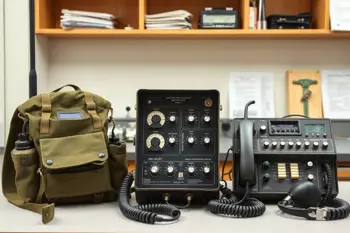
Historical field communication sets from the Korean and Vietnam War eras emphasize mechanical reliability and weather-resistant construction. The SB-22A/PT manual switchboard is a primary example, functioning as a portable local battery system adaptable for all-weather field use or mobile military shelter operations 1. This unit is designed to handle up to 12 separate voice frequency circuits, although its modular nature allows for the interconnection of an additional SB-22A to manage a total of 29 circuits 2. The switchboard features a tightly fitting front cover to protect internal components from environmental exposure and is equipped for night alarm operations and conference calling 1.
Complementing the switchboard is the TA-312/PT field telephone, an analog, two-wire, battery-operated device that replaced the earlier World War II EE-8 models 1. These telephones are noted for their rugged construction and were often issued with accessory kits, such as the MX-2915/PT, which contains spare signal lamps, trunk jacks, and line jacks housed in hard carrying cases with web straps 2. While these systems represent older technology, they demonstrate the fundamental military requirement for hardware that remains functional without reliance on fixed civilian infrastructure.
Portable Radio Development from Vietnam to Modern MANET
The evolution of man-portable radio systems reflects the changing demands of battlefield situational awareness. The AN/PRC-25, often called the Prick-25, was considered a critical tactical item during the Vietnam War, operating with frequency coverage between 30 and 75.95 MC across two bands 3. This unit was typically carried on a substantial backpack rig and included both short flexible and long rigid antennas 3. Despite its age, the PRC-25 architecture set the stage for later backpack-mounted transceivers like the Clansman series, including the RT320 and RT351, which are still utilized by radio enthusiasts for 40-meter band contacts 4.
Modern field operations have transitioned toward mobile ad-hoc networks (MANET). Systems like the MPU5 radios create a self-healing mesh network, allowing data, voice, and video to flow even if specific connection points are compromised 5. This technology improves situational awareness by enabling the transmission of videos, photos, and map data directly to tactical smartphones 5. This represents a significant shift from the voice-only limitations of legacy VHF and HF sets, integrating digital connectivity into the dismounted soldier ecosystem.
Technical Specifications of Software-Defined Radio Systems
Software-defined radios (SDR) have become the standard for modern military ground communications, offering the ability to update waveforms and protocols without changing physical hardware. The TruNet AN/PRC-162(V)1 is a prominent two-channel radio that supports simultaneous operation across a broad frequency spectrum 6. This system integrates cross-banding and retransmission capabilities, allowing it to bridge different communication layers within a single mission 6.
| Feature | PRC-162 Specification |
|---|---|
| Frequency Range | 30 to 1850 MHz |
| Output Power | 20W Peak (50W Vehicular) |
| Waveforms | SINCGARS, DAMA, MUOS, SRW |
| Data Interfaces | Ethernet, USB, RS232/RS-422 |
| Battery | Hot swappable lithium-ion |
Furthermore, soldier-worn tactical network gear such as the StreamCaster NEXUS focuses on size, weight, and power (SWaP) optimization 7. Utilizing the Silvus SM5200 MANET radio, these chest-mounted units can deliver data rates exceeding 100 megabits per second 7. Such high-bandwidth connectivity supports secure real-time coordination across dispersed units in contested environments, ensuring that voice and video streams remain accessible while the soldier is in motion.
Tactical Audio Interfaces and Hearing Protection Standards
Effective communication in high-noise environments requires specialized headsets that combine transmission capabilities with hearing protection. The FCS C3 ComTac3 tactical headset is designed with high-strength polycarbonate shells and silicone gel ear cups to facilitate long-term wear 8. This device offers a Noise Reduction Rating (NRR) of 22 dB and features True Sound Field Processing (TSFS) to accurately capture 360-degree environmental sounds while providing physical insulation against explosions and gunshots 8. The headset is compatible with U-174/U standard military radios and various Push-to-Talk (PTT) controllers 8.
Integration with head-borne systems is managed through adapters like the Unity MARK 2.0 (Modular Attach Rail Kit) 9. These kits enable headsets to be mounted directly onto helmet rail systems, such as the Ops-Core ARC or Team Wendy EXFIL, reducing the overall equipment profile 9. To ensure functionality in complex scenarios, PTT systems like the PolTact V2 utilize dual-button designs to prevent accidental transmissions while allowing the operator to trigger the microphone regardless of hand placement 10.
Enclosures and Environmental Protection for Field Hardware
Tactical communication gear requires specialized housing to survive extreme operational conditions. Tactical Communication System Boxes are often constructed from aluminum alloy 6061-T6 or stainless steel SS316, featuring IR-suppressive coatings and chemical agent resistant coatings (CARC) 11. These boxes utilize IP68 environmental sealing and EMI seam welding to protect sensitive transceivers and network encryption equipment from moisture, dust, and electromagnetic interference 11.
For modular portability, nylon solutions like the Radio Pop-Up TACO provide adjustable retention for various radio sizes using bungee tension and MOLLE-compatible clips 12. Specialized environments such as diving operations utilize dedicated pouches, like the Ocean Technology Systems Diver Unit Pouch, which secures wireless transceivers to diving gear using Mil-Spec straps
Regulatory Oversight and Acquisition Logistics
The transition of military communication hardware into the public sphere is overseen by specific government and regulatory bodies. In the United States, the Defense Logistics Agency (DLA) manages the disposition and sale of surplus property through programs such as the Defense Reutilization and Marketing Office (DRMO)
Prospective users of ex-military radios must also consider licensing and frequency restrictions. The Federal Communications Commission (FCC) regulates the civilian use of radio frequencies, and many tactical bands used by military gear require an amateur radio license for legal transmission
Sources
- Backcountry Hunt Shop - SB-22A/PT and TA-312/PT Specifications
- Backcountry Hunt Shop - Field Communications Accessory Set Details
- Colt & Winchester Firearms - AN/PRC-25 Backpack Radio Data
- Radio Workshop - Clansman Military Radio Equipment Analysis
- The British Army - MPU5 Radio and MANET System Testing
- Collins Aerospace - TruNet AN/PRC-162(V)1 Technical Overview
- Silvus Technologies - StreamCaster NEXUS Soldier-Worn Gear
- FMATAL Gear - FCS C3 Tactical Headset Features
- Defense Gear Zone - Unity MARK 2.0 Adapter Specifications
- Comm Gear Supply - PolTact V2 PTT System Compatibility
- Frigate - Tactical Communication System Box Fabrication
- Pop Smoke Media - Radio Pop-Up TACO Versatility
- Salt and Sea Scuba - Diver Unit Pouch for Wireless Transceivers
- DLA Disposition Services - Military Equipment Disposal Programs
- Military Surplus Data Analysis - Encryption Zeroization Policies
- Federal Communications Commission - Radio Licensing Requirements
- Market Research Data - Surplus Radio Pricing and Logistics
Authored by 24Trendz team