Ex-Military Fuel Bladders: A Complete Industry and Surplus Market Analysis
Ex-military fuel bladders represent one of the most technically robust categories of surplus equipment to enter the civilian market. Originally designed to sustain combat and expeditionary operations where fixed fuel infrastructure is unavailable, these collapsible, flexible storage containers have supported military missions for more than 50 years and continue to influence modern logistics doctrine. 1 Understanding their engineering heritage, material specifications, and regulatory obligations is essential for anyone evaluating their use outside a defense context.
What Are Ex-Military Fuel Bladders?
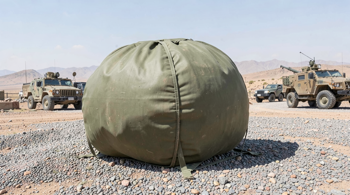
Ex-military fuel bladders, sometimes called blivets or flexible fuel tanks, are surplus collapsible fuel storage containers originally manufactured to military specifications and now available for civilian, commercial, and industrial acquisition. 2 In military terminology, they support Class III(B) distribution, which refers to petroleum products including diesel, jet fuel such as JP-8, and gasoline transported and stored in bulk quantities for field operations. 3 Their collapsible design means they reduce to a fraction of their full volume when empty, a critical logistical advantage during airlift and ground transport missions.
Standard fuel bladder tanks span a broad capacity range, from 100 US gallons to 200,000 US gallons and larger, though the most frequently available surplus models cluster around 500, 1,000, 2,500, and 5,000-gallon sizes. 4 High-end military fuel bladders incorporate a neutral barrier film on the interior to prevent liquid contamination and ensure contents never contact air, eliminating evaporation risk and reducing the potential for gas formation. 5
Military Construction Standards and Materials
Military fuel bladders are typically constructed from rubberized nylon or polyurethane-coated fabric, delivering flexibility, durability, and resistance to fuel permeation across extreme operating conditions. 6 Manufacturers such as Canflex USA produce bladders engineered to survive below-zero field deployments as well as desert heat exceeding 120 degrees Fahrenheit, while resisting puncture, abrasion, and UV degradation. 7 Some current-generation systems, such as the Butyl Products Ltd range, use 1.2mm polyurethane construction with reinforced corner mouldings and integral tie-down points, offering capacities from 1,000 to 150,000 litres. 8
The distinction between commercial and military fuel bladders is less about raw materials and more about the operational demands imposed on the system. Military units can transport filled bladders by vehicle in the field, a capability civilian operators do not typically exercise, which drives stricter engineering requirements around fitting integrity, load compatibility, and thermal range. 9 For example, the Canflex TCB-M (Medium Transportable Collapsible Bladder) supports up to 1,000-gallon bulk fuel volumes and is engineered in two configurations: the TCB-M1 with a long footprint for pallet-focused movement, and the TCB-M2 with a wide footprint for container-focused movement, both compatible with 463L pallet and ISO container logistics pathways. 10
Capacity Classes and Documented Specifications
Military fuel bladder systems span several defined capacity classes, each optimized for distinct logistical platforms. The TCB-XL is a 3,000-gallon class system optimized for 463L palletized air movement with approximate operating dimensions of 20 feet by 8 feet by 3 to 4 feet, while the TCB-TEU is a 5,000-gallon class system configured for 20-foot ISO container logistics. 11 At the higher end, systems can be linked to create fuel farms supplying millions of gallons of secure fuel, as demonstrated by Western Global's WX Autonomous containerized modular tank, which delivers a scalable fuel supply of up to 14,000 US gallons per unit. 12
| Capacity Class | Typical Military Designation | Primary Transport Method | Approx. Dimensions |
|---|---|---|---|
| 1,000 gal | TCB-M (M1/M2) | 463L pallet / ISO BICON | 14 ft x 4 ft x 3-4 ft (M1) |
| 3,000 gal | TCB-XL | 463L pallet (3 married) | ~20 ft x 8 ft x 3-4 ft |
| 5,000 gal | TCB-TEU | TEU 20-ft ISO container | Container-optimized |
| 500-999 gal | Blivet / Portable Bladder | Ground vehicle / helicopter sling | Variable by manufacturer |
Emerging alternatives to traditional soft-sided blivets include the Recoil Aerospace Expeditionary Fuel Tank (EFT), a 1,000-gallon carbon fiber composite tank tested by personnel from the U.S. Army's 101st Airborne Division during a large-scale training exercise in 2025, with scenarios including Forward Arming and Refueling Point (FARP) setup and aerial delivery. 13 Recoil's Expeditionary Fuel System (EFS), unveiled at the Army Aviation Association of America Summit, adds a 150-gallon-per-minute pump, filtration, and a 50-foot hose reel in a sling-loadable, air-droppable package scalable with additional 1,000-gallon tanks. 14
Surplus Acquisition Channels and Cost Benchmarks
Ex-military fuel bladders primarily enter the civilian market through decommissioned military equipment auctions, defense surplus dealers, and military liquidation companies operating across the United States. The Defense Logistics Agency (DLA) Disposition Services manages the disposal and surplus distribution of decommissioned military equipment, providing authorized channels through which qualifying buyers may access surplus fuel storage systems. 15 The GSA Federal Surplus Personal Property program represents another formal pathway, listing government surplus items that can include portable fuel storage equipment depending on availability. 16
The cost of ex-military fuel bladders varies significantly based on capacity, condition, and remaining service life, with functional used units historically ranging from approximately $500 to over $5,000 depending on size. 17 Platforms such as GovPlanet list surplus military fuel bladders and portable fuel storage systems through auction mechanisms, providing a visible price discovery channel for buyers. 18 South African Military Surplus, for example, lists used 20-litre fuel bladders as surplus items sold as-is with no returns granted, illustrating the condition-dependent and non-warranty nature of surplus military fuel equipment transactions at the smaller end of the market. 19
Civil and Industrial Applications
Fuel bladders have been documented in use across agribusiness, public works, humanitarian operations, military logistics, and industrial sectors. 5 Common applications identified for ex-military surplus units include emergency fuel reserves, construction site fueling operations, agricultural operations, remote location storage, and disaster relief fuel supplies. 2 Marine environments represent a significant secondary market, where bladders in sizes from 25 to 1,000 gallons provide auxiliary storage that extends vessel range and offers resistance to saltwater corrosion. 20
Today's armed forces have also expanded bladder use to support unmanned systems, fueling UAVs (unmanned aerial vehicles) and USVs (unmanned surface vessels) in remote operational theaters, a trend that points toward increasing technical complexity in future surplus inventory. 1 The Airborne Bulk Fuel Delivery System (ABFDS), for which a new flexible fuel bladder was developed by Canflex USA in collaboration with U.S. Air Force experts and the Defense Innovation Unit, was tested by the Petroleum, Oil and Lubricants schoolhouse of the 82nd Training Wing at Sheppard Air Force Base, underscoring the continued institutional investment in flexible fuel storage modernization. 21
Regulatory Requirements, Risks, and Inspection Obligations
The use of ex-military fuel bladders outside a military context carries substantial regulatory and operational obligations. The EPA requires secondary containment (bunding) for all fuel bladder deployments and imposes fines for discharging fuel into the environment, with clear SPCC (Spill Prevention, Control, and Countermeasure) guidelines applicable to storage systems of qualifying volume. 22 At sizes exceeding 50,000 US gallons, the risk of catastrophic spill increases materially, and secondary containment becomes non-negotiable. 4 The U.S. Department of Transportation (DOT) additionally governs the transport of ex-military fuel bladders containing hazardous materials, with specific requirements governing hose, fitting, and containment integrity. 23
Surplus flexible fuel containers must be inspected for integrity and suitability before reuse due to contamination, aging, and material degradation risks. 24 Common failure points in aged military bladders include valve condition deterioration, seam separation, UV-induced fabric weakening, and residual fuel contamination that may compromise new fuel purity. Many ex-military fuel bladders remain operationally viable despite age, but the absence of manufacturer warranties, the as-is nature of surplus transactions, and the EPA penalties associated with fuel release make independent inspection a prerequisite, not an option, before any petroleum product is stored. U.S. Army guidance addressing bulk petroleum products and field handling remains the primary technical reference for understanding the operational envelope these systems were designed to meet. 25
Sources
- ReadyContainment.com - The Versatility of Fuel Bladders: From Military to Marine Applications
- LLM General Research - Ex-Military Fuel Bladder Surplus Market Overview
- Canflex USA - Modular Transportable Collapsible Bladders for Military Use (canflexinc.com)
- Wikipedia - Fuel Bladder (en.wikipedia.org)
- Wikipedia - Fuel Bladder, Primary Use Section (en.wikipedia.org)
- LLM General Research - Military Fuel Bladder Materials
- ReadyContainment.com - Flexible Fuel Bladder Tanks for Military Operations
- Butyl Products Ltd - Flexible Fuel Storage Bladders for Remote Camps (butylproducts.co.uk)
- ReadyContainment.com - What Sets Military Fuel Bladder Requirements Apart
- Canflex USA - TCB-M Medium Transportable Collapsible Bladder (canflexinc.com/tcb-m)
- Canflex USA - TCB-XL / TCB-TEU High-Capacity Systems (canflexinc.com/tcb-xl-tcb-teu)
- Western Global - WX Autonomous Modular Fuel Tank (western-global.com)
- Vertical Aviation International - US Army Evaluates Recoil Aerospace Fuel Tank (verticalavi.org)
- Helis.com - Expeditionary Fuel System from Recoil Aerospace (helis.com)
- Defense Logistics Agency Disposition Services (dla.mil)
- GSA - Federal Surplus Personal Property (gsa.gov)
- LLM General Research - Ex-Military Fuel Bladder Cost Benchmarks
- GovPlanet - Military Surplus Equipment Auctions (govplanet.com)
- South African Military Surplus - 20L Fuel Bladder Used (southafricanmilitarysurplus.co.za)
- ReadyContainment.com - Marine Applications Section
- Canflex USA - Airborne Bulk Fuel Delivery System Testing (canflexinc.com)
- EPA - Spill Prevention Control and Countermeasure (epa.gov)
- U.S. Department of Transportation - Hazardous Materials Regulations (fmcsa.dot.gov)
- LLM General Research - Surplus Fuel Bladder Inspection Requirements
- U.S. Army Publishing Directorate - Bulk Petroleum Field Handling Guidance (armypubs.army.mil)
Authored by 24Trendz team