Ex-Military Night Vision: A Technical and Market Intelligence Guide
Ex-military night vision equipment spans a broad spectrum of technology, from Vietnam-era passive starlight scopes to current-generation autogated Gen 3 monoculars issued to U.S. and NATO forces today. Understanding the performance specifications, legal status, and market realities of these devices requires navigating a dense field of tube data, export regulations, and generational classifications that meaningfully affect what a given unit can do in the field.
A History of Military Night Vision Generations
Night vision technology deployed by armed forces is broadly categorized into generations based on the image intensifier tube design. Gen 1 devices, using basic electrostatic inversion tubes, were fielded widely during the Vietnam era. The AN/PVS-2 Starlight scope, a Vietnam-era U.S. military night vision device, used an image intensifier tube and photocathode to multiply photons into electrons, which struck a phosphor screen to produce a green-hued image without emitting any detectable infrared signature. 1 These early passive optical devices were a significant tactical development because they offered a major advantage while remaining undetectable compared to earlier active IR systems. 1
Gen 2 devices introduced microchannel plate (MCP) technology, substantially improving low-light sensitivity and image resolution. Gen 3, the current U.S. military standard, incorporates a gallium arsenide photocathode and a gated power supply, resulting in markedly higher signal-to-noise ratios and resolution figures. Research analyzing modern military operations has concluded that night vision devices as individual-soldier equipment will inevitably be widely fielded by the military forces of various countries in the future, with development focusing on enhancing stability and improving combat effectiveness. 2 Emerging fifth-generation (5G) tube technology has now entered active procurement, with more than 7,000 5G image intensifier tubes ordered by ACTinBlack Group to supply European Special Forces, representing the largest single procurement of 5G tubes secured by Exosens to date. 3
The AN/PVS-14: The Benchmark Ex-Military Monocular
The AN/PVS-14 Monocular Night Vision Device (MNVD) is in widespread use by the United States Armed Forces as well as NATO allies. It uses a third-generation image intensifier tube and is primarily manufactured by Elbit Systems of America (formerly Harris Night Vision, formerly Exelis, formerly ITT) and L3Harris Technologies (formerly Litton Industries). More than 500,000 units have been produced since its introduction in 2000. 4 The device weighs 351 grams, measures 4.5 inches in length, operates on a single AA battery, and achieves resolution greater than 64 lp/mm using the MX-11769 image intensifier tube. 4
The PVS-14 can be used hands-free with a head harness or mounted to combat helmets including the PASGT, MICH TC-2000, Advanced Combat Helmet, and IHPS. It also functions as a weapons night sight and was part of the U.S. Army's Land Warrior program. 4 Civilian-market versions built around the same platform use Gen 3 autogated tubes with published Figure of Merit (FOM) values ranging from roughly 1,421 to 2,002 depending on tube selection, with signal-to-noise ratios spanning approximately 21.3 to 30.6 and resolution figures of 64 to 72 lp/mm across commercially available hand-selected units. 5
Key Performance Metrics and Tube Grading Standards
Evaluating ex-military night vision equipment requires understanding the specific metrics used to grade image intensifier tubes. The Figure of Merit (FOM) is calculated by multiplying resolution (in line pairs per millimeter) by the signal-to-noise ratio (SNR) and serves as a single composite score. Higher FOM values indicate superior tube performance. Military-grade tubes from Elbit Systems and L3Harris typically carry FOM values starting around 1,400 for baseline Gen 3 units, with premium thin-filmed white phosphor tubes reaching FOM values of 2,376 and above. 6
Additional grading parameters include Equivalent Background Illumination (EBI), which measures residual noise in low light, and Halo, which describes the bright ring around light sources. Lower EBI and lower Halo values are preferable. For dual-tube devices such as the DTNVS, matched tube pairs are graded across both pods; one commercially available DTNVS configuration uses L3Harris 18UM tubes achieving FOM values of 2,570 and 2,599 per pod, with SNR readings of 35.7 and 36.1 respectively. 7 The BNVD-1431 MK2, another dual-tube system, is designed and tested to meet the requirements of elite law enforcement and special operations units, operating on a single AA battery for more than 15 hours under general temperature conditions, with run time extendable to more than 50 hours using an external battery pack. 8
Device Categories in the Ex-Military and Military-Grade Market
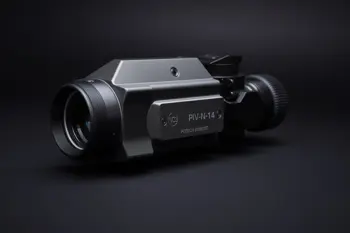
Several platform families dominate the ex-military and military-specification night vision landscape. The PVS-7 goggle system was the standard-issue U.S. Army goggle prior to broader PVS-14 adoption. It features Automatic Brightness Control (ABC), a built-in infrared illuminator, a bright-light cut-off to protect the image tube, and a flip-up shut-off for helmet-mount compatibility. Contemporary versions are available with Gen 2+ or Gen 3 tubes in either green phosphor or P45 white phosphor configurations. 9 The ATN PVS-7-WPT variant, for example, ships with a full U.S. Mil-Spec body, head mount assembly, and all accessories, and has been fielded by armed forces due to its waterproof, rugged construction. 10
Dual-tube binocular platforms represent the highest-performance category. The AB Night Vision RNVG (Ruggedized Night Vision Goggle) is CNC-machined from solid billet 7075 aluminum, a material described as 36% stronger than most common steel, weighing 555 grams without battery, with a field of view of 40 degrees, interpupillary adjustment of 51 to 73mm, and water resistance to 66 feet. 11 The AB Night Vision RPNVG (Ruggedized Panning Night Vision Goggle) adds an adjustable field of view from 40 to 65 degrees, with each optical pod able to slide and pan outward along an aircraft-grade aluminum bridge. 12 Digital night vision platforms such as the PARD Nightstalker 4K EX offer an alternative technology path, using a 4K CMOS sensor (3840x2160) with 0.001 lux sensitivity and a 2560x2560 OLED display, with the optional IL1 add-on extending detection capability to 1,100 yards. 13
Regulatory and Legal Framework
The purchase, possession, and transfer of ex-military night vision equipment in the United States is governed by a layered regulatory structure. Most image intensifier-based night vision devices are regulated under the International Traffic in Arms Regulations (ITAR), administered by the U.S. Department of State's Directorate of Defense Trade Controls. Export of Gen 3 tubes and devices outside the United States without proper authorization is prohibited. 14 Items not covered under ITAR may fall under the Export Administration Regulations (EAR), managed by the Bureau of Industry and Security at the U.S. Department of Commerce. 15
Within the United States, civilian ownership of most image-intensifier night vision devices is legal at the federal level without a specific federal license. However, some states impose additional restrictions on certain thermal imaging or night vision devices, and buyers should verify local statutes before acquiring equipment. Imported devices are subject to U.S. Customs and Border Protection enforcement of applicable customs and import laws, which may require end-use documentation for controlled items. 16 Retailers dealing in ITAR-controlled devices typically require purchasers to sign an ITAR agreement confirming U.S. person status and acknowledging the export control obligations associated with the technology.
Global Procurement Trends and Market Scale
Government procurement data illustrates the scale of current night vision investment. Exosens and Theon International signed a contract with OCCAR to supply 100,000 binocular MIKRON devices to the German Armed Forces, embedding 200,000 Exosens 16mm tubes for a total value of more than 500 million euros, described as the largest contract ever concluded in the history of night-vision technology, with deliveries scheduled from 2027 to 2029. The same contract amendment also included 4,000 devices for the Belgian Armed Forces. 17 Separately, Lithuanian sensing company BROLIS awarded a contract to Exosens for approximately 17,000 image intensifier tubes for the Czech Armed Forces, with work continuing through 2032 as part of Prague's ongoing military modernization efforts. 18
In Canada, a tender for night-vision binoculars valued at more than an estimated $100 million drew industry concerns that its technical requirements, specifically a particular signal-to-noise ratio specification, effectively limited competition to a single American company, a requirement described by a European competitor as not reflecting industry norms or the requirements of NATO allies. 19 These procurement dynamics demonstrate that tube-level performance specifications, rather than platform design alone, frequently determine competitive eligibility in government contracts, a dynamic equally relevant to civilian buyers evaluating ex-military hardware against published tube data sheets.
Sources
- Kelly's Sporting Goods - U.S. Starlight AN/PVS-2 Night Vision Scope (kellysonline.ca)
- Communications in Humanities Research - The Evolution of Night Vision Equipment (doi.org/10.54254/2753-7064/2025.ns28483)
- Euronext - Exosens signs largest contract for 5G image intensifier tubes with ACTinBlack (live.euronext.com)
- Wikipedia - AN/PVS-14 (en.wikipedia.org)
- Nighthawk Vision Systems - PVS-14 Elbit Gen 3 GP Hand Select (nighthawkvision.com)
- Procyon Industries - AB Night Vision RNVG tube configuration data (procyonnv.com)
- GPNVGs - DTNVS White Phosphor specifications (gpnvgs.com)
- Argus Night Vision - BNVD-1431 MK2 specifications (argusnvs.com)
- Night Vision Universe - AGM PVS-7 3AL1 Night Vision Goggle Gen 3 (nightvisionuniverse.com)
- Night Vision Universe - ATN PVS-7-WPT White Phosphor Night Vision Goggles (nightvisionuniverse.com)
- GPNVGs - AB Night Vision RNVG White Phosphor specifications (gpnvgs.com)
- Procyon Industries - AB Night Vision RPNVG (procyonnv.com)
- PARD USA - Night Stalker 4K EX Weapon Mounted Scope (pardusa.com)
- U.S. Department of State - Directorate of Defense Trade Controls (pmddtc.state.gov)
- U.S. Department of Commerce - Bureau of Industry and Security (bis.doc.gov)
- U.S. Customs and Border Protection (cbp.gov)
- Exosens - Historic Night-Vision Contract announcement (exosens.com)
- The Defense Post - Czech Military Orders 17,000 Night Vision Parts From Exosens (thedefensepost.com)
- CBC News - Major defence contract night-vision binoculars tender (cbc.ca)
Authored by 24Trendz team