Ex-Military Camping Tents: A Field Guide to Surplus Shelters, Specs, and What Buyers Should Know
Ex-military camping tents attract serious outdoor enthusiasts, hunters, survivalists, and collectors who need proven field performance rather than consumer-grade shelter. Sourced from government decommissioning programs, liquidation auctions, and dedicated surplus retailers, these shelters were originally built to withstand extreme combat and field conditions, and that engineering legacy makes them a compelling option for anyone who prioritizes structural durability over lightweight convenience.
What Defines an Ex-Military Camping Tent
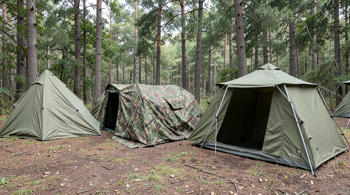
Military surplus tents are distinguished from commercial camping shelters by their construction standards, material selection, and functional specifications. Authentic ex-military tents are typically constructed from heavy-duty, water-resistant canvas, vinyl-coated polyester, or high-density nylon ripstop fabrics, each chosen to withstand extreme field conditions. 1 Most genuine-issue models are rated for four-season use, incorporating ventilation systems and insulation properties designed for both extreme heat and subzero cold environments. 2 The U.S. military, for example, has long relied on tent contractors such as Eureka and Diamond Brand for field shelter manufacturing, producing structures described by users as highly durable all-weather platforms. 3
A common structural feature in military-specification tents is modularity. Many systems, including the U.S. Army's Modular General Purpose Tent System (MGPTS), use a tensioned-fabric design that eliminates center poles, creating unobstructed interior space. 4 The MGPTS is built to withstand steady winds of 55 mph for 30 minutes and gusts of 65 mph in ten-second durations from any direction, and can support a snow load of 10 lbs per square foot for 12 hours. 5 Multiple units can be linked together to create larger command, medical, or billeting configurations, a design philosophy that distinguishes military platforms from fixed-size recreational tents. 6
Major Ex-Military Tent Categories and Historical Models
The ex-military surplus tent market encompasses several distinct product lines, ranging from compact individual shelters to large general-purpose frame tents. The U.S. Army General Purpose (GP) tent series, produced in Small, Medium, and Large variants, represents one of the most recognized categories. These models were used extensively across World War II, the Korean War, and Vietnam, constructed from heavy olive drab cotton duck canvas with roll-up sidewalls and stovepipe vents. 7 The USMC 2-Man Combat Shelter in Woodland camouflage is another well-documented individual shelter, a genuine-issue 4-season tent engineered by military contractors for durability and all-weather performance in field conditions. 8
British Army surplus contributes additional variety to the market. The British Army 2-Man Mosquito Net Tent, for instance, measures approximately 2.1m long by 1.5m wide by 2.0m high, weighs around 4 kg, includes fibreglass poles, a waterproof groundsheet, central mesh divider, and inner storage pockets, and is designed to fit directly onto two standard army-issue cot beds. 9 Finnish military field tent reproductions cover a historical range from early 20th-century canvas A-frame designs weighing 22 to 30 kg to the mid-20th-century four-season Finnish Defence Forces camp tent, illustrating how different national militaries approached cold-climate shelter design across successive eras. 10
Material Standards and Construction Specifications
Material quality is a primary factor that separates ex-military tents from consumer alternatives. Large military frame tents typically use 100% polyester canvas fabrics at weights around 300 g/m², reinforced with galvanized steel or aluminum pole systems. A representative 10-person military surplus tent, for example, measures 4.6 by 4.4 meters with a center height of 2.57 meters, and features high-frequency galvanized square steel tubes in 25x25x1.2mm and 30x30x1.2mm specifications. 11 Large GP-style tents scaled for 20 or more personnel use galvanized steel pipes with 38mm main poles and 25mm side poles, with outer fabrics rated at 300 g/m² and PVC-coated groundsheets at 500 g/m². 12
At the individual shelter end of the spectrum, modern military-influenced designs employ nylon ripstop with PU coatings and aluminum poles. The USGI Kelty 1-Man Field Tent, for instance, uses 70D nylon ripstop for both the main body and rainfly, features taller lower walls to prevent rain splash, and employs a two-pole design with buckle-clip rainfly attachment for rapid setup. 13 Advanced specialist platforms like the Hardline Scout Pup Tent use 100mm TPU-coated drop-stitch structural fabric (DWF) to achieve an inflatable-structure stiffness profile with a design envelope of -40°C to +80°C, a specification that reflects contemporary military requirements for rapid solo deployment across Arctic, desert, and maritime environments. 14
Condition Grading and Acquisition Channels
Surplus military tents reach the civilian market through several distinct channels, each presenting different condition profiles. Government liquidation programs and military auctions release decommissioned tent systems once they reach end-of-service life or are replaced by newer technology. 15 Dedicated surplus retailers and online marketplaces typically grade used inventory on structured scales. British Army surplus dealer GoArmy, for example, uses a three-tier grading system: Super Grade for unissued or like-new condition, Grade 1 for previously issued and lightly used items that are fully functional, and Grade 2 for items with heavier use showing visible defects such as small rips, stains, or minor zipper damage. 16
Pricing in the secondary surplus market varies considerably based on origin, era, and condition. General market expectations place authentic canvas military surplus tents in the $200 to $1,500 range depending on size and condition, with individual combat shelters such as the USMC 2-Man Combat Shelter typically available in the $100 range for defect-grade units. 17 Specialist military surplus stores, online platforms, and regional Craigslist listings represent the primary acquisition channels for individual buyers, while government-sanctioned liquidation sites handle bulk and institutional procurement. 18
Practical Limitations and Maintenance Requirements
Ex-military canvas tents carry documented limitations that buyers should understand before acquisition. Compared to modern synthetic tents, canvas military shelters weigh significantly more, making them impractical for backpacking or long-distance carries. The trade-off is superior durability and longevity, with properly maintained canvas tents capable of lasting 20 or more years. 19 Many surplus tents also lack features common in consumer-grade recreational gear, such as integrated mesh windows or lightweight aluminum poles, which contributes further to transport weight and setup complexity. 20
Canvas military tents require regular and specific maintenance to preserve function. Cleaning, thorough drying, and periodic waterproofing treatment are necessary to prevent mold and mildew accumulation, particularly after extended use in humid conditions. 21 The pole-and-stake systems used in surplus frame tents typically demand more setup time and labor than consumer recreational alternatives, though they provide superior structural integrity in high-wind environments. 22 Some specialist surplus dealers offer pre-sale cleaning and waterproofing services, and many authentic military tents arrive with original repair kits and documentation that inform ongoing maintenance. 23
Modern Military-Influenced Camping Tents for Civilian Use
Alongside genuine surplus, a growing segment of the market consists of commercially manufactured tents that adopt military design principles for civilian outdoor use. Products such as military-style inflatable tents use 3000mm or higher waterproof-rated Oxford fabric, weigh as little as 1.8 kg for solo models, and pack to compact dimensions such as 20cm by 50cm, offering tactical camouflage patterns alongside rapid three-minute setup times. 24 Four-season military-style inflatable tents designed for 2 to 4 occupants incorporate 5000mm waterproof coatings, multiple ventilation ports, and setup times of 15 to 20 minutes using an included pump, available in military green and desert tan colorways. 25
At the large-format end, modular military tent manufacturers use aerospace-grade 6061-T6 aluminum alloy frames, submit products to CE and ISO 9001 certification testing, and build to wind-resistance standards covering Category 12 to 16 storms, with four-person assembly completing large-scale camp construction within 30 minutes per module. 26 These commercially available military-specification systems serve buyers who require documented engineering standards and new-product warranties rather than the variable condition realities of the surplus market, though they generally carry substantially higher price points than secondhand surplus acquisitions. 27
Sources
- Army Surplus World – armysurplusworld.com
- GlobalSecurity.org – globalsecurity.org
- ONE SHEAR – oneshear.com
- Deployed Logix – deployedlogix.com
- Deployed Logix – deployedlogix.com
- OutsideTents / Tian'en Tent – outsidetents.com
- Replicaters – replicaters.com
- ONE SHEAR – oneshear.com
- GoArmy – goarmy.co.uk
- Replicaters – replicaters.com
- Tents Manufacture – tents-manufacture.com
- Tents Manufacture – tents-manufacture.com
- Venture Surplus – venturesurplus.com
- Hardline Global – hardline-global.com
- GovPlanet – govplanet.com
- GoArmy – goarmy.co.uk
- Coleman's Military Surplus – colemans.com
- eBay – ebay.com
- Four Peaks Tents – fourpeakstents.com
- Army Surplus World – armysurplusworld.com
- Weatherhaven – weatherhaven.com
- GlobalSecurity.org – globalsecurity.org
- Coleman's Military Surplus – colemans.com
- Traverseon – traverseon.com
- Camping Tent Manufacturers – camping-tent-manufacturers.com
- INNature Manufacturer – innaturemanufacturer.com
- Hardline Global – hardline-global.com
Authored by 24Trendz team