Ex-Military Inflatable Boats: A Complete Buyer's Intelligence Report
Ex-military inflatable boats attract significant interest from commercial operators, rescue agencies, law enforcement trainers, and serious recreational boaters because these vessels were engineered to perform in conditions that would compromise standard civilian craft. Originally built for defense forces, coast guards, and special operations units, these surplus boats combine reinforced construction with proven real-world reliability, making the secondary market for them both active and technically demanding for uninformed buyers.
Origins and Engineering Standards
The concept of the rigid inflatable boat evolved from work originally undertaken at Atlantic College on the southern coast of Wales in 1962, under the direction of retired Royal Navy Admiral Desmond Hoare. 1 Development work combined a hard hull form with pressurized, air-filled Hypalon sponsons over more than a decade of prototype testing. Zodiac, founded in 1896 and recognized as the pioneer of inflatable boat technology, has contributed significantly to this evolution and today leads as the premier manufacturer of inflatable and semi-rigid boats for professional and military use, with products deployed across more than 80 countries. 2
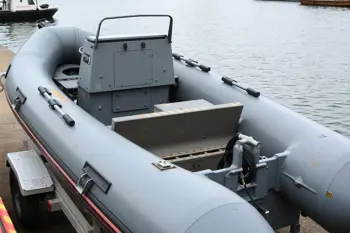
Military-specification inflatable boats are constructed with high-grade marine aluminum, advanced composites, or fiberglass for the hull, while the inflatable collars incorporate military-spec Hypalon or polyurethane-coated fabrics engineered to resist UV radiation, chemical exposure, and extreme temperatures. 3 These vessels feature reinforced deep-V hulls that efficiently cut through rough waters, multiple independent air chambers for redundancy, heavy-duty D-rings and lifting points, and specialized electronics mounting positions. Modular designs on advanced models allow full operational deployment in under 15 minutes. 4
Common Models Found on the Surplus Market
The most recognized ex-military inflatable encountered on the civilian secondary market is the Zodiac F470, the primary model used by U.S. forces, which features a modular design with a high-pressure inflatable keel and a rigid wooden or aluminum floorboard system. 5 A military variant, the F470HD, measures 4.7 meters in length with a 1.95-meter beam, weighs 127 kilograms dry, and carries a payload of 1,120 kilograms with a maximum engine power of 60 horsepower. 6 The Avon SeaRider represents another frequently encountered brand, alongside Zodiac Milpro models such as the Futura Commando and the MARK series, which were designed for special operations and versatile patrol roles respectively.
The Shadow Military 47, a more recent tactical design, reaches 14.50 meters in maximum length, accommodates up to 12 persons, and features a deep-V hull constructed from glass-reinforced polyester with Kevlar reinforcement built through a vacuum infusion process. Outboard configurations on that platform can achieve speeds of 60 knots with a range of 122 to 152 nautical miles. 7 Buyers should note that authentic Combat Rubber Raiding Craft (CRRC) models feature reinforced Hypalon or heavy-duty rubber construction making them significantly more abrasion-resistant than civilian-grade PVC inflatables. 8
Where Surplus Ex-Military Boats Enter Civilian Markets
The primary disposal route for U.S. government surplus vessels runs through federal agencies. The U.S. General Services Administration (GSA) conducts regular auctions of surplus federal property including military equipment and vessels through its GSA Auctions platform. 9 The Defense Logistics Agency (DLA) manages the disposition of excess Department of Defense property through its own public sales programs. 10 Government liquidation platforms such as GovLiquidation and GovPlanet also host auctions for decommissioned tactical gear including inflatable watercraft. 11
Beyond federal auction channels, used military RIBs appear through specialist surplus dealers, private brokers, and marine classifieds. Common models found on the second-hand market include Zodiac Milpro, Pacific 24, and Defender-class boats, all of which have documented service histories with navies and coast guards internationally. 12 Buyers acquiring through private channels rather than government disposition programs carry greater responsibility for verifying ownership documentation and vessel history.
Realistic Cost Expectations and Refurbishment Realities
Pricing for ex-military inflatable boats in the civilian secondary market generally ranges from approximately $2,000 to $15,000 or more, depending on condition, size, installed engine, and year of manufacture. 13 Buying used typically means paying 30 to 60 percent less than the original procurement price for a boat that still retains significant operational life. 14 However, these initial figures frequently do not represent total acquisition cost.
Many decommissioned units require meaningful refurbishment before they are reliably water-worthy. New engines, updated electronics, replacement upholstery, and rigging repairs can collectively add between $3,000 and $8,000 to the total cost of ownership. 15 Surplus equipment often arrives without original accessories including specialized mounting brackets for outboard motors, military-specification repair kits, or the high-pressure pump adapters required for inflation systems. 16 Prospective buyers must factor these gaps into total expenditure estimates before committing.
Critical Pre-Purchase Inspection Checklist
Because surplus military vessels may have experienced intensive operational use, thorough pre-purchase inspection is essential. Hypalon tubes, while more durable than civilian PVC, are subject to seam degradation and valve deterioration, particularly in older inventory. Prospective buyers are advised to test a vessel's air-holding capacity for at least 24 hours to identify slow leaks from degraded seals. 17 BoatUS safety guidelines specifically emphasize the importance of Hypalon material maintenance for older surplus vessels, noting that seam integrity assessment is non-negotiable before operational use. 18
A structured inspection protocol should cover the following areas:
- Hull integrity: inspect aluminum or fiberglass rigid sections for cracks, dents, or corrosion damage.
- Tube and collar condition: look for UV degradation, patches, abrasion wear, and valve function across all independent chambers.
- Engine health: conduct a compression test, verify throttle and steering response, and examine the fuel system.
- Paperwork: confirm registration, ownership transfer documentation, and any available service or maintenance records.
- Sea trial: always conduct an on-water test to verify handling, stability, and speed under load.
For higher-value purchases, engaging a certified marine surveyor is a recognized best practice that can prevent costly post-purchase surprises and inform insurance valuation. 12
Civilian Applications and Ownership Considerations
Ex-military inflatable boats find active use across a broad range of civilian applications precisely because their original engineering standards exceed the demands of most non-combat scenarios. Commercial fishing operators, dive clubs, search and rescue organizations, and law enforcement training programs all regularly source decommissioned military RIBs for their rugged construction and high stability under load. 19 The inflatable collar provides built-in buoyancy redundancy, meaning the vessel retains flotation even when taking on water, a characteristic that has direct safety implications for working boat applications.
Ownership carries ongoing maintenance obligations that differ from standard civilian boats. The weight of authentic military-grade inflatables is substantially higher than comparable civilian craft, often requiring specialized transport arrangements or purpose-built trailers. 20 Non-reflective and radar-deflecting surface treatments found on tactical models may require re-treatment over time. Hypalon, while the industry standard for military and professional maritime applications and recognized for maximum service life, does require periodic inspection of bonded seams and UV-protective coatings to maintain its performance characteristics. Buyers should also verify local registration requirements, as surplus military vessels may carry documentation gaps that need to be resolved through appropriate government channels before the vessel can be legally operated.
Sources
- Wikipedia - Rigid Inflatable Boat: en.wikipedia.org/wiki/Rigid_inflatable_boat
- Zodiac Milpro - Company History and Global Operations: zodiacmilpro.com
- RHIB-Boat.com - Ex Military RIB: Professional-Grade Maritime Vessels: rhib-boat.com/application/ex-military-rib
- RHIB-Boat.com - Latest Design Military Inflatable Boat: rhib-boat.com/application/latest-design-military-inflatable-boat
- LLM General Research - Zodiac F470 Primary Military Model
- AquaSpirit RIBs - F470HD Product Specifications: aquaspiritribs.co.uk/product/f470hd
- Tactical Supply Pakistan - Shadow Military 47 Specifications: tacticalsupplypakistan.com/product/rigid-inflatable-motor-boats
- LLM General Research - Hypalon vs. Civilian PVC Construction Standards
- U.S. General Services Administration - GSA Auctions: gsaauctions.gov
- Defense Logistics Agency - Disposal Services and Sales: dla.mil/DisposalServices/Sales
- GovPlanet - Boat Auctions: govplanet.com/Boat
- Outborn Watercraft - Used Military RIB Boats Buyer's Guide: outbornwatercraft.com
- LLM General Research - Pricing Range for Ex-Military Inflatable Boats
- Outborn Watercraft - Cost Savings on Used Military RIBs: outbornwatercraft.com
- LLM General Research - Refurbishment Cost Estimates for Surplus Vessels
- LLM General Research - Missing Accessories on Surplus Military Inflatables
- LLM General Research - 24-Hour Air Test for Surplus Vessel Inspection
- BoatUS - Inflatable Boat Care and Hypalon Maintenance: boatus.com
- LLM General Research - Civilian Applications of Ex-Military RIBs
- LLM General Research - Transport Weight of Military-Grade Inflatables
Authored by 24Trendz team