Ex-Military Excavators: An Analytical Guide to Surplus Engineering Machines
Ex-military excavators draw interest from contractors, farmers, and export dealers alike, primarily because these machines are built to standards exceeding typical commercial specifications. From tracked Caterpillar units retired by European NATO forces to purpose-built combat engineering vehicles once operated by the U.S. Army, the category spans a wide range of machine types, hours, and conditions that prospective buyers must carefully evaluate before acquisition.
What Defines an Ex-Military Excavator
The term covers any earthmoving or excavation machine that was formally operated by an armed forces branch, government defense agency, or military contractor and has since been decommissioned from active service. This includes conventional hydraulic excavators such as the Caterpillar 308E 2CR tracked excavator and the JCB 3CX Pro Backhoe Loader, both of which have appeared in UK Ministry of Defence disposal inventories. 1 It also includes highly specialized machines like the M9 Armored Combat Earthmover, a vehicle capable of high-speed travel across terrain while retaining full excavation capability, representing a class of asset built exclusively for combat engineering roles. 2
Military-grade excavators are typically equipped with reinforced frames, enhanced hydraulic systems, and specialized attachments designed for tasks such as fortification construction, obstacle clearing, and rapid trench digging. The Soviet-era BTM-3, for instance, was engineered to excavate up to 900 meters of trenches per hour and weighed nearly 30 tons, operating on a tank chassis specifically to survive near-nuclear battlefield conditions. 3 This level of engineering ruggedization is a defining characteristic separating genuinely military-configured machines from civilian units merely repainted in olive drab.
Major Models and Their Technical Profiles
Caterpillar dominates the ex-military earthmoving surplus market in Europe and North America. Netherlands-based surplus dealers have listed Caterpillar D7H Series II ex-army dozers with only 912 recorded hours, featuring E-ROPS cabs with air conditioning, Caterpillar 3306DI non-electronic engines producing 230 HP (172 kW), three-speed non-electronic powershift transmissions, semi-U blades with tilt, and undercarriage components averaging 90% remaining service life. 4 Comparable Caterpillar D7G units from the same Dutch-based disposal network recorded identical 912 hours, with 200 HP turbocharged engines and 85% undercarriage condition, with multiple units noted as available from stock. 4
The Caterpillar D7F EX ARMY variant has appeared in lots of 25 units simultaneously through Jacaranda Trading in the Netherlands, configured with 560mm shoe widths, semi-U blades with tilt, 3306DI engines, multi-shank rippers, and approximately 900 recorded hours, with undercarriage rated at 90% and an option to repaint into commercial yellow livery. 5 JCB equipment also features prominently: the U.S. Marine Corps awarded JCB a contract worth up to $205 million for 535 militarized versions of its 437HT wheeled loader, representing the third consecutive USMC contract for JCB machines and signaling the scale at which commercial designs are adapted to military specifications. 6 A prior $45 million contract covered 4CX backhoe loaders, and a $39 million deal in 2024 covered multi-terrain loaders. 7
Primary Procurement Channels and Disposal Frameworks
The U.S. Department of Defense disposes of surplus construction equipment through the Defense Logistics Agency's Disposition Services, formerly known as the Defense Reutilization and Marketing Office. 8 Online auction platforms including GovPlanet and IronPlanet regularly list these assets, providing detailed condition reports, machine hours, and photographic documentation. 9 Copart operates a parallel government and military vehicle auction channel where ex-military construction equipment appears periodically alongside other federal surplus assets. 10
In the UK, MOD and NATO disposal platforms such as exarmyuk.com handle British Army decommissioned plant, listing units including tracked excavators, wheeled loaders, and backhoe loaders sourced directly from defense contracts. 1 European dealers, particularly those operating out of the Netherlands, have emerged as significant intermediaries for ex-NATO equipment with global export networks. Machinery Values and similar platforms provide historical pricing benchmarks and valuation data for these surplus categories, which buyers can reference when assessing whether a given asking price reflects market norms. 11
Cost Expectations and Market Realities
Ex-military excavators generally reflect historical average price reductions of 30 to 50 percent compared to equivalent new commercial units, primarily due to their surplus classification. 12 However, this figure requires significant qualification. Machines purchased through formal government auction channels are typically sold strictly as-is, with no warranty or implied fitness for purpose, which shifts the entire burden of pre-purchase inspection to the buyer. Auction platforms such as GovPlanet and IronPlanet do provide graded inspection reports for many lots, but buyers must treat those assessments as preliminary starting points rather than guarantees of operational readiness.
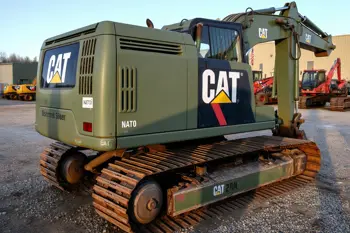
A 2010 Caterpillar 336DL hydraulic excavator showing 13,896 hours has appeared in Australian auction markets, illustrating the wide range of operational wear that exists within the ex-military and general surplus segment. 13 Hour meters alone do not capture the full maintenance story of a machine: factors such as idle hours, operating temperature ranges, the type of ground worked, and the quality of service intervals performed during active duty all materially affect residual mechanical life. Buyers without access to complete service records face inherent uncertainty in true cost-of-ownership projections.
Regulatory and Export Compliance Considerations
The regulatory framework governing ex-military equipment transactions is multifaceted. In the United States, the International Traffic in Arms Regulations administered by the State Department's Directorate of Defense Trade Controls govern what equipment may be exported and to which countries. 14 Buyers intending to resell internationally must verify ITAR compliance status before acquisition, as some military-configured engineering machines contain controlled components that trigger export licensing requirements regardless of their apparent commercial similarity.
The practical consequences of mismanaging this regulatory dimension are significant. Ghana's government in August 2025 ordered the relocation of approximately 1,200 impounded excavators from Tema Port to military installations in Tema, Shai Hills, and Accra, citing failures in the import validation process and concerns over excavators being diverted to illegal small-scale mining operations. 15 The Federal Acquisition Regulation and General Services Administration oversight frameworks in the U.S. similarly impose compliance obligations on domestic buyers, particularly when surplus federal assets are involved. 8
Maintenance Challenges and Parts Availability
One of the most underappreciated friction points in ex-military excavator ownership is parts sourcing. Machines configured specifically for military use, particularly those with proprietary electronic systems, specialized armor packages, or defense-contractor-specific hydraulic components, do not always share full parts compatibility with their civilian counterparts. 12 This divergence can translate into extended machine downtime during repair cycles, since civilian dealer networks may not stock the required components or possess the technical documentation to service them correctly.
For models that are closer to their commercial variants, such as Caterpillar 3306DI-engined dozers or JCB backhoe loaders, parts availability is generally better, but buyers should still confirm that the specific serial number range of the military-configured unit maps to standard civilian part numbers rather than a specialized variant. Inspection prior to any acquisition remains essential: the Ghana case saw excavators stored at Burma Camp with monitoring systems, batteries, and motors reported missing, highlighting the real-world risk of component loss between port arrival and final custody transfer. 16 Pre-purchase verification of completeness, operating documentation, and fluid analysis results forms the minimum due diligence threshold for any serious acquisition in this category.
Practical Considerations for Prospective Buyers
Understanding what category of ex-military excavator is being considered is a necessary first step. Machines used exclusively for training purposes, such as the D7H Series II examples documented in the Netherlands with only 912 hours and 90% undercarriage, represent a materially different proposition from machines deployed in active operational theaters. 4 Training-use units often receive consistent preventive maintenance under military schedule requirements, while operationally deployed units may have been subject to field-expedient repairs, harsh environmental conditions, and irregular service intervals driven by mission priorities rather than mechanical necessity.
Transport and logistics represent a further practical layer. Large tracked excavators and dozers require low-loader transport to reach operational sites, and international buyers must coordinate customs clearance, shipping documentation, and potential paint or configuration changes before deployment into civilian use. European disposal dealers typically offer logistics support and optional commercial repainting services as part of their disposal packages. 5 Buyers sourcing through North American government auction channels should account for transport costs separately, as winning bids at platforms like GovPlanet generally do not include haulage from the government holding yard to the end destination. 9
Sources
- exarmyuk.com - Ex Army UK (MOD and NATO Disposals)
- military-today.com - Military Today: M9 Armored Combat Earthmover
- en.clickpetroleoegas.com.br - Click Petroleo e Gas: BTM-3 Soviet Engineering Machine
- truck1.ke - Truck1: Caterpillar D7H II and D7G Ex-Army Listings
- machineryline.co.no - Machineryline: Caterpillar D7F EX ARMY Batch Listing
- projectplant.co.uk - Project Plant: JCB $205 Million USMC Contract
- compactequip.com - Compact Equipment: JCB $45 Million USMC 4CX Contract
- dla.mil - Defense Logistics Agency Disposition Services
- govplanet.com - GovPlanet: Military and Government Equipment Auctions
- copart.com - Copart: Government and Military Vehicle Auctions
- machineryvalues.com - Machinery Values: Equipment Pricing and Valuation
- gsa.gov - U.S. General Services Administration: Surplus Property
- sbauction.com.au - Smith Broughton Auctioneers: 2010 Caterpillar 336DL Listing
- pmddtc.state.gov - U.S. State Department DDTC: ITAR Regulations
- newsghana.com.gh - News Ghana: Ghana Port Excavator Relocation Directive
- daybreakgh.org - Day Break Newspaper: Excavator Parts Missing at Burma Camp
Authored by 24Trendz team