Ex-Military Utility Trailers: A Journalistic Analysis of Engineering Standards and Acquisition Trends
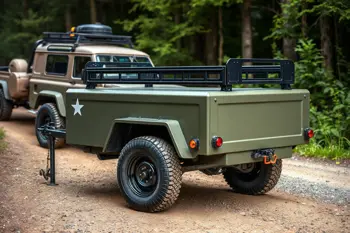
Ex-military utility trailers are defined by their rugged construction, high ground clearance, and specialized engineering originally intended for battlefield logistics and remote transport. These units have increasingly transitioned into the civilian sector, where they are utilized for off-road camping, agricultural support, and specialized equipment hauling due to their durability and high payload-to-weight ratios 8. In the modern secondary market, the demand for these trailers is driven by their ability to outperform standard consumer-grade utility trailers in harsh environments and uneven terrain 6.
Structural Engineering and Historical Classifications
The technical foundation of military trailers is rooted in historical classifications designed for specific towing vehicles. The M416, an iconic 1/4-ton, 2-wheel cargo trailer, was originally engineered to pair with the M151 Military Utility Tactical Truck 12. These vintage units are characterized by a compact steel tub and a weight-efficient design that remains highly sought after for minimalist off-road builds 5. While historical models like the M416 were built between 1940 and 1980, their structural integrity often remains intact due to military-grade steel and simplified mechanical components 5.
As towing requirements evolved, heavier models such as the M101 series became prominent. The M101A2 and M101A3 variants are 3/4-ton trailers that frequently feature surge brakes and heavy-duty leaf spring suspensions 1. These trailers are often repurposed as utility or camping units, with some modified examples including 3500lb axles, electric brake conversions, and integrated solar power systems 1. The transition from heavy steel frames to modern materials is seen in the M1101 and M1102 models, which utilize aluminum bodies to reduce curb weight while maintaining high load-bearing capacities 8.
Technical Specifications and Payload Capabilities
Modern ex-military trailers offer specialized configurations for diverse logistics roles. For instance, the AKXTERRA trailer system is engineered for exceptional mobility, featuring integrated power generation and environmental control unit (ECU) compatibility 7. These tactical units are designed to establishment forward bases and establish mobile command centers in harsh climates 7. Similarly, the GET-HX trailer provides a heavy-duty solution equipped with a 15 kW generator and a 5.0-ton HVAC system, ensuring stability and responsiveness across varied road conditions 9.
| Trailer Model | Payload Capacity | Chassis Composition | Axle/Suspension Type |
|---|---|---|---|
| M101A2 | 3/4 Ton | Steel | Torsion or Leaf Spring 1 |
| M1101 | Over 2,000 lbs | Aluminum | Torsion Axle 5 |
| Sankey 3/4 Ton | 1,500 lbs | Steel | Single Axle Drawbar 2 |
| Bantam T3 | Light Utility | Steel Frame | Vintage 1940s Leaf 4 |
Electrical Systems and Power Conversion Challenges
One of the primary technical hurdles in utilizing surplus military trailers is the discrepancy between tactical and civilian electrical standards. Military vehicles typically operate on a 24-volt electrical system with specialized NATO-style connectors 5. Civilian use generally requires a conversion to a 12-volt system and the installation of a standard 7-pin or 4-way plug to ensure compatibility with modern truck lighting systems 5. This process often involves replacing legacy incandescent bulbs with high-intensity LED units to improve visibility and signaling during transit 5.
Advanced utility trailers may also include integrated power solutions for remote operations. Research indicates that some modified M101A2 units are equipped with 100-watt solar panels and mounting points for portable power stations, such as the Goal Zero Yeti series 1. For specialized telecom or utility work, trailers like the Cable Splicer series incorporate 45-amp electrical service and 13.5K BTU air conditioning to protect sensitive fiber optic equipment from environmental fluctuations 27. These upgrades transform basic cargo hulls into climate-controlled workspaces suitable for sustained field operations 27.
Braking Systems and Towing Compatibility
Mechanical safety in ex-military trailers is governed by robust but often unique braking systems. The M101A2 originally utilized a hydraulic surge brake actuator, which is frequently deleted or replaced by electric brakes during civilian restoration to improve stopping control 1. Proper maintenance of these legacy systems requires regular bleeding of the brakes and verification of the brake fluid integrity 5. Additionally, older units like the Sankey 3/4-ton trailer may require rebuilt brakes and the inclusion of a reversing saddle to facilitate modern towing maneuvers 2.
Hitch compatibility is another critical factor for secondary market buyers. Most tactical trailers use a lunette ring designed for a pintle hook, providing a greater range of motion for off-road articulation than a standard ball hitch 12. While many users convert these to a standard 2-inch receiver and ball setup for convenience, retaining the pintle hook remains common for those prioritizing off-road performance 1. Torsion axles, found in models like the Acacia Contractor Trailer, are often preferred for their ability to absorb road shock and provide a smoother towing experience for sensitive cargo 25.
Regulatory Standards and Export Considerations
The acquisition and movement of ex-military hardware are subject to specific legal frameworks. In the United Kingdom, equipment classified as specially designed for military use requires an export license if it is to be taken out of the country 5. This regulation applies to both whole vehicles and individual component parts designed for military applications 5. However, it remains legal to operate modified ex-military trailers on public roads provided they meet local registration, licensing, and insurance requirements 5.
In the United States, surplus trailers are frequently sold through government auctions, such as those conducted by the Department of Defense 8. Buyers must often perform safety checks to ensure the equipment is road-legal, as many units are sold in as-is condition after being retired from active fleet service 8. Trends in 2025 show an increase in the availability of aluminum-bodied trailers like the M1101, as military fleets undergo modernization cycles and transition to NVG-compatible lighting systems 8. This influx has fostered a robust aftermarket ecosystem providing plug-and-play axle swaps and lockable cargo lids 8.
Market Volatility and Maintenance Realities
While ex-military trailers offer high value, prospective users must account for maintenance friction points associated with surplus equipment. Vintage models, such as the 1972 Sankey, may feature original wheels and tires that hold air but are technically aged beyond their recommended service life, requiring replacement for safe operation 2. Furthermore, internal bed dimensions vary significantly; a 1940s Willys Bantam T3 may offer a compact 3x6 bed suitable for yard work, whereas a modern M101A2 provides an 8-foot bed compatible with contractor-style toppers and slide systems 1, 4.
The secondary market pricing for these assets fluctuates based on condition and location. Smaller yard utility wagons built on vintage frames may be valued as low as $650, while fully modified off-road camping trailers with integrated electrical systems can reach $4,000 or more 1, 4. Buyers are encouraged to verify the presence of a clean title and documented maintenance history, especially for trailers that have undergone extensive modifications like Herculiner coatings, custom racks, or structural reinforcements 1, 5. Understanding these technical and market factors is essential for the successful integration of ex-military hardware into civilian utility roles.
Sources
- Expedition Portal
- Used Car Trailers
- eWillys
- ExArmyUK
- Poindaxster
- Alaska Defense
- Lewis County KY
- Deployed Logix
- Demarko Military
- Iron Bull
- Wikipedia
- GovPlanet
- Cargo Express
Authored by 24Trendz team