Ex-Military Sleeping Bags: A Field Guide to Specs, Systems, and What Buyers Should Know
Ex-military sleeping bags represent some of the most rigorously tested sleep systems ever produced, engineered to keep personnel alive under extreme field conditions ranging from tropical jungle environments to arctic expeditions. Genuine surplus items from forces including the U.S. military, Finnish Army, Czech Army, and NATO allies circulate through specialist retailers and online marketplaces, each carrying a set of specifications, condition ratings, and use histories that civilian buyers must carefully evaluate before purchase.
The U.S. Modular Sleep System: Architecture and Components
The most widely referenced American military sleep system is the Modular Sleep System (MSS), a four-component configuration designed to cover a temperature range from +50°F down to -40°F. 1 The complete GI Woodland MSS includes a Patrol Sleeping Bag rated to 30°F, an Intermediate Cold Weather (ICW) bag rated to -10°F, a GORE-TEX bivy cover, and a compression stuff sack. 2 The ICW bag weighs approximately 4 lbs, features water-resistant ripstop nylon, and is designed to integrate with the lighter Patrol bag for extreme cold layering. 2
The Patrol Bag component is manufactured by Tennier Industries Inc. under U.S. government contract and is NSN-marked for authenticity. 3 It features a reversible double-pull zipper that allows top or bottom ventilation, a non-locking slide fastener that self-repairs if jammed, and an adjustable hood. 4 When the MSS is fully assembled with all components, the compression stuff sack compresses the entire system to approximately one cubic foot, with dimensions of 30 inches in length and 14 inches in diameter. 2
NATO and European Military Sleeping Bag Specifications
Carinthia, an Austrian manufacturer, produces sleeping bags adopted by several NATO forces, most notably the Finnish Army. The Carinthia Finnish M05 Sleeping Bag measures 230 cm in length and 87 cm at the shoulder, weighs 2,000 g, and compresses to 25 x 32 cm. 5 Its outer shell is a wind and waterproof (1,000 mm) ripstop-reinforced polyamide, while the filling is G-Loft, Carinthia's own Austrian-made hollow-fiber insulation rated as highly compressible and moisture-resistant. 5 An additional internal component called Thermoflect, a thin aluminum-based material, reflects body heat and raises the bag's heat-retaining capacity by approximately 11%. 5
The Carinthia Defence 6, a more extreme-weather variant, weighs 2.6 kg and compresses to 25 x 45 cm. 6 It employs a three-layer design with a floating outer shell intended to eliminate cold spots, a dual-slider central zip for quick access, and a protective collar to reduce convective heat loss at the neck. 6 The Czech Army Thinsulate Summer Sleeping Bag represents the lighter end of the European surplus spectrum, using a 100% polyamide shell with 3M Thinsulate insulation, a heavy-duty YKK anti-snag slanted zipper, and an integrated mosquito head net, with dimensions of approximately 80.7 x 28.7 inches. 7
Snugpak Tactical and Special Forces Series: Documented Specifications
Snugpak, a UK-based manufacturer, produces the Tactical series of sleeping bags constructed from Paratex Steelplate outer fabric, a 100% nylon material with a breathability rating of 12 liters per square meter per 24 hours, Softie Premier fill, and Reflectatherm lining. 8 The Tactical 2 has a comfort limit of 0°C (32°F) and an extreme limit of -5°C (23°F), weighs 1,100 g, and packs to 18 x 17 cm. 8 The Tactical 3 extends the range to a comfort limit of -7°C (19°F) and extreme limit of -12°C (10°F), weighs 1,700 g, and packs to 23 x 20 cm. 9
The Tactical 4, positioned for more serious winter use, has a comfort limit of -12°C (10°F) and extreme limit of -17°C (1°F), weighs 2,100 g, and packs to 25 x 24 cm. 10 The Special Forces 2 (SF2) is designed for temperatures from 19°F to 10°F as a standalone bag, or -4°F when paired with the SF1 in Snugpak's two-bag Special Forces Sleep System. 11 Snugpak cautions that its temperature figures are proprietary ratings and may not be directly comparable to other manufacturers' EN or ISO standards. 8
Military-Derived Commercial Designs: The Recon Series
The Elite Survival Systems Recon 3 sleeping bag is documented as having been on issue with the Royal Australian Air Force (RAAF), commandos, and NATO forces, and was used by U.S. forces in Afghanistan. 12 It uses an outer top shell of 210T Ripstop Nylon with a Teflon finish, an outer bottom shell of 210D Nylon Oxford with a PU 2,000 mm waterproof finish, and 100 g per square meter DuPont Thermolite Micro insulation that incorporates an anti-bacterial pure silver microfibre layer. 12 The total system weight including compression sack is approximately 2 lbs 15 oz (1.33 kg), and unpacked dimensions are 220 cm in length, 85 cm wide at the shoulders, and 55 cm at the feet. 12
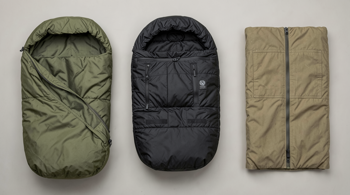
The Recon 4 Gen II extends the rating to -10°C, uses 80 g per square meter DuPont Thermolite Micro insulation, and adds a reinforced internal baffle foot constructed from 210D Nylon Oxford with PU 2,000 mm waterproofing to limit damage from combat boots. 13 Both Recon variants feature bonded seams, a central double-puller No. 8 spiral zip with storm flap, an internal PDA pocket, and a 210D Nylon Oxford compression sack. 13 These design elements reflect direct translation of field use requirements into commercial production.
Condition Grading, Procurement Risks, and Inspection Criteria
Surplus military sleeping bags are sold across a spectrum of condition grades. Retailers commonly use designations such as Unissued/Factory Sealed (never deployed, labels intact), Used/Like New (minimal signs of use), and Used/Good (functioning but showing marks, stains, or minor repairs). 14 The USMC Black Extreme Cold Weather Sleeping Bag, for example, is documented in Used/Good condition with a weight of 1.462 kg, dimensions of 220 cm x 80 cm (shoulders) and 45 cm (feet), and a pack size of approximately 24 x 27 x 37 cm. 15 Buyers of this grade should anticipate cosmetic wear consistent with surplus storage history.
Because ex-military sleeping bags were produced in batches under specific government contracts, exact dimensions and insulation loft can vary between manufacturing lots even when the same model designation is used. 16 Common inspection concerns documented by surplus retailers include torn outer shells, insulation clumping from moisture exposure, zipper teeth damage, and degraded waterproof coatings. 16 Temperature ratings on surplus items are frequently based on original military specification values rather than modern EN 13537 or ISO 23537-1:2022 comfort standards, meaning that a bag labeled for -10°F under mil-spec may translate differently when evaluated against contemporary civilian benchmarks. 16
Insulation Types, Shell Materials, and Modular Layering Logic
Across the documented ex-military sleeping bag landscape, two primary insulation approaches appear: synthetic hollow-fiber fills (including DuPont Thermolite, G-Loft, and 3M Thinsulate) and older cotton-based batting found in vintage USGI intermediate cold weather bags. The USGI vintage olive drab intermediate cold weather bag, rated for the 40°F to 20°F range, uses a heavy-duty cotton shell that is water resistant but highly bulky, with dimensions of 80 inches by 30 inches and a recommendation for bivy cover use when sleeping outdoors. 17 Synthetic fills, by contrast, retain functional loft when damp, a critical performance differentiator validated through field use across multiple military programs. 1
Modular systems add a layering variable that changes warmth-to-weight ratios and pack size relative to single-component civilian bags. The MSS GORE-TEX bivy cover, for instance, measures 85 x 28 x 35 inches, weighs approximately 1 lb 14 oz, and is constructed from a three-layer waterproof breathable laminate fabric compatible with both the Patrol and ICW bags. 2 Newer military-derived commercial designs such as the Spartan Odyssey incorporate ISO 23537-1:2022 certification, Thermolite fill with T-Down baffles around draft tubes, integrated armholes for in-bag equipment access, a 70D nylon footbox engineered to accommodate combat boots, and a two-way YKK No. 5 anti-snag centre zipper. 18 These innovations reflect the ongoing translation of operational lessons into measurable product engineering.
Sources
- OutdoorPro - outdoorpro.com
- Army Navy Marine Store - armynavymarinestore.com
- Gorilla Outfitters - gorilla-outfitters.com
- PNA Surplus - pnasurplus.com
- Varusteleka - varusteleka.com
- Goarmy - goarmy.co.uk
- Keep Shooting - keepshooting.com
- Varusteleka (Snugpak Tactical 2) - varusteleka.com
- Varusteleka (Snugpak Tactical 3) - varusteleka.com
- Varusteleka (Snugpak Tactical 4) - varusteleka.com
- Venture Surplus (Snugpak SF2) - venturesurplus.com
- SCY-Dist.com (Recon 3) - scy-dist.com
- Kit Bag Perth (Recon 4 Gen II) - kitbag.com.au
- Venture Surplus (USGI Vintage) - venturesurplus.com
- Army and Outdoors NZ - armyandoutdoors.co.nz
- S&K Surplus / General Surplus Research - skylinesurplus.com
- Venture Surplus (USGI Olive Drab) - venturesurplus.com
- JustGoodKit - justgoodkit.com.au
Authored by 24Trendz team