Ex-Military Field Kitchens: An Analytical Guide to Specifications, Reconditioning, and Civilian Reuse
Ex-military field kitchens have attracted sustained interest from emergency managers, catering operators, humanitarian organizations, and disaster relief contractors seeking proven, high-capacity mobile cooking infrastructure. These units were engineered for one of the most demanding operational contexts imaginable: feeding dozens to hundreds of personnel in austere, remote, or actively contested environments without access to permanent utilities or fixed structures. Understanding their design logic, reconditioning requirements, and limitations is essential before any procurement decision is made.
Historical Development and Design Origins
The concept of a mobile battlefield kitchen dates to four-wheeled wagon trains used by military units throughout the 19th century. 1 A pivotal engineering milestone arrived in 1892, when Karl Rudolf Fissler of Idar-Oberstein invented a mobile field kitchen that German forces called the Gulaschkanone, or "goulash cannon," because the chimney assembly resembled artillery ordnance when disassembled and limbered for towing. 1 By the 20th century, two-wheeled trailer configurations became dominant as motorized vehicles replaced horse teams, allowing heavier and more capable systems to be deployed at speed. 1
During World War II, mobile canteens served an explicit morale function in the United Kingdom, fitting into the cultural importance of the tea break, and wartime productivity experiments around the tea lady concept reinforced their operational value beyond mere caloric delivery. 1 Larger modern variants, frequently called "flying kitchens" because of their rapid deployment speed, can service entire battalions. 1 Today, many field kitchen programs distinguish between mobile canteen formats and full deployable field kitchen systems with facilities comparable to fixed commercial kitchens.
Key Technical Specifications Across Known Models
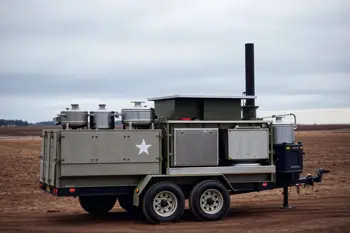
The Karcher TFK 250 is one of the most documented ex-military field kitchen trailers circulating in the secondary market. Built on a robust single-axle 3,500 kg trailer and constructed from chrome-nickel 18/10 stainless steel, it features two 150-litre double-walled GASTRONOM pressure cookers, two 55-litre GASTRONOM pressure fryers, two 78-litre dual-level oil-heated baking compartments, and two 28-litre hot water and tea boilers. 2 Its four-unit pressure vaporisation burner system accepts diesel, light fuel, petrol, or kerosene, providing multi-fuel flexibility critical in logistics-constrained environments. 2
A contrasting specification profile appears in the XC-250 Mobile Field Kitchen Trailer, a uniaxial platform with a total vehicle weight of 1,850 kg and overall dimensions of 4,000 x 2,250 x 2,420 mm. 3 Operated by four cooks, it can prepare meals for 250 persons within two hours and is rated for temperatures from -30°C to 42°C in all-weather, all-terrain conditions including fording depths of up to 500 mm. 3 The Finnish Teuvan LFK150+ presents a lighter trailer-based option, featuring a 150-litre double-walled stainless steel cooking kettle with heat-transferring fluid, a maximum axle load of 750 kg, and a transport envelope of 2,870 x 1,620 x 1,190 mm. 4
U.S. Military Field Kitchen Reconditioning and Cost Data
The U.S. Army's RESET program, administered through the Integrated Logistics Support Center at the Natick Soldier Systems Center, has produced detailed cost benchmarks for ex-military field kitchen reconditioning. As of reporting through 2011, a Mobile Kitchen Trailer (MKT) that would cost $105,000 new could be reconditioned through the RESET program for approximately $44,000. 5 For the more complex Containerized Kitchen (CK), new procurement cost was $235,000 compared to a RESET cost of $128,000. 5 Between 2004 and 2011, the RESET team processed 1,375 MKTs, 104 Containerized Kitchens, and 99 Laundry Advanced Design Systems returning from Iraq and Afghanistan. 5
The MKT production line has not manufactured new units since 1995, meaning large numbers of these trailers have remained in service well beyond their original design windows. 5 Buyers sourcing ex-military MKTs from surplus channels such as the Defense Reutilization and Marketing Office (DRMO) or GovPlanet should account for the age of the underlying chassis and cooking systems. 6 National Stock Number 7360-01-473-3408, assigned to the containerized kitchen with trailer category on April 5, 2000, reflects the formal federal logistics classification applied to these systems, and procurement records indicate this particular NSN has not seen U.S. government procurement in over five years. 7
Active Military Development and Next-Generation Systems
Military forces globally continue to develop new field kitchen systems alongside the secondary market in decommissioned units. The U.S. Navy Expeditionary Field Kitchen (NEFK), developed through a collaboration between NAVFAC EXWC and the U.S. Army Natick Soldier Systems Center, is designed for transport via ships, aircraft, and ground vehicles to support expeditionary operations worldwide. 8 A parallel development, the Sustained Autonomous Meals (SAM) system tested by the 19th Expeditionary Sustainment Command in Daegu, South Korea, operates within a 20-foot container and produces over 120 meals per hour with minimal personnel, using AI-driven robotic preparation rather than conventional cooking stations. 9
Ukraine's Armed Forces have been actively testing domestic designs including the Marichka 250, a prototype mobile complex featuring two 90-litre tanks for first courses, two 56-litre tanks for second courses, additional tanks for beverages, and a baking oven. The Marichka 250 runs exclusively on firewood and incorporates an oil-pillow heat retention system that extends usable heat after the fire diminishes. 10 Russia's KAMX-90, mounted on a UAZ Profi vehicle, is designed to feed a company or battery of more than 100 personnel and is now reportedly ready for mass production following successful off-road trials. 11
Civilian and Humanitarian Repurposing
Ex-military field kitchens have found documented application across a wide range of post-service civilian contexts. Containerized modular kitchen systems, including those engineered in Turkey and similar manufacturing hubs, have been deployed in flood response operations in Pakistan, refugee transit zones in northern Jordan, remote eco-lodges, mining and oil field camps, and disaster relief missions. 12 These systems are valued for their weatherproof sandwich-panel insulation, pre-installed gas lines, water inlets, drainage systems, and the ability to reach operational readiness in under two hours from delivery. 12
U.S. Army Field Manual FM 4-25.12 identifies three primary feeding models relevant to evaluating ex-military kitchen capability for civilian use: Unitized Group Rations (UGRs), which require steam kettles and bulk water heating; MRE augmentation, which requires efficient rehydration units; and Field Feeding Systems (FFS), which demand multi-fuel compatibility and rapid setup. 13 Emergency management firms have also commissioned purpose-built civilian equivalents: SDG Trailers of Waycross, Georgia built a 52-foot custom gooseneck disaster relief kitchen for Patriot Response Group engineered to produce over 5,000 meals per day in off-grid and rugged field environments. 14
Condition Assessment, Risks, and Buyer Considerations
Prospective buyers of ex-military field kitchens should approach condition assessment with rigor. RESET program records from Natick document that many units returning from Southwest Asia were too damaged to repair and were stripped for parts only. 5 Critical wear points include burner assemblies, pressure cooker seals, fuel lines, trailer axles and suspension components, and stainless steel cooking vessel integrity. Systems that have operated in extreme cold or high-humidity environments may exhibit corrosion in hidden structural welds or electrical conduit. Any unit sold as reconditioned without third-party inspection documentation should be treated with caution.
Regulatory considerations vary significantly by country. Trailer-based field kitchens entering the EU market must comply with vehicle directive 2007/46/EC, and some models, such as the Teuvan LFK150+, have received individual national approval rather than full EU type approval. 4 In the United States, surplus military equipment sold through DRMO or GovDeals may come with decommissioning paperwork but without commercial food-service certification, meaning operators intending to use them in regulated catering contexts must budget for inspection and code compliance work. Multi-fuel systems that accept diesel and kerosene in addition to gas introduce specific storage, handling, and ventilation obligations under fire safety codes that differ from standard commercial kitchen permitting requirements.
Sources
- Wikipedia - Field Kitchen (en.wikipedia.org/wiki/Field_kitchen)
- Autoline - Karcher TFK250 Ex-Military Field Kitchen Specifications (autoline24.se)
- HF Catchin - XC-250 Mobile Field Kitchen Trailer (hfcatchin.com)
- Fieldkitchen.eu - Teuvan LFK150+ Specifications (fieldkitchen.eu)
- Natick Soldier Systems Center / Talk-Technology Blog - RESET Field Feeding Program (talk-technology.blogspot.com)
- GovPlanet - Surplus Military Equipment Auctions (govplanet.com)
- ISO Group - NSN 7360-01-473-3408 Containerized Kitchen Record (iso-group.com)
- Military Provisioner - NAVFAC EXWC Navy Expeditionary Field Kitchen (militaryprovisioner.com)
- Military Online Blog / Sociedade Militar - SAM Containerized Autonomous Kitchen (military-online.blogspot.com)
- Oboronka / Mezha.ua - Marichka 250 Field Kitchen Testing (oboronka.mezha.ua)
- VPK.name - KAMX-90 Field Kitchen on UAZ Profi (vpk.name)
- Commercial Kitchen Project - Modular Container Remote Field Kitchens Turkey (commercialkitchenproject.com)
- Alibaba Product Insights - Military Camping Kitchen Selection Guide FM 4-25.12 Reference (alibaba.com)
- Eagle Country / SDG Trailers - Dual 5,000-Meal/Day Kitchen Fleet for Patriot Response Group (lifestyle.myeaglecountry.com)
Authored by 24Trendz team