Police auction motorcycles on sale: A factual guide to sources, terms, and buyer risks
The phrase “Police auction motorcycles on sale” covers several distinct categories rather than one national marketplace. Municipal departments may dispose of retired fleet motorcycles, while impound operators and forfeiture programs may sell abandoned, seized, recovered, or unclaimed vehicles under different rules and conditions.
What police motorcycle auctions include
Police-related motorcycle auctions generally contain three groups. The first is surplus fleet equipment, such as older patrol motorcycles retired after service requirements change. The second is impounded property, including abandoned vehicles and motorcycles connected with crashes or unclaimed storage. The third is seized or forfeited property released for public sale after the relevant legal process. These categories can have very different documentation, ownership histories, and mechanical conditions. 3 4 14
A Keizer, Oregon, surplus auction illustrates the municipal category. The police department announced a sale involving 12 vehicles, a trailer, and four electric bicycles, including old patrol cars and agency vehicles considered no longer necessary because of mileage or other service factors. The report described the sale as part of an effort to recycle equipment, not as a dedicated motorcycle marketplace. 1 This distinction matters because motorcycle inventory may appear intermittently rather than continuously.
Where listings are commonly published
Government agencies use several auction channels. GSA Auctions is the federal government’s online channel for surplus federal personal property and vehicles, while GovDeals, Public Surplus, and Municibid host listings from government agencies, municipalities, and other public organizations. The presence of a motorcycle on one of these platforms does not by itself establish that it was seized by police, because government surplus and law-enforcement property are separate classifications. 2 11 12 13
PropertyRoom is associated with property submitted by law-enforcement agencies, including recovered, seized, and unclaimed items. The U.S. Marshals Service also explains the federal asset-forfeiture process and the use of auctions or authorized contractors for federally forfeited property. These channels can improve provenance, but each individual lot still requires review of the seller, jurisdiction, title description, payment rules, and collection arrangements. 14 15
Examples of inventory and auction formats
Available research shows how varied the format can be. RAW2K’s motorcycle category displays fields such as lot number, end time, starting condition, keys, V5 status, mileage, transmission, fuel type, location, and current bid. Its sample listings include a pit bike marked “doesn’t start” with no keys and unknown mileage, a Honda CRF250 with similar documentation limitations, and electric motorcycles. These are auction descriptors, not guarantees of roadworthiness. 5
SCA’s Oregon motorcycle search includes salvage inventory with damage descriptions, branded-document information, mileage, location, sale date, and bid status. Examples in the supplied data include a 2023 Kawasaki Ninja 400 with front-end damage and 14,279 miles, a 2022 Yamaha Tracer 9 with front-end damage and 15,743 miles, and other powersports vehicles. Such listings are salvage-market examples and should not be treated as proof of direct police ownership. 6
How retired police motorcycles differ
Retired police motorcycles may have been used in intensive operational service and can show wear that is not fully captured by age or odometer readings. A Corpus Christi report stated that four of eight 2018 police motorcycles were being replaced after exceeding their intended four-year service life; one replacement had been involved in an accident. The department said the older units would be sent to public auction after the new fleet arrived. 9
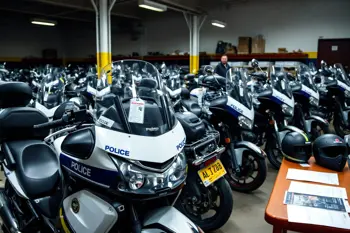
Fleet replacement can also involve equipment-specific changes rather than simple age-based disposal. Corpus Christi approved four pursuit-rated Harley-Davidson motorcycles and upfitting for a total of $181,405, with the fleet remaining at 12 motorcycles. The report noted integrated lighting and electronic changes in redesigned police models, as well as inflation and tariff effects on replacement costs. These details show why retired units may contain specialized fittings or altered controls that need inspection. 9
Documents, inspection, and legal status
“As-is” language is a central risk in public and seized-property auctions. A listing may identify unknown mileage, missing keys, absent registration documents, salvage branding, or a non-starting condition. A Vietnamese public notice, for example, described an auction of 155 two-wheeled motorcycles as scrap from a local police agency, with online bidding, specified viewing dates, and a stated auction date. That example demonstrates that some police-associated motorcycle sales are intended for material recovery rather than normal road use. 8
Buyers should distinguish a clean title, salvage title, rebuilt title, no-title status, and scrap designation before evaluating a lot. The vehicle identification number should be checked through an approved NMVTIS vehicle-history provider, because reports may reveal title brands, salvage records, and other title events. Registration requirements, inspection standards, taxes, buyer premiums, transport costs, and repair certification vary by jurisdiction and auction contract. 16
Mechanical and financial risks
Photographs and short descriptions cannot establish engine compression, frame alignment, electrical integrity, brake condition, tire age, or the completeness of police-specific equipment. Salvage motorcycles may have damage that is difficult to see in images, while fleet motorcycles may have accumulated operational wear. Inspection windows, where offered, are therefore important for confirming the VIN, controls, fluids, tires, frame, forks, wheels, battery, and evidence of crash repair.
The final cost extends beyond the winning bid. Potential obligations include auction fees, sales taxes, towing or freight, storage charges, replacement keys, title work, registration, safety inspection, parts, and labor. A motorcycle that does not start or lacks documents can require substantial work before lawful road use, and a scrap-designated unit may not be eligible for registration at all. Auction terms, rather than general assumptions about police property, determine the buyer’s rights and responsibilities.
How to evaluate a listing objectively
A disciplined review starts with the agency or auctioneer, lot number, VIN visibility, document type, ownership category, location, inspection schedule, and payment deadline. The listing should be read for exclusions such as “no keys,” “unknown mileage,” “doesn’t start,” “no V5,” “salvage,” or “as-is-where-is.” Comparable auction-result pages can provide context, but a past result is not a current valuation or a promise of future inventory. 5 10
TractorHouse publishes auction-result pages that include Harley-Davidson Road King Police touring motorcycles, showing that retired police models can also appear in equipment-auction ecosystems rather than dedicated police portals. However, the platform’s category and result format do not establish the mechanical condition or title status of every motorcycle. A sound assessment combines official documentation, physical inspection, history verification, transport planning, and a written calculation of all post-auction costs. 10
Sources
- Keizertimes, “Keizer police auctioning off a trailer, motorcycle, and cars”
- GSA Auctions
- Liquidity Services, “Where to Find Reliable Police-Seized Motorcycle Auctions Nearby”
- Abilene Police online impounded-vehicle auction report, MyFoxZone
- RAW2K motorcycle auctions
- SCA Oregon salvage motorcycle auctions
- GSU Boarded Vehicles and Store Items Public Auction notice
- Taisancong.vn notice concerning 155 police motorcycles sold as scrap
- Corpus Christi police motorcycle fleet replacement report
- TractorHouse Harley-Davidson Road King Police auction results
- GovDeals
- Public Surplus
- Municibid
- PropertyRoom
- U.S. Marshals Service Asset Forfeiture
- U.S. Department of Justice NMVTIS Consumer Access
Authored by 24Trendz team