Industrial Procurement Analysis: A guide to evaluating surplus military workshop equipment
Evaluating Surplus Workshop Equipment: An Overview
Acquiring rugged, battle-tested equipment for a fraction of its original cost is highly attractive for operators seeking quality industrial machinery 1. The global military surplus market provides access to a massive volume of retired government assets, ranging from standard vehicle fleets to complex workshop and manufacturing tools 1. Navigating the bidding process requires rigorous due diligence to ensure that the initial cost-saving benefits are not offset by hidden operational risks or high repair requirements 2.
According to the Defense Logistics Agency’s 2023 Annual Report, the government disposed of over $4.2 billion in surplus property within a single fiscal year 1. This extensive disposal pipeline includes personal property, vehicle assets, and industrial machinery no longer required for official military functions 3. Proper evaluation of these assets is essential before integrating them into civilian workshop environments, as military-spec equipment is built to specialized design parameters that differ fundamentally from civilian commercial standards.
Regulatory Framework and Sourcing Channels
The sale of government and military surplus equipment is strictly governed by the Federal Property and Administrative Services Act of 1949 1. Excess property no longer needed by federal agencies undergoes screening and donation phases before being designated as surplus 4. Once categorized under Federal Management Regulation Part 102-38, these assets are cleared for public sale through online auction portals 4. The primary official channels for these public acquisitions include GSA Auctions, GovDeals, and GovPlanet 4.
Purchasing through these platforms requires strict adherence to standardized legal frameworks. Federal personal property is typically sold according to the U.S. Government’s Standard Form 114C, which outlines the General Sale Terms and Conditions 3. All items are sold strictly as-is, where-is, with no warranties or options for negotiation after the close of bidding 5. Transaction limits are also enforced; for instance, credit card transactions through GSA Auctions are capped at $24,999.99 3.
| Sourcing Channel | Primary Property Type | Governing Regulation |
|---|---|---|
| GSA Auctions | Federal personal and real property | FMR Part 102-38 |
| GovDeals | State and local agency surplus | Platform Terms and Conditions |
| DLA Disposition Services | Department of Defense military equipment | Federal Property Act of 1949 |
Evaluating Physical Condition and Cannibalization Risks
A key step in assessing military workshop machinery is understanding the Department of Defense supply chain Condition Codes, which categorize asset serviceability from Factory Fresh down to unserviceable scrap. Buyers must prioritize reading the physical data plates affixed to the equipment, as they represent the primary source for verifying original manufacturer specifications, part numbers, and voltage requirements. While a clean exterior indicates proper cosmetic maintenance, inspections must focus on physical components that directly impact geometric accuracy, spindle runout, and mechanical reliability 6.
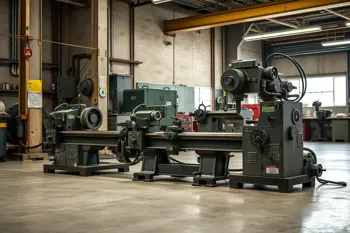
One of the most persistent operational risks in surplus military equipment is cannibalization, where parts are removed from one machine to service another active unit in the field. When evaluating workshop machinery like manual lathes, milling machines, or industrial drills, buyers must systematically check for missing gears, handles, and electrical controls. Standard components may have been replaced with non-standard field retrofits, complicating modern training and parts replacement 7. Verifying whether the model is still supported by manufacturers is essential to prevent long-term downtime 8.
Technical Specifications and Electrical Power Compatibility
A major engineering hurdle when integrating surplus military equipment into a civilian workshop is electrical power compatibility. Many pieces of specialized military-spec equipment are designed to run on 400Hz electrical systems rather than the standard 60Hz civilian utility grid. Operating a 400Hz machine on standard civilian power requires expensive frequency converters, which can double the true cost of the machine. Additionally, larger workshop systems, such as industrial rotary screw air compressors, are frequently wired strictly for three-phase power, requiring phase converters if three-phase power is unavailable 9.
Furthermore, precision machinery like vertical machining centers requires close inspection of control compatibility. Some older military-spec models feature highly customized or proprietary control interfaces that do not easily support modern programming workflows or standard computer-aided manufacturing post-processors 6. When evaluating high-speed CNC machinery, buyers must measure spindle runout with a test indicator and inspect linear guideways for uneven wear patterns or deep scoring, which can compromise the high tolerances required for precise industrial fabrication 10.
Financial Valuation and Total Acquisition Costs
Determining the fair market value of used military assets requires moving beyond sunk accounting book values to analyze the real marketability of the machine 11. Professional machinery and equipment valuation typically relies on three standard approaches: cost, market, and income 12. For active workshop machinery, the market approach comparing historical sales data of similar equipment models represents the most reliable benchmark 12. Brands like Lincoln Electric, Haas, and Mazak generally command higher resale values due to widespread parts availability 13.
The actual winning bid at auction represents only a portion of the total acquisition cost. Buyers must factor in the buyer’s premium, which is an administrative fee added by platforms like GovDeals, alongside local taxes and mandatory removal deadlines 4. Furthermore, military-grade workshop equipment is often heavily over-engineered, resulting in non-standard dimensions and extreme physical weights. This requires specialized transport logistics, crane rigging, and freight coordination, which can increase the total financial investment by 15% to 40% 14.
Safety Standards, Deactivation, and Compliance
Before any former military manufacturing or workshop tool can be legally operated, it must undergo thorough safety certification. Military systems are exempt from certain domestic commercial regulations during active service, but they must comply with Occupational Safety and Health Administration regulations upon transfer to private industry. This includes installing retrofitted safety guards, emergency stop switches, and electrical lock-out tag-out mechanisms. Furthermore, any pressurized vessel, such as a used shop air compressor, must be inspected for ASME tank corrosion to prevent fragmentation hazards 9.
Legal compliance also dictates that buyers verify the demilitarization coding status of the surplus assets. Under the Federal Management Regulation, certain military items have specific Controlled Inventory Item Codes that mandate the permanent deactivation or destruction of military-specific technology before public release 15. Failing to verify that a machine has been properly cleared can result in legal challenges or asset seizure. By utilizing structured pre-auction inspection strategies, buyers can successfully navigate the surplus market while mitigating regulatory risk 16.
Sources
- gov.deal
- gov.deal
- gsa.gov
- invrecovery.org
- revelationmachinery.com
- revelationmachinery.com
- manustructix.com
- alaskaresidential.com
- tooladvisorpro.com
- cncbul.com
- revelationmachinery.com
- ctacquisitions.com
- machinetoolsearch.com
- sinotruckexp.com
- waru.edu
- pesco.com
Authored by 24Trendz team