Energy efficient tankless water heating systems
How Tankless Water Heating Systems Work and Why Efficiency Matters
Water heating accounts for approximately 18% of a household's total energy consumption, making it the second-largest energy expense after space conditioning. 1 Traditional storage tank water heaters maintain a reservoir of 30 to 80 gallons at a preset temperature around the clock, continuously firing their burners or electric elements to compensate for heat that dissipates through the tank walls. This phenomenon, known as standby heat loss, quietly drains energy every day regardless of actual hot water demand. 2
Tankless systems, also called on-demand or demand-type water heaters, operate on a fundamentally different principle. When a hot water tap is opened, cold water flows through an internal heat exchanger where a gas burner or electric heating element activates instantly, delivering hot water within seconds without storing any volume. Once flow stops, the unit shuts off completely. This architecture eliminates standby loss entirely, which is why these systems can reduce water heating energy consumption by 24% to 34% in homes that use under 41 gallons per day, and by 8% to 14% in higher-demand households consuming around 86 gallons daily. 3
Efficiency Ratings and 2026 Federal Standards Explained
The primary metric used to evaluate tankless water heater performance is the Uniform Energy Factor (UEF), which measures how efficiently a unit converts its energy source into usable hot water under standardized test conditions. As of 2026, federal standards require new residential electric storage tanks to meet a minimum UEF of 0.95, a threshold that represents a meaningful baseline elevation from prior decades. 4 Tankless models generally outperform this floor, with gas condensing units achieving UEF ratings of 0.96 to 0.99 and electric models reaching up to 99% efficiency in laboratory conditions. 5
ENERGY STAR certification adds a further layer of verification. Certified whole-home gas tankless units must meet minimum requirements for efficiency, hot water delivery rate, warranty duration, and safety standards. The Noritz EZ Series Pro, for example, carries an ENERGY STAR-certified UEF of 0.98 across its 160,000 BTU and 199,900 BTU configurations, delivering flow rates of 9.0 GPM and 11.1 GPM respectively. 6 State Water Heaters' Adapt+ Premium Condensing line similarly achieves a UEF of 0.95 with ENERGY STAR certification across multiple BTU capacities from 160,000 to 199,000 BTU. 7 The U.S. Department of Energy recommends matching a unit's rated capacity to actual household demand to avoid both undersizing and efficiency penalties from oversizing. 8
Gas Versus Electric Tankless Systems: A Technical Comparison
The choice between gas and electric tankless systems involves tradeoffs in efficiency profile, infrastructure requirements, and operational behavior. Gas condensing tankless units typically achieve thermal efficiencies between 80% and 97%, with the higher figures associated with condensing designs that recover latent heat from exhaust gases. 9 Lochinvar's commercial Regent series, for instance, achieves up to 97% thermal efficiency with a turndown ratio of 25:1, enabling it to modulate output across a wide demand range rather than cycling on and off at full capacity. 10 The gas infrastructure, however, requires proper venting, and condensing models need PVC vent runs that can span significant distances.
Electric tankless systems operate at up to 99% efficiency because virtually no energy escapes through combustion byproducts. 5 A typical whole-home electric unit rated at 14 to 15 kW requires a dedicated 240V circuit, a 60-amp double-pole breaker, and 6 AWG copper conductors. Homes with panels under 150 amps may require a panel upgrade before installation, which adds to total project costs. An average electric tankless unit consumes roughly 4,500 to 5,500 watt-hours per day for a family of four, translating to approximately $40 to $60 per month in electricity costs depending on local rates. 11
| Technology | Typical UEF Range | Fuel Source | Avg. Lifespan |
|---|---|---|---|
| Gas Condensing Tankless | 0.96 - 0.99 | Natural Gas / Propane | 18 - 22 years |
| Electric Tankless | 0.99 (up to 99% efficiency) | Electricity | 15 - 20 years |
| High-Efficiency Storage Tank | 0.80 - 0.95 | Gas or Electric | 8 - 12 years |
| Heat Pump (Hybrid) | 3.0 - 4.1 | Electricity | 13 - 15 years |
Installation Costs, Lifespan, and Long-Term Financial Realities
Installed costs for tankless systems in the U.S. market range broadly. In markets such as the Denver metro area, gas tankless installations typically run between $3,500 and $6,500, compared to $1,500 to $3,000 for a gas storage tank replacement. 12 The higher upfront expenditure reflects venting modifications, potential gas-line upgrades, and the labor complexity of transitioning from a tank-based configuration. Annual energy costs for a typical household using a gas tankless unit are estimated at $200 to $350, versus $300 to $500 for a conventional storage system in the same market. 12
Lifespan is a significant financial variable. Tankless units generally last 18 to 22 years compared to 8 to 12 years for standard storage tanks, meaning a single tankless installation may outlast two conventional replacements. 12 State Water Heaters' condensing models project estimated annual energy costs as low as $227 per year for a 180,000 BTU unit operating in a northeastern climate. 13 Federal tax credits for ENERGY STAR-certified tankless water heaters have provided homeowners with meaningful offsets; Colorado-based analysis notes credits up to $2,000 are accessible under specific qualifying conditions tied to the Inflation Reduction Act provisions. 14
Key Limitations, Maintenance Requirements, and Risk Factors
Despite their efficiency advantages, tankless systems carry several practical limitations that homeowners must evaluate objectively. Whole-home gas units require minimum activation flow rates, typically 0.25 to 0.5 GPM for electric models and higher for gas, meaning very low-flow fixtures may not trigger heating. 8 In hard-water regions, mineral scale accumulates on heat exchanger surfaces and progressively degrades performance. Annual descaling with a vinegar flush or chemical descaler is necessary to maintain rated efficiency, and some manufacturers integrate scale prevention technologies such as State's X3 Scale Prevention system to reduce this burden. 7
Gas venting requirements add complexity absent in tank installations. Condensing units exhaust cooler gases suitable for PVC, but 2-inch runs are typically limited to 75 feet and 3-inch runs to 150 feet, constraining placement options in some structures. 7 Electric installations demand panel capacity that many older homes lack. In cold climates, incoming groundwater temperatures are significantly lower, reducing effective flow rate output; a unit rated for 9.0 GPM in a southern climate may deliver substantially less in northern regions where groundwater approaches 40 degrees Fahrenheit. Cold weather also increases burner ignition frequency and can create performance challenges for improperly sized systems. Homeowners in jurisdictions such as Colorado must also ensure compliance with ultra-low NOx emission standards introduced in 2026, which apply to new gas water heater installations statewide. 14
Smart Technology Integration and Emerging Innovations in Tankless Systems
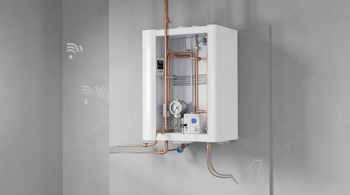
A growing segment of the tankless market incorporates WiFi connectivity, enabling remote temperature adjustment, usage monitoring, and diagnostic alerts through mobile applications. Self-modulating technology, which automatically adjusts power output based on incoming water temperature and real-time flow rate, is now standard across mid-range and premium electric models. This modulation prevents energy waste during low-demand periods and maintains stable outlet temperatures. 15 Brands such as Rheem, Rinnai, and Navien are noted for premium smart-feature integration alongside high ENERGY STAR performance ratings. 16
Commercial applications are advancing in parallel. Lochinvar's Regent series applies RealTime O2 Trim combustion management and ultrasonic flow sensing to detect demand shifts instantaneously, maintaining consistent water temperature across dynamic load conditions ranging from 500,000 to 1,000,000 BTU/hr. 10 On the residential side, heat pump water heaters represent a parallel technology achieving UEF ratings of 3.0 to 4.1 by moving ambient heat rather than generating it, delivering three to four units of thermal energy per unit of electricity consumed. While not tankless in the conventional sense, they are increasingly considered alongside tankless systems as the high-efficiency alternative for households transitioning away from electric resistance storage tanks. 4
Sources
- Consumer Reports - Water Heater Buying Guide (consumerreports.org)
- Noble Plumbing - Should You Switch to a Tankless Water Heater? (noble-plumbing.com)
- Burnside AC - Do Tankless Water Heaters Save Money Over Time? 2026 Guide (burnsideac.com)
- BestOwnerDirect - Energy Efficient Water Heater Options Compared: 2026 (bestownerdirect.com)
- Optimal Tankless Water Heaters - opti15 Product Specifications (itsoptimal.com)
- HVACDirect - Noritz EZ Series Pro Tankless Water Heater Specifications (hvacdirect.com)
- State Water Heaters - Adapt+ Premium Condensing Tankless Series (statewaterheaters.com)
- U.S. Department of Energy - Tankless or Demand-Type Water Heaters (energy.gov)
- Rheem Manufacturing - Heat Pump Water Heater vs Gas Tankless Comparison (rheem.com)
- Green Lodging News - Lochinvar Launches Regent Commercial Tankless Water Heater (greenlodgingnews.com)
- Heater Advisor - How Much Electricity Does a Tankless Water Heater Use? (heateradvisor.com)
- Goodfellas Heating - Tank vs. Tankless Water Heater in Denver (goodfellasheating.com)
- State Water Heaters - ProLine XE Condensing Tankless Series (statewaterheaters.com)
- The Daily Moss - Why Tankless Water Heaters Are Booming in Colorado Springs (dailymoss.com)
- Eccotemp - Smart Homes and Hot Water: Tankless Heaters and Smart Tech (eccotemp.com)
- Modernize - Best Tankless Water Heater Brands of 2026 (modernize.com)
Authored by 24Trendz team