Surplus Military Grade Solar Generators for Sale: A Buyer's Research Guide
Surplus military grade solar generators for sale appear across multiple government auction platforms and secondary markets, drawing interest from emergency preparedness professionals, remote industrial operators, and off-grid homesteaders. These units were originally designed to power tactical field operations, border outposts, and command-and-control centers, meaning their construction standards far exceed typical consumer or commercial power equipment. Understanding what defines military-grade solar power, how surplus units reach the public, and what practical limitations exist is essential before any acquisition decision is made.
What 'Military Grade' Actually Means for Solar Generators
The term military-grade is not a marketing label when applied to genuine surplus equipment. It refers to specifications that equipment must satisfy before acceptance into military service. Key standards relevant to solar power systems include MIL-STD-810, which covers environmental testing across temperature extremes, humidity, altitude, vibration, and dust exposure, and MIL-STD-461, which governs electromagnetic interference (EMI) and electromagnetic compatibility (EMC). 1 A generator certified to MIL-STD-461G (2015 revision) will not disrupt sensitive nearby electronics such as radios, drones, or surveillance systems, a critical characteristic in contested tactical environments. 1
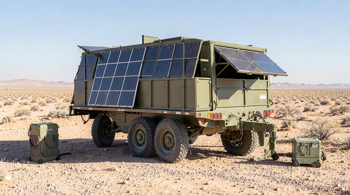
True military solar trailers and portable power stations also typically feature ruggedized chassis compliant with MIL-STD-810G environmental testing standards, all-terrain suspension for off-road deployment, and foldable high-efficiency monocrystalline panels capable of deploying in under 15 minutes. 2 Some classified operation configurations include TEMPEST-certified enclosures that provide shielded electronics to prevent interference with tactical communications systems. 2 These are not specifications found in consumer portable power stations, and they are a primary reason surplus military units attract civilian interest.
How Military Solar Equipment Enters the Surplus Market
The General Services Administration (GSA) Auctions platform at gsaauctions.gov is the primary federal portal through which agencies sell surplus personal property, including power generation equipment. 3 The Defense Logistics Agency (DLA) Disposition Services manages the disposal process for military equipment and is the upstream source before items reach public auction. 4 Once DLA declares items excess to military needs, they flow through designated channels to become publicly available.
GovPlanet, a subsidiary of Ritchie Bros., specializes in surplus military equipment and periodically features portable power units and solar array trailers. 5 Public Surplus is another government-contracted auction venue used by municipalities and military bases to list decommissioned portable power infrastructure. 6 Inventory on these platforms fluctuates significantly; availability depends on active decommissioning cycles, base closures, or equipment upgrade programs rather than consistent commercial restocking.
Technical Specifications Observed in Military Solar Power Systems
Documented military and expeditionary solar power systems reveal a wide performance range. The LKD Aerospace SunCase 605, designed for professional field and mission-critical use, provides 550 Wh of usable capacity with a 600 W pure sine wave inverter in a 16 lb chassis with tactical rails and reinforced corners. 7 At the larger end, containerized military solar systems such as the HJ-FBESS Solar Container are built to ISO and CSC standards with IP55 environmental protection, incorporating N-Type TOPCon PV arrays with 22.5% or higher efficiency and liquid-cooled lithium-ion battery racks delivering 3.7 MWh to 5.0 MWh of energy storage capacity inside a standard 20-foot container. 8
Flexible panel configurations engineered for expeditionary teams, such as the Power Logix 110W Flexible Solar Panel, weigh 6.1 lbs and measure 23 inches by 40 inches by half an inch, deploying in under one minute and surviving harsh conditions that would destroy conventional glass and aluminum panels. 9 Military microgrid battery energy storage systems (BESS) used on island military bases are designed to provide instantaneous frequency regulation, black start capabilities, and renewable energy firming by smoothing the volatility of solar output to deliver a steady, predictable supply. 10
Battery Chemistry and Connectivity Considerations for Surplus Buyers
One of the most significant technical variables in surplus military solar generators is battery chemistry. Buyers must verify what energy storage technology is present in any surplus unit, as older inventory may still utilize lead-acid or absorbed glass mat (AGM) batteries rather than modern Lithium Iron Phosphate (LiFePO4) chemistry. 11 LiFePO4 batteries, common in newer tactical systems, offer substantially longer cycle life, with commercially comparable units rated for 3,500 or more cycles, compared to the much shorter lifespan of legacy AGM configurations. 12
Connectivity is another friction point. Used military solar generators frequently employ MIL-SPEC circular connectors that are not compatible with standard civilian power interfaces. 11 Custom cabling fabrication is often required, which adds cost, lead time, and technical complexity. Buyers without access to military electrical engineering support or specialized contractors should factor this into any acquisition assessment. Units that use more standardized output ports may be easier to integrate into civilian infrastructure but may also represent older or lower-specification configurations.
Civilian-Grade Alternatives with Military-Inspired Specifications
Because genuine military surplus solar generators are irregularly available and may require significant retrofitting, many buyers evaluate high-specification civilian systems as functional alternatives. The commercial market offers units with overlapping performance characteristics. The Grid Doctor 3300, for example, features built-in EMP Intercept Technology, a 3300 W pure sine wave inverter with 6600 W surge capacity, a 2048 Wh LiFePO4 battery with 3,500 or more charge cycles, and AC surge protection rated at 260 kA with a 3-nanosecond reaction time. 13 Larger civilian systems like the Anker SOLIX F3800 Plus offer 3,840 Wh base capacity, 6,000 W dual-voltage output supporting both 120V and 240V, solar input up to 3,200 W, and expandable storage reaching 53.8 kWh. 14
Refurbished civilian units also appear in the market. Platforms such as Anker SOLIX's own refurbished channel list units like the F2600, a 2,560 Wh LiFePO4 system with 2,400 W continuous AC output and a 6-month warranty, at reduced price points compared to new inventory. 15 These refurbished civilian systems do not carry MIL-SPEC certifications, but they represent a more predictable acquisition path than auction-dependent surplus channels for buyers with immediate power requirements.
Risks, Limitations, and Due Diligence Requirements
Surplus military solar equipment carries inherent acquisition risks that demand careful due diligence. Condition grading on government auction platforms varies, and units may have accumulated significant operational hours, exposure to extreme environments, or physical damage from deployment. Battery state of health is rarely independently verified in auction listings, and replacement battery packs for military-specification systems can be difficult to source and expensive. The preppers and emergency preparedness market has documented cases where Department of Defense warehouse inventory reaches public auction for a fraction of original procurement cost, but the condition and functionality of such units are never guaranteed by the selling agency. 16
Regulatory considerations also apply. Some military electronic systems are subject to export controls, demilitarization requirements, or Federal Communications Commission regulations related to EMC equipment that emits or is sensitive to radio frequencies. Buyers should confirm with the DLA or GSA whether a specific lot has been cleared for unrestricted civilian resale before completing any transaction. 4 Additionally, OPTIMA and Teledyne battery systems used in military generator starting applications, while commercially available, require compatibility verification with specific generator models, such as the Teledyne 7243-16A which is tested for the 3 kW tactical generator. 17 Total cost of ownership, including transport, inspection, reconditioning, and integration, frequently exceeds the initial auction price by a substantial margin.
Sources
- Americas Generators - americasgenerators.com
- ALP Technology - wx-alp.com
- GSA Auctions - gsaauctions.gov
- DLA Disposition Services - dla.mil
- GovPlanet - govplanet.com
- Public Surplus - publicsurplus.com
- LKD Aerospace - lkdaerospace.com
- Solar Container Kit - solarcontainerkit.com
- Deployed Logix - deployedlogix.com
- Genetec Microgrid - genetec.net
- LLM General Research - Buyer Technical Considerations
- 101 Generator - 101generator.com
- My Patriot Supply - mypatriotsupply.com
- Solar Guys Pro - solarguyspro.com
- Anker SOLIX US - ankersolix.com
- Shanhua China - shanhuachina.com
- Military Battery Systems - milbatteries.com
Authored by 24Trendz team