The best vitamin C serum for brightening: A Comparative Analysis of Skincare Science and Formulations
In the pursuit of an even, radiant complexion, choosing the best vitamin C serum for brightening requires a deep understanding of molecular stability and skin biology. As a potent antioxidant, topical vitamin C defends against oxidative stress caused by ultraviolet rays and environmental pollution while suppressing melanin production to fade discoloration. To assist consumers in navigating the skincare market, this analysis presents an objective overview of the clinical formulations, derivative options, and application practices that define high-performance brightening serums.
The Physiology of Vitamin C and Skin Brightening
Topical vitamin C works primarily by delivering active L-ascorbic acid or its stable derivatives directly to the epidermal layers of the skin 1. Once absorbed, it serves as a powerful electron donor, neutralizing the free radicals generated by daily environmental exposures such as sun and pollution 2. This antioxidant mechanism prevents the oxidative cascade that triggers melanin synthesis, protecting the skin barrier from degradation 3.
Furthermore, vitamin C is a crucial cofactor in collagen synthesis, which helps improve overall skin density, elasticity, and firmness 4. By inhibiting the tyrosinase enzyme, which is responsible for melanin production, consistent daily application of vitamin C directly reduces dark spots and hyperpigmentation 5. This dual action of environmental protection and melanin regulation results in a more luminous, even-toned complexion over a typical observational period of six to twelve weeks 6.
Evaluating Leading Industry Formulations
Skincare research teams and dermatological laboratories have developed diverse formulations to balance molecular potency with skin tolerance 7. At the luxury tier, SkinCeuticals C E Ferulic is widely recognized as a benchmark formula, utilizing 15% pure L-ascorbic acid paired with 1% vitamin E and 0.5% ferulic acid to maximize stability 8. Conversely, Timeless Skin Care offers a 20% C + E Ferulic Acid Serum, which serves as a potent mid-range option with similar active pathways 9. For entry-level options, TruSkin Vitamin C offers a gentler concentration suitable for beginners seeking brightening without irritation 10.
To illustrate how different clinical and consumer brands formulate their serums, the following table details some prominent examples available in the market:
| Brand & Product | Active Vitamin C Type | Primary Intended Benefit |
|---|---|---|
| SkinCeuticals C E Ferulic | 15% L-Ascorbic Acid | Antioxidant defense and firming 8 |
| Timeless Skin Care 20% C + E Ferulic | 20% L-Ascorbic Acid | Intense brightening and environmental protection 9 |
| The INKEY List 15% Vitamin C + EGF | 15% Ascorbyl Glucoside | Gentle brightening and skin cell regeneration 11 |
| Vichy 16% Pure Vitamin C | 16% L-Ascorbic Acid | Complexion brightening and fine line reduction 12 |
| BeautyStat Universal C Skin Refiner | 20% Pure L-Ascorbic Acid | Stable, high-strength dark spot correction 13 |
Understanding Concentration and Formulation Stability
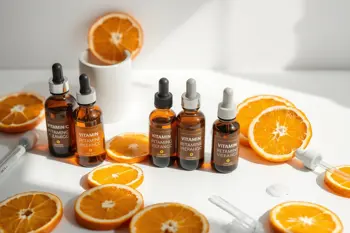
One of the greatest challenges in formulating topical vitamin C is its inherent chemical instability 14. Pure L-ascorbic acid is highly prone to oxidation when exposed to light, air, and varying temperatures, which causes the serum to turn brown and lose its clinical efficacy 15. To prevent this degradation, manufacturers often package these formulations in dark, opaque glass bottles or airless pump containers designed to shield the contents 12 13.
Additionally, the concentration of the active ingredient dictates both its efficacy and potential for irritation 6. Clinical studies show that while concentrations between 10% and 20% deliver optimal brightening benefits, going above 20% does not increase absorption but significantly raises the risk of skin irritation 6. Advanced formulations, such as Murad's Vita-C Glycolic Acid Serum, use gold-stabilized vitamin C to increase antioxidant retention and delivery without needing extreme acid concentrations 16.
Tailoring Vitamin C to Different Skin Types
Different skin types respond uniquely to the various molecular forms of vitamin C. For individuals with sensitive skin, pure L-ascorbic acid can trigger redness, stinging, or peeling 11. In these cases, stabilized derivatives such as ascorbyl glucoside or 3-O-ethyl ascorbic acid, found in formulations like Naturium Vitamin C Complex Serum or Remedy Science Daily Defense, are highly recommended because they remain gentle on the skin barrier 9 11 17.
In contrast, those with dry skin may benefit from rich, moisturizing bases such as Sunday Riley's C.E.O. 15% Vitamin C Brightening Serum, which combines tetrahexyldecyl ascorbate with hydrating lipids 9. For oily and acne-prone complexions, lightweight, non-comedogenic serums such as La Roche-Posay's C12 Serum or CLEARSTEM Vibrance-C deliver oil-free antioxidant benefits without clogging pores 9 18. Choosing the right vehicle for the active ingredient ensures that the user can maintain daily consistency, which is vital for long-term brightening outcomes.
The Role of Secondary Actives and Antioxidants
Modern skincare science frequently pairs vitamin C with secondary active ingredients to produce synergistic brightening effects. For instance, Clinique's Even Better Clinical Serum combines vitamin C with salicylic acid and niacinamide to gently exfoliate dulling surface cells while reducing the appearance of stubborn dark spots 19. Similarly, the addition of peptide complexes, such as those in the Bliss Bright Idea Vitamin C Serum, supports skin elasticity and smooths fine lines, reinforcing the structural benefits of the antioxidant 20.
In global skincare, particularly within Korean beauty philosophy, brightening is treated as a multifaceted category rather than a single-ingredient objective 21. Korean vitamin C formulations, such as the Numbuzin No. 5+ Vitamin Concentrated Serum or Goodal Green Tangerine Vita C, often blend gentler vitamin C derivatives with soothing botanicals, niacinamide, and tranexamic acid 21. This cooperative approach aims to soothe the skin barrier and prevent micro-irritations that could potentially trigger post-inflammatory hyperpigmentation.
Application Methodologies and Photoprotection Realities
To achieve optimal results, a vitamin C serum should be applied systematically within a daily skincare routine. Dermatologists recommend applying the formulation to clean, dry skin in the morning immediately after cleansing to allow complete absorption before layering other products 22. When applied in the morning, vitamin C acts as a secondary shield against daily environmental aggressors, supplementing the skin's defense systems 22.
However, it is crucial to recognize that vitamin C is not a substitute for daily sunscreen 23. Ultraviolet radiation is a primary driver of hyperpigmentation, and failing to apply a broad-spectrum SPF of 15 or higher can completely negate the brightening benefits of any topical active 24 25. Consistent daily application of both a stable vitamin C serum and a high-quality sunscreen remains the clinical standard for safely revealing a brighter, more even-toned complexion.
Sources
- Healthline
- Cleveland Clinic
- NIH Office of Dietary Supplements
- Verywell Health
- American Academy of Dermatology
- Dermatology Times
- Forbes
- NYT Wirecutter
- Timeless Official
- Dr. Sam Ellis Skincare Review
- The INKEY List
- Ulta Beauty - Vichy
- BeautyStat
- Mona Dermatology
- Paula's Choice
- Murad Skincare
- Remedy Science by Dr. Muneeb Shah
- CLEARSTEM
- Ulta Beauty - Clinique
- Bliss World
- Vogue
- American Academy of Dermatology - Skincare Serums
- NIH Office of Dietary Supplements - Antioxidants
- EVER Skincare
- American Academy of Dermatology - Clearing Dark Spots
Authored by 24Trendz team