Guide to the mechanics of vacuum enhancement pumps: An Engineering Analysis
Understanding the Core Principle: What a Vacuum Enhancement Pump Does
A vacuum enhancement pump is not a standalone device. It is an auxiliary component installed in series with a primary backing pump to amplify pumping speed and lower achievable pressure levels. The fundamental function of any vacuum pump is not to pull gas, but to push it. By mechanically capturing gas molecules from a sealed space and expelling them through a discharge port, the device creates a pressure differential that causes gas to flow naturally from the high-pressure system into the lower-pressure pump inlet. 1 Enhancement pumps extend this principle by increasing volumetric throughput in the medium vacuum range, the pressure band where single primary pumps typically experience a performance bottleneck.
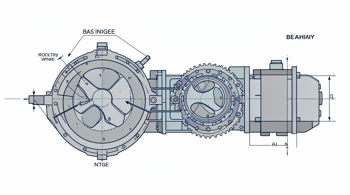
The most widely deployed type is the Roots vacuum booster, which uses two counter-rotating figure-eight-shaped lobes synchronized by external gears. As these lobes turn, they create expanding volumes on the inlet side that draw gas in and contracting volumes on the discharge side that push it toward the backing pump. The rotors operate without contact and require no internal lubrication, making the pumping chamber inherently clean and oil-free. 2 Because the booster cannot discharge gas directly to atmosphere without overheating, it depends entirely on the backing pump to exhaust that gas, establishing the paired-system architecture that defines all enhancement pump configurations. 3
The Pumping Speed Bottleneck and Why Enhancement Is Necessary
Single primary pumps follow a characteristic pumping speed curve in which performance drops significantly as pressure decreases into the medium vacuum range, roughly 1 to 100 mbar. In this range, internal gas leakage within a dry screw or rotary vane pump begins to offset effective displacement, making further pressure reduction slow and energy-intensive. Upgrading to a physically larger primary pump to overcome this limitation requires a proportional increase in motor power, which raises energy consumption and often exceeds site power capacity constraints. 4
A vacuum booster resolves this problem through a different engineering logic. By placing the booster in series upstream of the backing pump, system pumping speed in the medium vacuum range increases substantially without a proportional rise in total motor power. Published engineering data indicates that the combination of a backing pump and a vacuum booster can achieve pumping speeds at low pressure far greater than the backing pump could reach alone, with system performance improvements documented at up to a factor of ten in applicable configurations. 5 This efficiency gain directly reduces production cycle times and lowers energy costs per unit of throughput.
Mechanical Architecture: Key Components and Their Functions
The internal architecture of a Roots-type vacuum enhancement pump consists of several precisely engineered elements. The two lobed rotors are the active displacement components, maintained in synchronization by a pair of external timing gears that keep them separated by a precise, non-contact clearance from each other and the pump casing. This clearance is critical: it must be tight enough to limit gas backflow but large enough to prevent thermal contact as the rotors expand during operation. 6 Proper thermal management is essential because high compression ratios generate heat that can cause rotor seizure if cooling systems are inadequate.
Supporting components include shaft seals that isolate the pumping chamber from the gear and bearing housings, preventing oil migration into the vacuum space. The inlet and outlet connections are sized to match the backing pump displacement, and in most industrial configurations a pressure switch or electronic control system is integrated to delay booster startup until the primary pump has reduced system pressure to a safe threshold level. 7 Starting the booster prematurely at high pressure generates excessive compression heat and can damage both the booster and backing pump. The control interlock is therefore a standard and non-negotiable design element.
Primary Pump Technologies That Pair with Enhancement Pumps
The choice of backing pump determines the effective operating range and contamination profile of the entire vacuum system. Three primary pump technologies are commonly used as backing stages for enhancement pumps.
| Backing Pump Type | Operating Principle | Typical Application Context |
|---|---|---|
| Rotary Vane Pump | Eccentric rotor with sliding vanes creates expanding and contracting chambers; oil-sealed for sealing and lubrication | Vacuum sintering furnaces, freeze drying, analytical instruments |
| Dry Screw Pump | Two counter-rotating helical screws trap and transport gas without internal lubrication; oil-free exhaust | Semiconductor fabs, pharmaceutical processing, corrosive gas handling |
| Liquid Ring Pump | Rotating impeller forms a liquid ring that compresses gas pockets; uses water or process-compatible liquid as sealant | Chemical processing, power plant condenser exhausting, vacuum distillation |
In vacuum sintering furnaces, the industry-standard configuration is a two-stage system combining a rotary vane pump with a Roots booster. This pairing targets final operating pressures in the range of 10 to the negative one to 10 to the negative two hPa, which prevents oxidation and removes trapped gases from the material being processed. 8 For semiconductor coating and photovoltaic wafer processing in the medium vacuum range of 1 to 10 to the negative one mbar, a Roots booster paired with a dry screw pump provides the stable, repeatable pumping speed that process repeatability demands. 9
Performance Parameters: Ultimate Pressure, Pumping Speed, and Compression Ratio
Correct system sizing requires understanding several distinct performance metrics, each of which affects a different aspect of process outcomes. Ultimate pressure is the lowest pressure achievable by the pump under ideal, leak-free conditions; it represents the physical limit imposed by pump design, construction materials, and the vapor pressure of any sealing fluids present. Pumping speed, measured in cubic meters per hour or liters per second, measures the volume of gas the system can remove per unit of time and directly governs pump-down duration and process throughput. 10 These two metrics do not move in tandem: higher pumping speed does not automatically produce lower ultimate pressure, and optimizing a system requires balancing both independently.
The compression ratio of a Roots booster describes the ratio between its inlet pumping speed and the backing pump's displacement capacity. Oversizing the booster relative to the backing pump creates excessive differential pressure across the booster, driving up internal temperature, increasing energy consumption, and potentially causing pressure instability that degrades process repeatability. Undersizing the system results in extended pump-down times and may prevent the process from reaching its required operating vacuum under real gas load conditions. 11 Engineers must define four non-negotiable parameters before sizing: the actual operating vacuum range during production, the gas load throughout the process cycle, the required pump-down time, and the nature of any vapors or reactive by-products present.
Industrial Applications and Operating Considerations
Vacuum enhancement pump systems serve a wide range of demanding industrial processes. In pharmaceutical manufacturing, stable medium-vacuum conditions are required for lyophilization, solvent recovery, and sterile filling operations. In food packaging, rapid evacuation of large chamber volumes demands the high pumping speeds that boosters provide. Power generation facilities use liquid ring and Roots booster combinations for steam condenser exhausting, where maintaining stable low pressure directly affects thermal efficiency. 12 Precision heat treatment and vacuum metallurgy depend on booster-equipped systems to achieve the clean, contaminant-free environments required for aerospace and medical device components.
Operational maintenance considerations include regular inspection of rotor clearances for signs of thermal distortion, monitoring of backing pump oil condition in oil-sealed configurations, and periodic verification of control interlock functionality. Excessive noise during operation frequently signals worn bearings, misaligned rotor shafts, or insufficient lubrication in the gear housing, all of which require prompt investigation to avoid cascading mechanical failure. 13 Unlike primary pumps, Roots boosters have no internal lubrication in the pumping chamber, meaning any contamination of the rotor surfaces from process gases or particles can accelerate wear and reduce clearance tolerances. Process-side filtration upstream of the booster inlet is therefore a standard protective measure in corrosive or particulate-laden applications.
System Design Risks and Engineering Constraints
Despite their performance advantages, vacuum enhancement pump systems introduce engineering risks that require careful management. A common design error is selecting the highest available pumping speed without accounting for the actual gas load profile throughout the process cycle. An oversized Roots booster screw vacuum system introduces hidden penalties including excessive energy consumption, accelerated component wear, and unnecessary capital expenditure. 14 Conversely, an undersized system struggles to maintain required vacuum under real load, leading to extended pump-down times and process instability.
Thermal management failures represent another significant risk category. When compression ratios are high and cooling is insufficient, rotor seizure can occur within minutes of startup, causing catastrophic mechanical damage to both the booster and the backing pump. Systems processing condensable vapors such as water vapor or solvents must incorporate adequate vapor handling measures, either through condensers, cold traps, or gas ballast valves on the backing pump, to prevent liquid accumulation in the pump housing. 15 Finally, system leak integrity is a continuous operational concern: even small atmospheric leaks at flanges, shaft seals, or instrumentation ports limit the achievable vacuum level and place a continuous gas load on both the booster and backing pump, increasing energy consumption and reducing component service life.
Sources
- kindle-tech.com - How Does The Vacuum Effect Work In A Vacuum Pump?
- sdycmachine.com - The Ultimate Guide to Roots Vacuum Pumps: Technology, Applications and Selection
- Edwards Vacuum - Mechanical Booster Pumps (edwardsvacuum.com)
- nexisvacuum.com - How A Roots Booster Increases Pumping Speed Without Increasing Motor Power
- impeller.net - Designing Vacuum Processes for Greater Efficiency: Four Key Considerations
- ecoprocesssolutions.com - An Introduction to Mechanical Booster Vacuum Pumps
- nexisvacuum.com - Roots Booster Screw Vacuum System Selection: When A System Solution Becomes Necessary
- kintekfurnace.com - What Combination Of Pumps Is Typically Used For Vacuum Sintering Furnaces?
- nexisvacuum.com - Roots Booster Screw Vacuum System Sizing Guide for Industrial Processes
- chemicalceo.com - Vacuum Pump Truths: Ultimate Pressure vs Pumping Speed Explained
- nexisvacuum.com - Roots Booster Screw Vacuum System Sizing Guide for Industrial Processes
- ecoprocesssolutions.com - Mechanical Vacuum Boosters for Industrial Vacuum Systems
- hvvac.com - Rotary Vane Pump Noise: Causes and Reduction Measures
- nexisvacuum.com - Roots Booster Screw Vacuum System Sizing Guide for Industrial Processes
- kintekfurnace.com - How To Improve Vacuum Pump Performance?
Authored by 24Trendz team