A guide to acquiring decommissioned naval equipment: Regulatory frameworks, acquisition channels, and restoration realities
Primary Acquisition Channels for Surplus Naval Assets
For entities seeking a guide to acquiring decommissioned naval equipment, navigating the landscape of military surplus requires understanding the specialized channels managed by state and federal authorities. These vessels and related hardware are not available through typical commercial boat-selling marketplaces 1. Instead, the primary avenues include official government surplus auctions such as GovPlanet, Government Liquidation, and the Defense Logistics Agency (DLA) Disposition Services 1. These public portals manage the disposition of excess military assets to return value to public treasuries 2.
For other asset classes, international buyers and domestic organizations rely on direct government sales and donations. This includes programs like the United States Navy Ship Donation Program or the United Kingdom's Defence Equipment Sales Authority (DESA) 1. Additionally, specialized commercial brokers, such as Apollo Duck and Seaboats.net, sometimes facilitate transactions involving retired commercial platforms 1. For aviation assets, specialized providers like VEBEG handle the disposal of retired military helicopters and components on behalf of the German federal government 3. General federal surplus property is also routed through the General Services Administration (GSA) Auctions portal and public liquidators like GovDeals 4.
Legal and Statutory Frameworks Under Title 10
The legal authority governing the transfer, sale, and disposition of naval vessels is strictly codified under Chapter 863 of Title 10 of the United States Code 5. These statutes grant the Secretary of the Navy the authority to manage aging fleets and clear obsolete platforms to mitigate high maintenance costs 5. A critical legal prerequisite for any disposal action is that the vessel must be officially stricken from the Naval Vessel Register (NVR) 5. This administrative designation signals that the ship has reached the end of its active service life 5.
To manage this process, the military relies on systematic schedules, such as the Navy Ship Decommissioning Schedule, which details the planned retirement of active hulls 6. For example, recent inactivation schedules have detailed the planned retirement of fourteen vessels, including submarines, cruisers, and support ships 7. Under these frameworks, retired assets are allocated to specific pathways: some are designated for recycling or dismantling, while others are prepared as logistics support assets or transferred to the Maritime Administration (MARAD) for reserve storage 7.
Financial Realities and Historical Market Valuations
Prospective buyers must distinguish between symbolic purchase prices and the actual cost of possession. Historically, the military has sold iconic conventionally powered aircraft carriers, such as the USS John F. Kennedy (CV-67), for a nominal fee of just one cent 8. The vessel subsequently completed its final journey from Philadelphia to Brownsville, Texas for dismantling 9. This negligible price reflects the massive hidden financial burdens that follow, including hazardous material removal, towing, and dismantling operations under strict safety rules 8. Turnkey operational vessels command far higher values on the surplus market 1, as detailed in historical averages below:
| Vessel Type / Program | Historical Price Range | Operational Status / Note |
|---|---|---|
| Small Patrol Boats (14m-68m) | $110,000 to $450,000 | Sold 'as is, where is' without electronics 1 |
| Survey Vessels & Icebreakers | $4,000,000+ | Complex platforms requiring active crews 1 |
| Scrap Sales (e.g., USS Long Beach) | Minimum bid from $150 | Dismantled for raw materials only 1 |
| Government Parts Acquisition | $67,000 (Bulk parts purchase) | Used to harvest parts for active fleets 2 |
Demilitarization, Refitting, and Hazardous Material Challenges
Decommissioned military vessels are almost universally sold under 'as is, where is' terms, which means they are stripped of their core systems before transfer 1. Sellers routinely remove engines, advanced communications, radar, and weapon systems to meet national security requirements 1. Consequently, the eventual cost of refitting and restoring a former military craft for civilian or commercial use can easily exceed the initial purchase price by three to ten times 1.
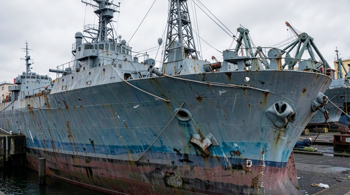
Furthermore, structural remediation poses significant regulatory and financial challenges. Aging naval assets frequently contain toxic materials, including asbestos, lead paint, and polychlorinated biphenyls (PCBs) 8. The disposal of nuclear-powered warships, such as the ex-USS Enterprise (CVN-65) or the cruiser USS Long Beach, presents even greater complexity due to radiological concerns 10 11. Dismantling these nuclear-powered giants requires specialized commercial contracts, with costs reaching $418.5 million for commercial shipbreakers to complete safe dismantlement, recycling, and disposal 12 11.
International Transfers and Bilateral Defense Agreements
Significant naval assets that are not sold to commercial breakers are often transferred through government-to-government bilateral agreements. For example, the Italian Parliament approved the non-compensated transfer of the decommissioned aircraft carrier Giuseppe Garibaldi (C-551) to Indonesia 13. This transfer allowed Italy to eliminate approximately 5 million euros in annual maintenance and security costs, while avoiding an estimated 19 million euros in dismantling fees 13. Indonesia plans to integrate this vessel to support its regional maritime helicopter and unmanned aerial vehicle capabilities 14.
Similarly, countries like Japan have adjusted their legal frameworks, including proposed revisions to the Self-Defense Forces Law, to permit the transfer of retired destroyers and submarines to Southeast Asian partners like the Philippines 15 16. These low-cost or non-compensated transfers serve to bolster regional security networks and repurpose equipment that would otherwise face expensive domestic storage or dismantling 15. Even major military powers leverage these international surplus markets; for instance, the U.S. Navy historically acquired retired Japanese military helicopters for $67,000 to harvest critical spare parts for its MH-53E Sea Dragon fleet 2.
Environmental Liabilities and Maritime Abandonment Laws
Individual buyers who acquire surplus or derelict vessels without conducting proper due diligence face severe legal and financial risks. Under maritime law, claiming an abandoned boat is highly regulated, and unauthorized possession of a vessel can result in criminal charges under federal theft statutes such as 18 U.S.C. Section 2311 17. A boat that appears abandoned may still have registered owners, active liens, or lender claims that must be legally resolved through formal title procedures 17 4.
Inadequate planning can lead to catastrophic environmental liabilities. A prime example is the Pacific Producer, an 80-year-old retired steel vessel that was left floating in Commencement Bay, Tacoma 18. After ecological inspections revealed dangerous ammonia leaks and flooding, state and federal agencies had to intervene 18. Ultimately, Washington's Derelict Vessel Removal Program spent $3.9 million to destroy the ship, absorbing nearly 40% of its biennial budget 19. When private restoration plans fail, regional authorities often resort to sinking decommissioned hulls, such as the 120-foot torpedo retriever HAZAR, to serve as offshore artificial reefs 20 21.
Sources
- Seaspension
- Indian Strategic Studies
- Luftfahrtmagazin
- Green Tree Search
- LegalClarity
- Schedule2026
- Okdiario
- Automotive Body Care
- National Security Journal
- The War Zone
- Defence Industry Europe
- Govcon Feed
- The Defense News
- VPK.name
- UPI.com
- USNI News
- Passage Maker Mag
- Salem Reporter
- ICT News
- Post and Courier (Reefing preparation)
- Post and Courier (SCDNR removal)
Authored by 24Trendz team