Military surplus heavy duty camping equipment: Durability Standards and Material Specifications for Wilderness Survival
When planning for extended wilderness exposure, choosing authentic Military surplus heavy duty camping equipment is critical for safety and operational endurance. Unlike commercial gear that prioritize minimalist weight reduction over structural integrity, government-procured tactical equipment is engineered to withstand extreme physical abuse across unforgiving environments, from frozen arctic landscapes to dry desert terrains 1. This analysis reviews the performance specifications of military-grade shelters, sleeping configurations, and specialized load-bearing setups used for heavy-duty field applications.
The Engineering Heritage of Tactical Field Gear
Military field gear is designed with the primary understanding that equipment failure in remote outdoor environments can quickly lead to life-threatening scenarios. Every structural element carried by modern military personnel is the result of continuous refinement through multiple procurement cycles, field reports, and lessons learned from challenging environments 1. This design philosophy produces durable gear that is available on the surplus market, offering survivalists and wilderness researchers robust solutions at a lower cost than premium commercial gear 1, 2.
True military surplus equipment is defined by its government-issue heritage and precise manufacturing lineage rather than decorative aesthetics 1. While many commercial brands market items painted in olive drab or desert tan as tactical, genuine surplus items are built to rigid standards, including specific National Stock Numbers (NSN) 1, 3. Sourcing these products requires careful inspection, as authentic gear is designed to perform reliably under severe stresses that would compromise standard recreational gear 1.
High-Capacity Modular Shelters and Expedition Tents
Large-scale group shelters represent some of the most robust designs found in the surplus inventory. Systems such as the HDT Base-X Model 505 provide a substantial workspace of 625 square feet and a clear span of 25.25 feet, using a patented folding frame and dual-layer design to create an insulating thermal barrier 4. Similarly, the 15-man ArctiX Shelter utilizes an articulating frame built from aircraft-grade aluminum, allowing for rapid deployment in extreme sub-zero conditions without the need for pre-bent or extension poles 5.
For heavy-duty deployment, the Modular General Purpose Tent System (MGPTS) features a tensioned-fabric design that eliminates central poles, maximizing usable interior space for tactical operations or field hospitals 6. Engineered to withstand 35 mph wind-driven rain and steady winds of 55 mph, this system supports snow loads of up to 10 pounds per square foot for a 12-hour period, showing its resilience in harsh climates 6.
Personal Bivouacs and Solo Shelter Technologies
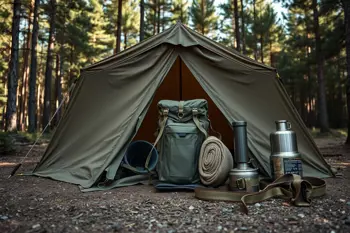
For individual shelter, modular options like the Original Dutch Military DPM Individual Shelter offer excellent weather protection 3. Instead of thin, loud synthetic fabrics common in modern recreational tents, this shelter is built from heavy polycotton canvas 3. This material provides natural breathability to prevent condensation buildup while maintaining a highly water-repellent exterior, creating a quiet and exceptionally durable personal fortress in the field 3.
The Dutch DPM shelter features a lateral heavy-duty zipper system that allows users to link multiple tents together to construct a larger, shared bivouac space while preserving individual footprints 3. With an NSN of 8340-17-106-6375, the shelter includes an integrated bathtub groundsheet made of reinforced polyester, ensuring that the occupant's sleep setup remains entirely dry even when pitched on saturated or swampy terrain 3.
All-Weather Sleep Systems and Thermal Insulation
Sleep systems engineered for military deployment focus on thermal efficiency and modularity. The U.S. Military Modular Sleeping Bag System, or Extreme Cold Weather Sleep System (ECWS), is a versatile cold-weather sleep setup consisting of four primary components 7. This setup includes a lightweight patrol bag for temperate conditions, an intermediate cold-weather bag, a waterproof Gore-Tex bivy cover, and a compression stuff sack to store the complete assembly 7.
For simpler insulation, traditional gear such as the Canadian wool blanket offers a durable thermal barrier measuring 84.5 inches by 61 inches 2. These traditional textiles are frequently paired with heavy-duty foam mats, such as the Coyote ThermaRest folding foam mat or self-inflating foliage sleep mats, to isolate the sleeper's body from frozen or damp ground during cold-weather operations 8.
Advanced Load-Bearing Systems and Rucksack Construction
Transporting heavy gear over rugged terrain requires specialized load-bearing systems. The USGI MOLLE II Large Rucksack, made from heavy-duty 1000D Cordura nylon, is designed to support loads between 60 and 120 pounds 9. It features external MOLLE webbing for modular attachments and a padded suspension system that distributes weight across the hips and shoulders to reduce physical fatigue 9. This system represents a major upgrade over the older metal-framed ALICE packs 9, 10.
The USMC Gen 2 ILBE APB03 Field Pack, designed by Arc'teryx and produced by Propper International, offers a 4,500 cubic inch main compartment built from 720D Cordura fabric 11. This system utilizes an internal frame with metal ribs and central spars to balance heavy loads during extended marches 11. The following table compares the design specifications of these primary military load-bearing systems:
| Specification | USGI MOLLE II Large Rucksack | USMC Gen 2 ILBE APB03 |
|---|---|---|
| Primary Material | 1000D Cordura Nylon 9 | 720D Cordura Fabric 11 |
| Capacity | 4,000+ cubic inches 9 | 4,500 cubic inches 11 |
| Load Capacity | 60 to 120 pounds 9 | Up to 120 pounds 11 |
| Frame Style | External polymer frame 9 | Internal frame with aluminum spars 11 |
Field Hydration, Heating, and Tactical Stove Systems
Hydration and field cooking systems are designed to nest together to save vital pack space. The traditional 4-Piece Canteen Kit, produced by manufacturers like Rothco, integrates a 1-quart plastic canteen, a stainless steel cup with butterfly handles, a nesting cup stove, and a MOLLE-compatible cover into a single unit 1, 8. This design allows campers to boil water and prepare field rations efficiently using minimal physical space 1.
For larger heating needs in winter tents, dedicated wood-burning heaters like the KingCamp Surefire stove provide robust and clean warmth 12. Constructed from heavy-duty stainless steel, this portable heater features a 2.7-meter chimney system to safely draft smoke out of the tent's stove jack, maintaining a clean and warm interior environment during cold-weather expeditions 12.
Sources
- Military Machine
- Swiss Link
- Swiss Link Blog
- General Jim's Surplus - Base-X 505
- General Jim's Surplus - ArctiX Shelter
- Deployed Logix - MGPTS
- Hornets Central - ECWS Sleep System
- Military Outdoor Clothing
- Fury28
- PNA Surplus
- B and M Military Surplus
- KingCamp Outdoors
Authored by 24Trendz team