Best Tai Chi Classes Near Me: A Report on Local Formats, Instructors, and Practical Fit
People searching for “Best Tai Chi Classes Near Me” are generally trying to identify a suitable local class rather than a single universally superior provider. Available listings show substantial variation in style, setting, skill level, schedule, instructor background, tuition structure, and whether the emphasis is wellness, meditation, balance training, or martial arts. The examples below are geographically diverse and should be treated as documented class models, not as a live local directory.
How local Tai Chi classes differ
Tai Chi is a low-impact martial art commonly practiced for stress reduction, balance, flexibility, coordination, and general wellbeing. The American Tai Chi and Qigong Association maintains a searchable database of instructors and schools, while the Tai Chi for Health Institute publishes training and certification standards. These resources can help with background checks, although a directory entry or credential does not by itself establish that a class is appropriate for every participant. 1 2
Class labels often refer to Yang, Chen, or Sun styles, which can differ in pace, posture, physical intensity, and technical content. Community centers, YMCA programs, park districts, municipal recreation departments, meditation centers, and specialist martial arts schools may all use the term Tai Chi while teaching different forms. Harvard Health describes the practice as “meditation in motion,” reflecting its combination of deliberate movement, breathing, and focused attention. 3 4
Documented beginner and multi-level formats
Several current listings explicitly accommodate beginners. Just Breathe Tai Chi documents a Monday evening, 15-class Yang-style session in Burke, Virginia, scheduled from May 4 through August 24, 2026, with 16 movements and Tai Chi Walking. The class is described as beginner, advanced, and multi-level, with modifications for physical considerations and an occasional weather-related online session. 5
Norwich Qwan Ki Do lists Wednesday sessions for adults of all ages and abilities, including many students aged 50 and over. Its published schedule shows one-hour classes at 18:00 and 19:00, with a beginner-friendly, small-group teaching approach. Instructor Nicolae Popan is identified as a 3rd Dang Black Belt in Qwan Ki Do with more than 15 years of Tai Chi and Qi Gong training under Master Pham Xuan Tong. 6
Examples of class settings and schedules
Documented schedules cover several useful patterns for local searches. New York Insight Meditation Center lists an in-person Wednesday session from 5:30 to 6:30 p.m. at 115 West 29th Street in Manhattan, running through September 2026. The stated format welcomes people without previous experience and allows participation in one session or multiple sessions within the series. 7
Dharma Drum Mountain Chicago lists recurring Wednesday evening classes from 6:30 to 7:30 p.m. at its Chicago chapter, with dates extending from August 2026 into 2027. In Atlanta, USA Chen Taiji Center identifies class locations in Dunwoody, Norcross, and Sandy Springs, including beginner classes at City Green. These examples show why distance, transportation, weather arrangements, and schedule continuity matter as much as a class title. 8 9
Health-focused and balance-oriented instruction
Health goals are a major reason people compare Tai Chi classes. The Centers for Disease Control and Prevention identifies Tai Chi as an evidence-based activity for reducing fall risk among older adults, and the National Center for Complementary and Integrative Health describes Tai Chi as a practice that may support health and wellbeing. These findings do not replace clinical advice, particularly for people with recent injuries, serious balance limitations, or conditions affecting movement. 10 11
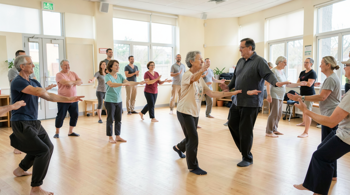
Chicago Tai Chi’s documented Level 1 course is specifically framed around balance, stability, posture, leg and hip strength, body awareness, and practical fall-avoidance strategies. Sonoma Community Center describes its Beginning Yang-Style class as a meditative practice for all levels, with stated aims that include balance, stability, stress reduction, body awareness, and restoring energy. Such descriptions help distinguish a fall-prevention course from a traditional form class, even when both use gentle movements. 12 13
Instructor credentials and teaching structure
Instructor background is relevant because Tai Chi classes can range from recreational wellness sessions to lineage-based martial arts training. Balance and Flow Studio describes a structured Yang Family Tai Chi Chuan progression beginning with posture, alignment, stepping, balance, and whole-body coordination. Its Level 1 class is presented as suitable for people without prior experience, with possible progression into partner work, weapons forms, and formal ranking. 14
Credential terms should be read carefully. The supplied listings identify experience, rank, lineage, and association with training bodies, but they do not establish a single universal regulatory system for all instructors. A practical assessment includes asking how beginners are grouped, whether movements can be modified, how falls or pain are handled, and whether the teacher distinguishes exercise instruction from medical treatment. Tai Chi for Health Institute standards and the American Tai Chi and Qigong Association directory are reference points, not substitutes for personal assessment. 1 2
Practical risks and selection criteria
Potential friction points include inconsistent attendance, weather interruptions, unfamiliar terminology, unsuitable pace, and the possibility that a class’s advertised emphasis differs from a participant’s needs. Duality Fitness in Sandton, South Africa, documents outdoor sessions six mornings per week at Ernest Ullmann Park, with covered studio space when weather changes. Outdoor access can be appealing, but location, surface conditions, temperature, and transport should be considered before committing to a recurring schedule. 15
Before selecting a nearby class, the most useful comparison points are the following:
- Style and form: Yang, Chen, Sun, 16 movements, or another stated sequence.
- Purpose: general wellness, meditation, martial arts, mobility, or fall prevention.
- Level: beginner-only, mixed-level, or a structured progression.
- Setting: library, community center, studio, park, meditation center, or church.
- Continuity: weekly dates, seasonal enrollment, weather policy, and online alternatives.
- Instructional safeguards: modifications, pacing, balance support, and clear boundaries around medical claims.
Local park and recreation departments, YMCA programs, community wellness catalogs, martial arts schools, and national instructor directories are common places to investigate availability. Because class schedules and terms can change, published details should be verified with the named organization before attendance. Online videos from platforms such as Gaiam and YouTube may supplement practice, but they do not provide the same real-time correction, supervision, or adaptation as an in-person class. 16 17
Sources
- American Tai Chi and Qigong Association, https://www.americantaichi.net/
- Tai Chi for Health Institute, https://taichiforhealthinstitute.org/
- Harvard Health Publishing, https://www.health.harvard.edu/staying-healthy/the-health-benefits-of-tai-chi
- National Recreation and Park Association, https://www.nrpa.org/
- Just Breathe Tai Chi, https://justbreathetaichi.com/tai-chi-classes-burke-va-16-movements-mon-may-aug-2026/
- Qwan Ki Do UK, https://qwankido.co.uk/tai-chi-norwich/
- New York Insight Meditation Center, https://www.nyimc.org/event/tai-chi-9-2-26/
- Dharma Drum Mountain Chicago, https://www.ddmbachicago.org/event/tai-chi-class-2026/
- USA Chen Taiji Center, https://www.usachentaijicenter.com/
- Centers for Disease Control and Prevention, https://www.cdc.gov/steadi/pdf/Tai_Chi_Fact_Sheet-508.pdf
- National Center for Complementary and Integrative Health, https://www.nccih.nih.gov/health/tai-chi-what-you-need-to-know
- Chicago Tai Chi, https://www.chicagotaichi.org/tcfb-level-1-q2-2026-course-sales-page/
- Sonoma Community Center, https://sonomacommunitycenter.org/programs/beginning-yang-style-tai-chi/2026-09-03/
- Balance and Flow Studio, https://balanceandflowstudio.com/traditional-tai-chi-classes/
- Duality Fitness, https://duality-fitness.com/tai-chi-classes-sandton/
- YMCA, https://www.ymca.org/
- Verywell Health, https://www.verywellhealth.com/tai-chi-5082046
Authored by 24Trendz team