8 Effortless Hairstyles for Women Over 60: A Practical Style Analysis
What Makes a Hairstyle Effortless
An effortless hairstyle is shaped to work with the wearer’s natural texture, rather than requiring prolonged heat styling or elaborate techniques. Guidance across mature-hair references consistently emphasizes practical silhouettes, including short crops, bobs, layered lobs, and movement-focused cuts. Hair may become finer, drier, less dense, or more unpredictable with age, so the most useful approach is to select a structure that supports the existing texture instead of forcing it into an unrelated shape. 1
- Blunt or carefully protected ends can help fine hair appear denser.
- Strategic crown layering can create the appearance of lift.
- Natural waves and curls generally benefit from texture-specific shaping.
- Side-swept fringe can soften the forehead and frame the eyes.
1. Soft Pixie Cut
A soft pixie is among the most practical short options because its compact shape reduces drying and styling time. References recommend leaving enough length through the crown to create lift, while a side-swept fringe can add softness around the face. The cut can be adapted for straight, slightly wavy, or textured hair, although excessively thinned layers may make fine hair look less substantial. Finger styling with a small amount of cream or mousse is generally consistent with the low-maintenance purpose of this shape. 2
- Useful for people who prefer a short, structured outline.
- Works particularly well when crown volume is built into the cut.
- Requires regular shaping to keep the cropped silhouette intentional.
2. Chin-Length Blunt Bob
A chin-length blunt bob creates a clear perimeter that can make fine hair look fuller without extensive styling. The weight concentrated at the ends helps the shape retain definition, while a deep or side part can provide additional visual lift at the crown. This bob can suit straight, wavy, or lightly curly hair when the length and graduation are adjusted to the texture. Its face-framing position also gives a polished appearance while retaining enough length for simple changes in parting. 5
- Ask for a strong edge when the goal is a denser-looking outline.
- Use subtle graduation if the hair needs additional fullness near the back.
- Consider a side part for a softer, less symmetrical finish.
3. Air-Dried Flipped Lob
An air-dried flipped lob reaches approximately the shoulders and uses softly bending or flipped ends to create movement without requiring a precise blowout. Its medium length preserves styling flexibility, while light layering can prevent the shape from appearing heavy. The style can be adjusted for straight, wavy, or slightly curly hair by changing the amount of layering and the direction of the ends. It is a practical middle ground for someone who wants more length than a bob but less daily work than a long, highly styled cut. 3
- Suitable for a natural bend that becomes visible as the hair dries.
- Shoulder-skimming length allows simple part changes and restrained waves.
- Light layering helps remove weight without sacrificing the outline.
4. Layered Lob
A layered lob, or long bob, usually sits near the shoulders and uses soft layers to add movement around the face and through the ends. The shape is suitable for straight and wavy hair and can be worn smooth or with loose waves. For fine hair, the layers should be controlled rather than heavily feathered, since removing too much density can make the ends appear sparse. This option balances a contemporary appearance with enough length for a ponytail or other uncomplicated arrangement. 8
- Provides more versatility than a short crop while remaining relatively manageable.
- Face-framing layers can be placed to soften or emphasize specific features.
- Works best when the stylist protects fullness at the perimeter.
5. Textured Shag or Cropped Shag
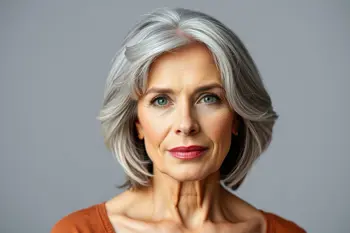
A textured shag uses graduated, piecey layers to encourage movement and reduce the need for precise styling. A cropped version combines the relaxed character of a shag with a shorter outline, making it suitable for people who want texture without shoulder-length hair. The style can be particularly compatible with naturally wavy or coarse gray hair because existing movement helps support the shape. However, random thinning is not the same as purposeful texture, and over-texturizing may reduce the visual density of fine hair. 6
- Best suited to hair that already has wave, bend, or coarse texture.
- Piecey ends can be defined with a small amount of styling cream.
- Fine hair requires selective texturizing rather than extensive thinning.
6. Wash-and-Wear Curly or Wavy Cut
A wash-and-wear cut for curly or wavy hair is designed around the pattern that appears naturally after washing. Tailored layers can prevent curls from becoming weighed down, while the correct shape distributes volume rather than flattening it at the crown. The central consideration is compatibility: a cut created for straight hair may not fall properly when curls contract or waves expand. Air-drying can preserve the intended movement, with a small amount of product used to define texture when necessary. 7
- Layer placement should reflect curl shrinkage and natural volume.
- Heavy, uniform lengths can make textured hair appear broader or flatter.
- Natural movement is the primary styling feature, not a flaw to remove.
7. Short Tapered Gray Cut
A short tapered cut narrows gradually toward the neckline and sides while retaining controlled length on top. This structure can make gray hair appear polished and reduce the amount of hair that must be dried or shaped each morning. Gray strands may have a different texture from previously pigmented hair, so the cut should account for coarseness, dryness, or irregular movement. A tapered silhouette can be softened with a side-swept top or lightly separated pieces rather than a rigid, highly sculpted finish. 9
- Creates a clean neckline while preserving styling flexibility at the crown.
- Can emphasize natural silver color through a defined shape.
- Benefits from moisturizing care when gray strands feel dry or coarse.
8. Rounded Bubble Bob
A rounded bubble bob has a softly curved silhouette that gives chin-length hair an immediately organized appearance. Internal layers or gentle graduation can be used to tailor fullness for finer or thicker hair, while the rounded outline supplies much of the style without complex styling. It is distinct from a severely geometric bob because the contour is softened and slightly lifted. The result can work for someone seeking a playful, polished shape that remains visually complete after air-drying or a brief blow-dry. 3
- Rounded graduation can increase the impression of fullness.
- The contour should be adjusted to the wearer’s density and face shape.
- Soft ends prevent the style from appearing overly rigid.
Maintenance, Fit, and Potential Drawbacks
Low-maintenance does not mean maintenance-free. Short cuts, bobs, and layered shapes gradually lose their intended proportions as they grow, and references commonly identify six to eight weeks as a practical interval for preserving the structure of some short-to-medium cuts. Hair type, growth rate, density, and personal tolerance determine the actual schedule. Before choosing a style, the key questions concern daily styling time, natural texture, face framing, and whether the wearer wants enough length for tying back. 4
- Bring reference photos, but ask whether the pictured texture matches the wearer’s own hair.
- Avoid excessive thinning when fine or thinning hair needs a fuller perimeter.
- Discuss crown volume, fringe length, gray texture, and air-drying expectations with the stylist.
- Choose a cut that remains presentable between appointments, not only immediately after one.
Sources
- The Pioneer Woman
- Numi Hair
- SheFinds
- Style Blooming
- Glam Hair Nails
- ShineFits
- InStyluxe
- Style Shears
- Serene Hair Lounge
- PIED-DE-POULE
Authored by 24Trendz team