Vibration Plate Exercise Machines: A Consumer's Analytical Guide to How They Work, What the Research Says, and What to Consider Before Buying
Vibration plate exercise machines are generating substantial consumer interest, appearing in home workout setups, wellness studios, and physical therapy environments alike. These motorized platforms deliver rapid, whole-body vibrations designed to stimulate muscle contractions, and their manufacturers market them for applications ranging from circulation support to bone density improvement. Consumer Reports tested six vibration plates in 2026, concluding that four of the six models performed well, while one lower-tier model produced a burning plastic smell during testing, underscoring the importance of understanding product quality variation before any purchase. 1
How Vibration Plate Exercise Machines Work
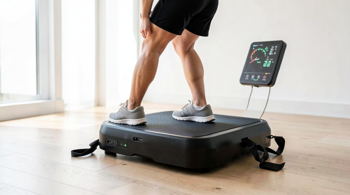
A vibration plate exercise machine consists of a motorized platform that generates oscillatory motion, which passes through the body of anyone standing, sitting, or exercising on its surface. These vibrations cause muscles to contract and relax rapidly, similar to the body's natural reflex response, while also forcing the central nervous system to maintain postural stability against the motion. 2 According to John Snellings, MD, professor and chair of Family and Community Medicine at Old Dominion University, these repeated contractions represent the primary mechanism through which vibration training may amplify the effects of simple movements, potentially making short sessions more effective than equivalent static exercises. 3
Machines on the market fall into two primary categories: oscillating platforms, which pivot side-to-side in a seesaw motion, and lineal platforms, which generate a straight vertical pulse. Fitness-grade vibration plates typically operate within a frequency range of 5 to 50 Hz, a range considered appropriate for muscle activation, circulation, and lymphatic flow applications rather than the high-intensity industrial vibration exposure that raises occupational health concerns. 4 Most manufacturers cap recommended continuous use at approximately 30 minutes per session, with general guidance suggesting users begin with shorter intervals of 10 to 15 minutes, three times per week. 5
What the Research Actually Confirms
The evidence base surrounding vibration plate exercise machines is real but limited in scope. Clinical research suggests that whole-body vibration therapy may assist in improving bone density, balance, and muscle strength, particularly in older populations. 5 GoodRx reports that studies indicate whole-body vibration training increases circulation, strengthens muscles, and supports exercise recovery, though researchers consistently note that the overall body of evidence remains relatively narrow. 6 Conner Lorenzo, Director of Fitness Science at University of Rochester Medicine's Orthopaedics and Physical Performance, states directly that there is little evidence vibration plates alone lead to significant fat loss or muscle gain, and that traditional exercises such as walking, strength training, and resistance work remain the most effective tools for building fitness. 2
One physiological effect with consistent anecdotal and clinical support involves circulation and lymphatic flow. Health coach Robin Laird, reporting after a six-month trial, noted that vibration plate sessions reliably stimulated digestion, a reflection of how the mechanical energy affects internal tissue and fluid movement. 4 Research also suggests that performing exercises such as squats, lunges, push-ups, and planks on a vibrating surface can increase electromyographic activity in engaged muscle groups compared with performing the same movements on a solid surface, offering a measurable supplemental benefit when plates are combined with active exercise rather than passive standing. 5
Market Segments and Specification Ranges
The vibration plate market spans a wide range of price points and technical configurations. Entry-level consumer models occupy the lower end of the spectrum, with units from brands such as Costway listing at approximately $82, offering 10 adjustable speed levels and gravity sensor detection in a compact 13-pound frame that supports up to 440 pounds. 7 Mid-tier home options, such as the Lifepro Waver, operate with a 200W motor, 99 speed levels reaching approximately 12 Hz, and an amplitude range of 0 to 8 mm, supporting users up to 330 pounds and retailing around $199. 8 The Lifepro Rumblex Plus 4D steps further with a triple-motor configuration totaling 640W, combining oscillation, lateral, and pulsation vibration patterns across 60 speeds ranging from 4 to 40 Hz, with a weight capacity of 500 pounds. 9
At the professional end of the spectrum, the Power Plate pro8 features a frequency range of 25 to 50 Hz adjustable in 1 Hz increments, integrated LCD touchscreen controls, electronically controlled resistance cables, over 250 coach-led built-in workout programs, a library of more than 1,000 unique technique videos, and 12 supported languages, listed at $16,495. 10 The Power Plate my8, designed for advanced home use, operates across 30 to 45 Hz with retractable proMOTION resistance cables and lists at $10,495. 11 The Power Plate MOVE, widely reviewed as the brand's most popular home model with 943 reviews at a 4.9 rating, offers 6 variable frequency modes in a columnless design that supports 300 pounds, listed at approximately $3,720. 12
Key Specifications to Evaluate
Understanding the technical terminology in product listings helps consumers compare machines on meaningful criteria rather than marketing language. Frequency, measured in Hz, determines how many vibration cycles occur per second; a broader adjustable range offers more versatility for different training goals. Amplitude, measured in millimeters, indicates the displacement distance of the platform surface; larger amplitude values generally correspond to more intense muscle recruitment. Motor wattage provides a proxy for platform stability under load, with higher wattage motors typically maintaining consistent vibration quality during dynamic movement rather than only passive standing.
- Frequency range: Consumer models typically span 5 to 50 Hz; narrower ranges limit training versatility
- Amplitude: Ranges from approximately 1.5 mm on lateral motors to 12 mm on oscillating platforms in mid-tier machines
- Weight capacity: Varies widely, from 265 pounds on compact units to 500 pounds on larger multi-motor models
- Vibration modes: Entry-level units offer oscillating only; advanced models combine oscillation, lateral, and vertical pulsation
- Included accessories: Resistance bands, remote controls, and exercise mats are common additions across most price tiers
- Noise output: Quieter motors, often described as operating below 40 dB, are relevant for apartment or shared-space use
Safety Considerations and Contraindications
Health regulatory bodies generally classify vibration plate exercise machines as exercise equipment rather than medical devices, meaning no clinically guaranteed outcomes apply to all users. 5 University of Rochester Medicine advises that people with back pain, sciatica, balance problems, or certain medical conditions speak with a healthcare provider before beginning vibration plate training. 2 Established contraindications documented by manufacturers and medical guidance include pregnancy, the presence of cardiac pacemakers, recovery from recent surgery, and acute joint injuries. 5
Consumer Reports' expert testing in 2026 identified comfort and stability as the primary differentiators between well-performing models and those that underperformed, noting that one lower-cost machine generated a burning plastic odor during use, a meaningful safety and durability concern. 1 GoodRx notes that vibration plate training is generally safe for the broader population but emphasizes that individuals who are pregnant, recovering from surgery, or managing heart conditions should not use these machines without a medical professional's prior approval. 6 Starting at the lowest available intensity setting and progressively increasing frequency or duration over multiple weeks represents standard harm-reduction practice across medical and manufacturer guidance.
Practical Usage and Realistic Expectations
Research and expert commentary consistently indicate that vibration plates produce the most measurable outcomes when combined with active exercises rather than used as passive standing devices. Performing bodyweight squats, lunges, calf raises, or push-up variations on the platform amplifies muscle recruitment compared with stationary use alone. 3 Standard usage protocols recommend starting with 10 to 15 minute sessions before gradually extending duration, a guideline reflected across commercial product manuals from Lifepro, Nautilus, and Hophorse. 8 The Nautilus Vibratone, for example, promotes 10-minute sessions as the baseline starting point, combining its 120 speed levels and 4 preset programs with Bluetooth audio to encourage consistent session structure. 13
Calorie expenditure from passive standing on a vibration plate is modest, roughly comparable to a slow walk, and the machines are not positioned by medical evidence as standalone weight loss solutions. 4 However, for populations with mobility limitations, post-rehabilitation needs, or those seeking low-impact supplemental movement, vibration plates represent a documented option with a measurable physiological effect on circulation and neuromuscular activation. Warranty terms vary significantly by brand, ranging from 90-day limited warranties on entry-level models to lifetime warranties offered by brands such as Lifepro, making warranty coverage a practical evaluation criterion alongside technical specifications. 8
Sources
- Consumer Reports - Best Vibration Plates of 2026, Tested by Experts (consumerreports.org)
- University of Rochester Medicine - Vibration Plates: Hot Fitness Trend, But Do They Work? (urmc.rochester.edu)
- Old Dominion University - Vibration Plate Machines Are Trending, But Are They Actually Good for Your Health? (odu.edu)
- News and Observer - Vibration Plate Benefits, Risks and Who Should Skip It (newsobserver.com)
- General LLM Research Data - Clinical and Regulatory Overview of Whole-Body Vibration Equipment
- GoodRx - 7 Vibration Plate Benefits Your Whole Body Will Love (goodrx.com)
- Costway - Vibration Plate Exercise Machine with Gravity Sensor and Remote Control (costway.com)
- Lifepro - Waver Vibration Plate Product Specifications (lifeprofitness.com)
- Lifepro - Rumblex Plus 4D Vibration Plate Product Specifications (lifeprofitness.com)
- Power Plate - pro8 Product Specifications (powerplate.com)
- Power Plate - my8 Product Specifications (powerplate.com)
- Power Plate - MOVE Product Specifications (powerplate.com)
- Nautilus - VIBRATONE Vibration Board Product Specifications (nautilus.com)
Authored by 24Trendz team