Heavy Duty Punching Bag Stands: Engineering, Stability, and Selection Guide
Optimizing a home gym or commercial combat training space requires highly stable equipment capable of absorbing significant kinetic forces. For athletes and facility operators who cannot suspend equipment directly from a ceiling or wall, heavy duty punching bag stands serve as a critical structural alternative. These standalone frameworks must support high-impact strikes from various martial arts disciplines without tipping, sliding, or flexing excessively under load.
Understanding the structural engineering, weight capacities, and spatial footprints of modern freestanding frames is essential to selecting a system that ensures both athlete safety and equipment longevity. This guide examines the design principles, material standards, and structural configurations of contemporary steel bag stands utilized in modern combat training.
Steel Thickness and Tubing Specifications
The primary indicator of a training stand's structural integrity is the gauge and profile of its steel tubing. Industrial-grade stands are typically manufactured from heavy-gauge steel ranging from 11-gauge to 14-gauge tubing to resist bending and structural fatigue 1. For example, professional single-tree designs often employ 4-inch by 4-inch 11-gauge steel tubing 2, while other stable designs utilize 3-inch round steel frames with a thickness of approximately 3mm 3. This dense metal construction ensures the main mast remains rigid during heavy combat workouts.
To protect the steel from oxidation caused by perspiration and environmental humidity, manufacturers apply specialized finishes. Most commercial-grade frames are finished with an epoxy powder coat 4. This dry powder is applied electrostatically and cured under heat to create a hard, scratch-resistant barrier that allows some models to be utilized in semi-outdoor or garage environments 5.
Weight Capacities and Structural Load Limits
Heavy duty stands are engineered to support various load classes. Standard consumer-grade frames typically accommodate heavy bags weighing up to 100 pounds 4
Using a bag that exceeds a stand's rated limit introduces structural risks, including metal fatigue, weld cracking, and joint failure. It is also important to account for dynamic loading. A 100-pound bag struck with high velocity exerts a peak dynamic force that far exceeds its static weight. High-capacity stands utilize reinforced gusseted footplates and robust bolt-together connections to safely distribute these sudden energy spikes 2.
Footprint Requirements and Spatial Clearance
Freestanding boxing frames require significant floor space to accommodate both the base of the stand and the swing radius of the bag. A standard single-station heavy bag stand typically features a footprint of approximately 55 inches by 68 inches 4 or 47.6 inches by 57 inches 5. More expansive multi-station rigs can demand footprints stretching up to 66 inches deep by 48 inches wide 10, or require base dimensions of 233 cm by 140 cm 11.
| Stand Model / Type | Footprint Dimensions | Height Clearance | Maximum Bag Capacity |
|---|---|---|---|
| Standard Single Station Frame | 55" x 68" | 89" (7.4 ft) | 100 lbs |
| Adjustable Single-Tree Mast | Compact (12" x 12" base) | 88" or 102" | 300 lbs |
| Multi-Station Platform (3-Station) | 66" x 48" | 94" (7.8 ft) | 100 lbs (main bag) |
| Versatile Home Gym Frame | 233 cm x 140 cm | 233 cm (7.6 ft) | 121 lbs (55 kg) |
Ceiling height is another crucial variable. Most residential heavy bag stands are engineered to fit within standard 8-foot (96-inch) ceilings, standing between 84 and 89 inches tall 4
Stability Systems and Counterweight Methods
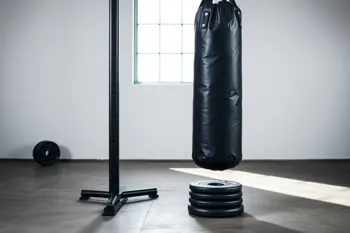
Freestanding frames are subject to shifting, sliding, or tipping during intense training sessions. To mitigate this kinetic energy, manufacturers employ various stabilization strategies. One common approach is integrating heavy-duty steel peg tubes on the base legs
For permanent or high-impact installations, structural anchoring is the most secure option. Premium single-tree masts and commercial frames feature pre-drilled bolt holes in the base plate, allowing them to be secured directly into concrete subfloors
Multi-Station and Hybrid Platform Configurations
To maximize utility within a limited footprint, many heavy duty stands feature multi-functional, hybrid configurations. These multi-station units combine a primary heavy bag station with secondary training attachments, such as speed bag platforms, double-end striking bag loops, pull-up bars, or dip stations
However, multi-station designs introduce unique balance and vibration challenges. A strike delivered to a speed bag can cause a poorly welded frame to vibrate, disrupting the rhythm of the speed bag rebound. To counter this, premium dual-station platforms utilize thick, solid hardwood drums (typically maple, measuring 1.25 to 1.75 inches thick)
Potential Operational and Maintenance Challenges
While heavy duty stands provide excellent training flexibility, they also present several operational challenges that buyers must consider. First, many residential designs feature frame supports that run directly beneath the hanging bag. This layout can restrict an athlete's footwork, presenting a tripping hazard or preventing 360-degree movement around the bag
Additionally, modular stands require periodic maintenance. The repetitive vibrations from heavy strikes can loosen connection bolts over time, leading to structural play and increased noise. Regular inspections of the locking pins, swivels, and base bolts are required to keep the stand safe and stable. Finally, users must calculate the total loaded weight of their setup-including the stand, hanging bags, and counterweight plates-to ensure it does not exceed the load-bearing limits of residential subfloors.
Sources
- REP Fitness
- Titan Fitness
- Flaman Fitness
- MAGMA Fitness
- BENZA SPORTS Toronto
- Century Martial Arts
- Until Times Up
- Keep Body Health
- PROLAST
- TITLE Boxing
- Decathlon Saudi Arabia
- Balazs Boxing (UBS)
- Balazs Boxing (i-Box)
- Tuf Wear Direct
Authored by 24Trendz team