A guide to purchasing ex-military uniforms wholesale: What Buyers Need to Know Before Sourcing Surplus Apparel in Bulk
Wholesale buyers seeking ex-military uniforms encounter a market shaped by government disposal cycles, condition-based pricing tiers, and regulatory frameworks that differ substantially from standard apparel sourcing. According to the Defense Logistics Agency's 2023 Annual Report, the U.S. government disposed of over $4.2 billion in surplus property in a single year, a figure that underscores both the scale of available inventory and the complexity of acquiring it systematically. 1 Understanding the supply chain behind that disposal process is the essential first step for any wholesale buyer entering this category.
Where Ex-Military Uniforms Enter the Wholesale Market
Ex-military uniforms flow into the wholesale market through two distinct pathways. The primary channel is the Defense Logistics Agency (DLA) Disposition Services, the government body that manages the formal transfer of excess military property. 2 The DLA routes surplus to eligible state agencies, nonprofits, and federal programs before opening remaining inventory to commercial disposal. Most wholesale buyers do not access DLA directly; instead, they source from secondary surplus liquidators who acquire inventory through government auction platforms. 3
GSA Auctions, operated by the U.S. General Services Administration, provides the general public with electronic bidding access to federal surplus assets, including military apparel and uniform lots. 4 Registered participants can bid on single items or grouped lots within specified time windows. Payment methods accepted through GSA Auctions include wire transfers, government-issued checks, and major credit cards, though credit card purchases are capped at $24,999.99 per transaction. 4 Beyond GSA, platforms such as GovLiquidation.com operate as authorized sales contractors specifically for government surplus, including military uniforms sold in palletized bulk quantities. 5
Condition Grading and Pricing Benchmarks
Wholesale pricing for ex-military uniforms is directly tied to a condition grading system that classifies items from new and unissued through serviceable used grades. Common designations include New/Unissued, Excellent, Good, and Fair or Serviceable, with each tier reflecting a distinct price bracket. 6 Bulk military uniform prices generally range from approximately $5 to $25 per item depending on condition, era, and specific uniform type, though auction dynamics can push prices outside that range for sought-after items. 6
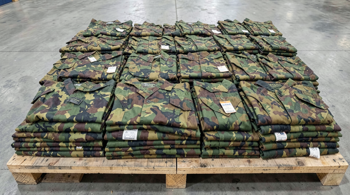
Large-scale surplus wholesalers frequently sell inventory by the bale or pallet rather than by individual unit counts, which requires buyers to arrange freight shipping rather than standard parcel delivery. 7 A single pallet of mixed-grade BDU shirts or field jackets may contain anywhere from several dozen to several hundred items, and condition distribution within an unsorted lot is not guaranteed. Reputable wholesale suppliers provide authentication documentation and condition reports to verify origin and quality, but buyers sourcing through auction platforms are often working from manifest descriptions rather than pre-purchase inspection. 8
Popular Uniform Categories in Wholesale Supply
The most consistently available categories in military surplus wholesale include BDU (Battle Dress Uniform) shirts and trousers, M-65 field jackets, Army Combat Uniform (ACU) sets, cargo trousers, and cold-weather Extended Cold Weather Clothing System (ECWCS) layers. 9 Tactical uniform systems such as BDU and ACU platforms serve different climatic conditions, pocket configurations, and camouflage pattern requirements, meaning wholesale buyers need to specify the uniform system before placing an order rather than treating all military surplus apparel as interchangeable. 10
Fabric specifications vary across uniform categories and production eras. Standard army green and camouflage uniforms are frequently constructed from 65% polyester and 35% cotton or 60% cotton and 40% polyester blends, with ripstop and twill weaves being the most common fabric types. 11 Combat shirts and field jackets sourced from surplus channels may include reinforced elbow and knee panels, Velcro patch attachment points, and multiple utility pockets, features that increase their appeal to security firms, outdoor retailers, and tactical apparel distributors purchasing in bulk. 12
Regulatory and Legal Considerations for Resellers
Buyers intending to resell ex-military uniforms must account for regulatory requirements that do not apply to standard apparel resale. Military surplus uniforms prepared for civilian resale may be subject to alteration requirements mandating the removal of rank insignia, unit patches, and identifying service markers before the items can be legally offered for sale. 13 Failure to comply with these requirements exposes resellers to liability under federal impersonation statutes, making supplier-side documentation of alteration status an important due diligence item.
The Berry Amendment, administered by the U.S. Department of Defense, mandates that certain military-grade clothing items be domestically manufactured. This factor affects the resale positioning and marketing of authentic U.S.-issue surplus gear, since genuine Berry Amendment-compliant items carry a verifiable domestic origin that is valued by institutional buyers, law enforcement procurement offices, and collectors. 14 Buyers sourcing internationally manufactured reproductions or non-U.S.-issue surplus should be aware that these items occupy a different regulatory and market segment from authentic U.S.-origin surplus.
Supplier Verification and Buyer Requirements
Accessing wholesale pricing from reputable military surplus distributors typically requires the buyer to hold a valid business license or resale certificate. Most established surplus wholesalers mandate a tax identification number or equivalent commercial credential before granting access to B2B pricing tiers and bulk order catalogs. 15 This credentialing step filters out individual consumers and ensures that surplus inventory flows through commercial channels where tracking and compliance obligations can be maintained.
When evaluating wholesale suppliers, buyers should distinguish between genuine manufacturers or direct government-authorized liquidators and trading intermediaries who may have limited visibility into inventory provenance or condition accuracy. One practical indicator is whether a supplier provides verifiable condition grade documentation, lot manifests, and return or dispute procedures for items that do not match stated descriptions. Wholesale return windows in this category are typically narrow, with many suppliers accepting quality disputes only within seven calendar days of goods receipt and requiring photographic or video evidence of defects to initiate any resolution process. 16
Supply Inconsistency and Sourcing Risks
One of the most significant structural challenges in this wholesale category is inventory inconsistency. Wholesale surplus catalogs rotate based on Department of Defense disposal cycles, meaning stock availability is irregular and highly dependent on when specific uniform programs are retired or replaced. 17 Buyers cannot rely on a single surplus channel to provide continuous replenishment of a specific uniform type, camouflage pattern, or size distribution across multiple order cycles.
The information asymmetry that characterizes military surplus markets generally also affects wholesale uniform sourcing specifically. Buyers who lack knowledge of specific uniform markings, contract tags, lot numbers, and production era indicators are more likely to overpay for reproduction items misrepresented as genuine issue, or to underestimate condition deterioration in aged stock. Developing category expertise through published uniform identification resources, consultation with established surplus dealers, and incremental trial orders before committing to full pallet or container quantities is a standard risk mitigation practice in this segment. 18 Key wholesale hubs for military surplus in the United States include major importers and liquidators concentrated in states such as Georgia, Texas, and Pennsylvania, where proximity to military installations and established logistics infrastructure supports high-volume surplus trade. 17
Sources
- Defense Logistics Agency - dla.mil (2023 Annual Report data on surplus property disposal)
- Defense Logistics Agency Disposition Services - dla.mil/DispositionServices
- gov.deal - Military Surplus Buying Guide: From Field Gear to Heavy Equipment
- GSA - How to Purchase Surplus Property (gsa.gov)
- GovLiquidation.com - Government Liquidations surplus platform
- LLM Research Data - Bulk military uniform pricing and condition grade tiers
- LLM Research Data - Bale and pallet fulfillment practices among large-scale surplus wholesalers
- LLM Research Data - Authentication documentation practices for wholesale military surplus suppliers
- LLM Research Data - Popular wholesale military uniform categories including BDU, ACU, M-65, and ECWCS
- Zennison.com - Tactical Uniforms Bulk Buyer Guide for BDU, ACU and OEM Camo
- Lisenxinghua.com - Army Green Military Uniform specifications (fabric blends and construction)
- Wigmoretrading.com - Wholesale Combat Trouser Supply and sourcing guide
- LLM Research Data - Alteration requirements for military surplus resale and insignia removal regulations
- U.S. Department of Defense - Berry Amendment (acq.osd.mil)
- LLM Research Data - Business license and tax ID requirements for wholesale surplus access
- MilitaryUniformWholesale.com - Return and Refund Policy for Wholesale Orders
- LLM Research Data - DoD disposal cycle inconsistency and U.S. regional wholesale hubs
- Underpriced.app - Militaria Reselling Guide and surplus authentication considerations
Authored by 24Trendz team