Effective Uses of Inversion Tables for Back and Core Strength
Inversion tables have attracted sustained interest from physical therapists, orthopedic specialists, and fitness practitioners seeking non-surgical approaches to back pain and core conditioning. The device works by reversing the gravitational load on the spine, creating traction that temporarily separates vertebrae and reduces disc pressure. Understanding how inversion therapy intersects with back health and core strength requires examining the underlying mechanics, the clinical evidence, the specific exercises enabled by the equipment, and the population groups for whom it carries measurable risk.
How Inversion Tables Work: The Biomechanical Basis
An inversion table secures the user's ankles and allows the body to tilt backward from a slight recline to a full 180-degree hang. In a standard upright posture, the weight of the upper body continuously compresses the intervertebral discs, the fluid-filled shock absorbers located between each vertebra. 1 Over time, this daily compression can reduce disc height, impinge spinal nerves, and contribute to stiffness. When the body inverts, gravity reverses its effect on the spine, creating a negative-pressure environment within the disc space. 2 Biomechanically, this vacuum effect may help retract bulging disc material toward the disc center while stretching spinal ligaments and paraspinal muscles, temporarily restoring space between vertebral joints. Research measuring disc-space changes has recorded increases of 3 to 5 mm during inversion sessions. 3
Most inversion tables include a rotating pivot system, an ankle locking mechanism, adjustable height settings, and an angle-limiter safety strap. Users do not require a motor or external pulling force; body weight provides all the traction. Studies note that 60 degrees of inversion represents an optimal angle for disc decompression, while the full 90-degree position delivers maximum traction. 4 Crucially, this decompression effect is temporary. Once the user returns to an upright stance, the spine gradually recompresses under normal gravitational load, which underscores why consistent, progressive use is generally recommended over single isolated sessions.
Muscles Targeted During Inversion Therapy
Although inversion therapy is often described as a passive stretch, it engages several muscle groups throughout the body. The primary muscles targeted include the erector spinae, the long group of muscles running along either side of the vertebral column that maintains posture and spinal support. 5 Secondary muscles engaged during inversion include the hamstrings, glutes, and hip flexors, all of which experience a lengthening stretch as the inverted body position alters gravitational pull on the posterior chain. The hip flexors in particular benefit from this stretch, as prolonged sitting typically shortens them and contributes to anterior pelvic tilt.
Core muscles, including the rectus abdominis, transverse abdominis, and obliques, are subtly activated during passive inversion to stabilize the trunk. 6 This stabilizing demand increases substantially when active exercises are introduced on the table. Inverted crunches, for example, primarily target the rectus abdominis and engage the obliques and hip flexors as secondary movers. Inverted leg raises place heightened demand on the lower abdominal region because gravity amplifies resistance throughout the full range of motion, making these movements more mechanically challenging than floor-based equivalents. 7
Core Strengthening Exercises Performed on an Inversion Table
An inversion table creates a decompressed spinal environment that enables a category of exercises unavailable in standard upright or flat positions. Most exercises targeting the lower back and core remain effective at partial angles between 20 and 60 degrees, meaning users do not need to invert fully to achieve meaningful muscle engagement. 8 Combining passive inversion with active movement produces better long-term outcomes than passive hanging alone, as the decompressed vertebral space provides an opportunity to strengthen the muscles that support it.
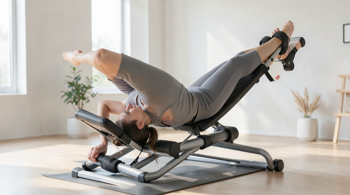
- Inverted Crunches: Hook feet into the table, slowly lift the upper body toward the knees, engaging the abdominal muscles through a controlled concentric contraction.
- Inverted Leg Raises: Hang inverted and slowly raise the legs toward the ceiling, targeting the lower abdominal region with gravity increasing the resistance load.
- Inverted Plank Hold: Secure feet in the table and hold a plank-like position, focusing on sustained core activation and spinal stability.
- Passive Decompression Hold: Hang at a comfortable angle between 20 and 45 degrees for 10 to 30 seconds, allowing paraspinal muscles to relax and disc spaces to expand before transitioning to active movements. 9
Research supports the integration of these active exercises with passive decompression as the most effective protocol for both pain reduction and core development. Inversion therapy used in isolation, without complementary stretching and targeted strength training, yields more limited and shorter-lasting results. 10
Evidence Base: What Clinical Research Shows
Clinical evidence on inversion therapy offers a nuanced picture. A 2012 study conducted at Newcastle University found that patients with sciatica who practiced inversion therapy were significantly less likely to require surgery compared to those who did not undergo inversion treatment. 11 Separately, one randomized controlled trial reported that 77 percent of patients with disc herniation avoided surgery after incorporating inversion into their management plan. 12 Multiple studies document short-term reductions in low back pain scores following inversion sessions, while long-term structural benefits are less consistently supported due to the limited size and follow-up periods of available trials.
Longer-term outcomes appear most favorable when inversion is integrated into a broader rehabilitation framework. Physical therapists note that inversion addresses compression-based pain effectively but does not resolve underlying muscular weakness, postural imbalances, or movement dysfunction. Research characterizes inversion therapy as a supplemental tool rather than a standalone treatment for serious spinal conditions. 13 The general guidance from spine specialists is that inversion works best for individuals with herniated discs, sciatica, degenerative disc disease, muscle spasms, or general stiffness, rather than for those with structural fractures or acute inflammatory spinal pathology.
Recommended Protocols and Usage Frequency
Guidelines for safe inversion table use emphasize gradual progression. New users are advised to begin sessions at 1 to 3 minutes at a shallow angle of 20 to 30 degrees and build tolerance before increasing duration or incline. 14 A general practice frequency of three to five sessions per week is cited for individuals seeking consistent back pain management. For short-term symptom relief, more frequent brief sessions are typically more useful; for longer-term rehabilitation goals, fewer but more consistent sessions tend to produce superior outcomes.
| Experience Level | Recommended Angle | Session Duration | Weekly Frequency |
|---|---|---|---|
| Beginner | 20 to 30 degrees | 1 to 3 minutes | 3 sessions |
| Intermediate | 30 to 60 degrees | 3 to 10 minutes | 4 to 5 sessions |
| Advanced | 60 to 90 degrees | Up to 20 minutes | As tolerated with rest days |
Proper setup is non-negotiable at any experience level. This includes adjusting the table to the user's height, firmly securing the ankle locking mechanism, and calibrating the angle-limiter safety strap before every session. 15 Inverting without these checks in place significantly increases the risk of falls or abrupt uncontrolled rotation. Most manufacturers specify that users should follow equipment-specific instructions, as pivot tension, ankle system design, and weight capacity vary across models.
Contraindications and Medical Risk Factors
Inversion therapy is not appropriate for all individuals. Raising the body to an inverted angle increases both blood pressure and intraocular pressure, which poses documented risks for specific populations. Individuals with uncontrolled hypertension, glaucoma, detached retinas, heart disease, or a history of recent abdominal surgery should avoid inversion tables entirely. 16 Pregnant individuals and those with bone fragility conditions such as osteoporosis also fall outside the recommended user profile, as the ankle loading and spinal traction forces can create mechanical stress incompatible with those conditions.
Even within the general healthy population, side effects can emerge from improper use or excessive session lengths. Overuse may strain muscles or produce discomfort, particularly in the ankles and lower back, if the body has not adapted progressively. 17 Typical usage duration cited in clinical and consumer guidance is 1 to 5 minutes per session at the start, gradually increasing as tolerance develops. Consulting a healthcare professional before beginning inversion therapy remains the standard recommendation for anyone with pre-existing orthopedic, cardiovascular, or ocular conditions. The judgment of a qualified clinician is particularly important when inversion is being considered alongside other treatments such as physical therapy, chiropractic care, or pain management protocols.
Sources
- explore.oreate.ai - Using Inversion Tables for Spinal Decompression and Back Pain Relief
- inversionexpert.com - How Inversion Tables Work (What They Really Do)
- youboost.com - Inversion Therapy: Benefits, Dosage and Evidence
- fitcore360.com - Inversion Tables: Back Pain Relief Complete Guide
- cyvigor.com - Inversion Table Benefits: Targeted Muscles and Decompression Explained
- a4fitness.com - Boost Your Abs Workout with Inversion Table Exercises
- cyvigor.com - Upside Down Crunches: Targeted Muscles and Core Strengthening Benefits
- bestinversiontables.org - Lower Back Exercises Using an Inversion Table
- Healthline - Inversion Table Benefits
- Spine-Health - Inversion Therapy for Back Pain
- teeter.com - Inversion Therapy Benefits: How It Relieves Back Pain Safely
- youboost.com - Inversion Therapy Evidence Summary
- t7fit.com - Are Inversion Tables Effective For Back Pain
- t7fit.com - How Often Should You Use An Inversion Table
- Verywell Health - What Is an Inversion Table and How Does It Work
- Cleveland Clinic - Inversion Tables: How They Work and Benefits
- cyvigor.com - Inversion Tables: Effective Relief for Tight Muscles or Just Hype
Authored by 24Trendz team