Early symptoms of congestive heart failure: Clinical signs, progression, and evaluation
Early symptoms of congestive heart failure often include fatigue, breathlessness, swelling, persistent coughing, and unexplained weight gain. These changes may appear gradually rather than as a single sudden event, which can make them easy to overlook or attribute to aging. 1
What congestive heart failure means
Heart failure is a clinical syndrome in which the heart cannot meet the body’s metabolic demands because of a structural or functional abnormality. The problem may involve reduced pumping, impaired filling, elevated pressure inside the heart, or a combination of these mechanisms. The term congestive emphasizes fluid accumulation, although a person may initially have fatigue or reduced exercise tolerance without obvious swelling. 5
Heart failure is not a single disease. Coronary artery disease and previous heart attack are common causes, while high blood pressure, valve disorders, cardiomyopathy, congenital heart disease, abnormal rhythms, diabetes, obesity, severe lung disease, sleep apnea, and some cancer treatments can also contribute. 3 If the condition becomes chronic, it is often referred to as congestive heart failure, or CHF. 2
Breathing changes and persistent cough
Shortness of breath during routine activity, such as walking or climbing stairs, can be an early sign that the heart is not circulating blood efficiently. Breathlessness may also occur when lying flat because pressure and fluid can back up toward the lungs. Left-sided heart failure typically produces respiratory symptoms because blood backs up into the pulmonary circulation. 2 5
A cough or wheeze that persists, especially when it becomes worse at night or while lying down, may reflect fluid in the lungs. Some descriptions include white or pink mucus, although cough has many possible causes and cannot establish a diagnosis by itself. A change that is new, persistent, or associated with other heart failure signs requires clinical assessment rather than being assumed to be an ordinary respiratory problem. 2 6
Fatigue, weakness, and reduced activity tolerance
Fatigue is among the subtle symptoms that people may dismiss as normal aging or a demanding schedule. When the heart cannot pump enough oxygen-rich blood, muscles may receive less oxygen for ordinary tasks. The resulting low energy can appear as difficulty completing familiar activities, reduced stamina, or unusual weakness after relatively small amounts of exertion. 1 2
Reduced exercise capacity can occur even when there is no dramatic chest symptom or visible swelling. The pattern is more informative when it represents a meaningful change from a person’s usual ability, particularly if it occurs alongside breathlessness, rapid weight gain, or edema. Heart failure can involve either reduced contraction or impaired relaxation and filling, so a normal assumption that only a weakly squeezing heart can cause symptoms is inaccurate. 4 5
Swelling and fluid-related weight gain
Edema commonly affects the feet, ankles, and legs when excess fluid collects in tissues. Fluid may also accumulate in the abdomen, producing enlargement or discomfort. Right-sided heart failure more typically causes fluid backup in the legs or abdomen, while both sides of the heart can be affected together. Swelling can have other causes, but its appearance with breathlessness or declining stamina is clinically significant. 4 5
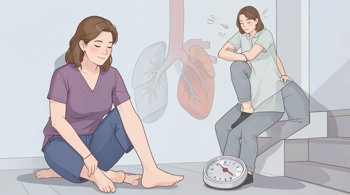
A rapid increase in body weight over several days may represent retained fluid rather than increased body fat. Patient guidance identifies an increase of 2 to 3 pounds in one day or 5 pounds in one week as a warning that fluid retention may be worsening. Tracking weight consistently can therefore provide useful information for a clinician, particularly when the change occurs with swelling or breathing difficulty. 2 8
Other symptoms that may accompany early disease
Several less prominent symptoms may occur as circulation and fluid balance change. Increased urination at night can happen when fluid accumulated in the legs during the day returns to the bloodstream after lying down. Loss of appetite, nausea, abdominal discomfort, or abdominal swelling may reflect congestion involving the digestive organs and liver. These symptoms are nonspecific, but their combination with fatigue, edema, or breathlessness can strengthen the reason for medical evaluation. 9 10
A rapid or irregular heartbeat may develop as the body attempts to maintain adequate circulation. Difficulty concentrating or reduced alertness has also been described when blood flow to the brain is reduced. These findings are not unique to heart failure and may result from other conditions, medications, or rhythm disorders, so they should be interpreted in the context of medical history and examination rather than used as a self-diagnosis. 11 12
How clinicians evaluate suspected heart failure
Symptoms alone do not confirm CHF because breathlessness, tiredness, cough, swelling, appetite changes, and palpitations have numerous possible explanations. Diagnosis begins with clinical assessment and is supported by laboratory testing, chest radiography, echocardiography, and, when needed, hemodynamic evaluation. An echocardiogram can help assess how the heart contracts and fills, while other tests help identify causes or competing diagnoses. 5
Evaluation also considers whether symptoms primarily reflect left-sided, right-sided, or combined heart involvement. Left-sided disease commonly causes fatigue and shortness of breath, whereas right-sided disease more often produces peripheral or abdominal fluid accumulation. The underlying cause matters because coronary disease, hypertension, valve disease, rhythm abnormalities, and cardiomyopathy require different clinical approaches. Early recognition supports a care plan intended to control symptoms, address causes, and reduce progression. 4 5
Patterns that should not be dismissed
Persistent or progressively worsening symptoms deserve attention when they represent a change from normal function. Particularly informative patterns include breathlessness during ordinary activity, difficulty breathing while lying flat, swelling that appears alongside weight gain, nighttime cough, and fatigue that limits routine tasks. No single symptom is diagnostic, but multiple changes occurring together are more concerning than an isolated, short-lived complaint. 1 2
Risk is higher when symptoms occur in a person with coronary artery disease, prior heart attack, longstanding high blood pressure, diabetes, obesity, sleep apnea, valve disease, abnormal heart rhythm, or known heart muscle disease. Heart failure is progressive and can lead to repeated decompensation and hospitalization when unmanaged, making symptom tracking and professional assessment important components of ongoing care. 3 7
Sources
- Harvard Health, “5 Warning Signs and Symptoms of Early Heart Failure”
- Presbyterian Healthcare Services, “Early Signs and Symptoms of Heart Failure”
- Baylor Scott & White Health, “Understanding the early signs of heart failure”
- Penn Medicine, “Heart Failure”
- Merck Manual Professional Edition, “Overview of Heart Failure”
- Mayo Clinic, “Heart failure: Symptoms and causes”
- American Heart Association, “Warning Signs of Heart Failure”
- Cleveland Clinic, “Heart Failure: Understanding Heart Failure”
- Johns Hopkins Medicine, “Heart Failure”
- MedlinePlus, “Heart Failure”
- NHS, “Heart failure: Symptoms”
- British Heart Foundation, “Heart failure”
Authored by 24Trendz team