Complete Italy Getaway: 10 Days with Flights: A Route, Rail and Planning Analysis
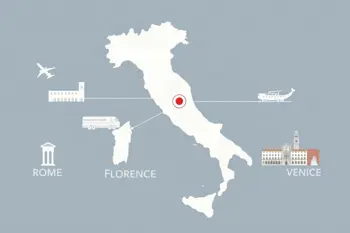
Complete Italy Getaway: 10 Days with Flights is most practical as a south-to-north journey through Rome, Florence and Venice, using an international arrival in Rome and departure from Venice. The route concentrates on Italy's major historical and artistic centers while using direct high-speed trains between them, rather than spending valuable travel time returning to the original airport. 1
Route structure and flight planning
A 10-day schedule generally means nine nights on the ground. A workable division is four nights in Rome, two or three nights in Florence, and three nights in Venice. Flying into Rome Fiumicino and out of Venice Marco Polo creates an open-jaw itinerary that follows the country's geography from south to north. Rome Fiumicino is the principal international gateway for Rome, while Venice Marco Polo is a practical airport for a northern departure. 2 8
The flight plan should account for arrival-day fatigue and airport transfer time. From Fiumicino, the Leonardo Express connects with Rome Termini in about 32 minutes and is listed at approximately €14 in the supplied itinerary research. A return flight from Venice should be scheduled with sufficient time for the journey from the historic center to the airport, since Venice requires a combination of walking and water or land transport depending on the selected connection. 1 5
Days 1 to 4: Rome's ancient and historic core
The first day can combine arrival logistics with a limited introduction to central Rome. After reaching accommodation, a walk through the ancient core may include the Colosseum area, the Roman Forum, Palatine Hill, Trevi Fountain and the Pantheon. The Colosseum, Roman Forum and Palatine Hill operate as an integrated archaeological attraction, so timed admission rules should be checked through the official archaeological park website before travel. 1 9
A second full day is suited to Vatican City, including the Vatican Museums, Sistine Chapel and St. Peter's Basilica. The Vatican Museums identify advance reservations and visitor information through their official ticketing system, making preplanning particularly relevant during busy periods. The remaining Rome time can cover Trastevere, Piazza Navona, Campo de' Fiori, the Spanish Steps and neighborhood meals. Four nights provide room for major sites without requiring every day to be filled with timed attractions. 3 11
Days 5 to 6: Florence and Renaissance landmarks
Rome to Florence is one of the itinerary's shortest major transfers, with high-speed trains taking roughly 90 minutes in the supplied route research. Florence's historic center is compact, allowing visitors to place the Duomo complex, Ponte Vecchio, Piazza della Signoria and a panoramic viewpoint into a concentrated schedule. The city is also a useful base for a countryside excursion, although a day trip reduces time available for museums and central streets. 2 7
Art planning is the principal constraint in Florence. The Uffizi Gallery and Accademia Gallery are distinct priorities, and the Uffizi's official website provides visitor information and reservation details. A two-night stay can support one major museum, the Duomo area and an evening walk, while three nights allow an additional museum or Tuscan excursion. Adding both Cinque Terre and a substantial Tuscany day trip would make this section more transfer-heavy. 10 1
Days 7 to 9: Venice and the lagoon
Florence to Venice is another direct high-speed rail leg, taking about two hours in the supplied itinerary data. Venice's central priorities include St. Mark's Square, St. Mark's Basilica, the Doge's Palace, Rialto and the smaller neighborhoods beyond the most visited corridors. Three nights allow time to experience the city at different times of day and reduce the pressure to treat every sightseeing period as a continuous checklist. 2 7
A lagoon excursion to Murano and Burano is a possible use of the second full day, with local water buses connecting the islands. Venice requires attention to mobility because many routes involve bridges, narrow lanes and water transport rather than conventional streets. Visitor access rules and any city requirements should be verified through the Comune di Venezia's official mobility portal, since policies can change between travel seasons. 12 1
Rail, reservations and optional detours
Trenitalia and Italo provide high-speed connections among the major cities on this route. Advance planning is most important for the Colosseum complex, Vatican Museums, Uffizi Gallery and other timed-entry attractions, while train reservations should be coordinated with hotel checkout and luggage movement. Rail is generally more practical than renting a car for Rome, Florence and Venice because the city centers are linked directly and driving introduces station transfers, parking and restricted-traffic considerations. 6 7 9
Pompeii, the Amalfi Coast and Cinque Terre are feasible only as trade-offs in a 10-day plan. Pompeii can be reached as a day trip from Naples or incorporated through southern Italy, but adding it to the classic route requires reducing time in Rome, Florence or Venice. Similarly, an Amalfi itinerary changes the route toward Naples and the coast, while Cinque Terre is more logical when Florence time is expanded or another city is removed. 13 1
Season, entry rules and cost expectations
The supplied itinerary research identifies May through June and September through October as favorable periods, while August brings heat, Ferragosto conditions and heavier crowds. July is described as especially crowded. A stated overall estimate for a 10-day trip, including flights, internal trains, mid-range accommodation, food and attractions, is approximately US$3,000 to US$4,500 for one traveler or US$5,000 to US$7,500 for a couple. These figures are planning ranges rather than live quotations. 1
U.S. citizens generally may visit Italy and other Schengen countries for up to 90 days within a 180-day period without a tourist visa, subject to passport and entry requirements. Travelers should verify current rules with the U.S. Department of State and relevant Italian authorities before departure. The main planning risks are missed timed entries, tight train connections, excessive hotel changes and trying to add both a coast and multiple day trips without removing another destination. 4
Sources
- Packzup, 10-Day Italy Itinerary
- Tripstou, 10-Day Italy Itinerary
- Destination.com, Rome, Florence and Amalfi Itinerary
- U.S. Department of State, Italy Travel Information
- Aeroporti di Roma
- Trenitalia
- Italo
- Parco archeologico del Colosseo
- Uffizi Galleries
- Vatican Museums
- Comune di Venezia
- Pompeii Archaeological Park
Authored by 24Trendz team