Intermittent fasting protocols for 2026: Evidence, schedules, and safety considerations
Intermittent fasting protocols for 2026 include daily time-restricted eating, weekly calorie-restriction patterns, alternate-day fasting, and one-meal-a-day schedules. Current evidence indicates that fasting can help some adults manage weight when it improves adherence and lowers total calorie intake, but it does not reliably outperform conventional calorie restriction when calories are matched. 1
What intermittent fasting means in 2026
Intermittent fasting is an eating pattern that alternates defined periods of eating with defined periods without caloric intake. Time-restricted eating, including 16:8, uses a consistent daily window, while 5:2 generally involves normal eating on five days and substantial calorie restriction on two nonconsecutive days. Alternate-day fasting varies between low-intake or no-intake days and normal-intake days. 2
The principal distinction among protocols is scheduling, not a guaranteed biological advantage. Clinical findings summarized by Harvard Health, the National Institute on Aging, and a Cochrane review indicate that weight change is strongly influenced by total intake, food quality, adherence, activity, and sleep. Human evidence for longevity and cellular effects remains more limited than laboratory research. 3
Comparing the main protocols
A 12:12 schedule creates a 12-hour fasting period and a 12-hour eating period, often by finishing dinner at 8 p.m. and eating breakfast at 8 a.m. A 14:10 schedule extends the fast modestly. These approaches are generally more gradual than 16:8 and can establish regular meal timing without immediately compressing food intake into a short window. 1
Under 16:8, food is consumed within eight hours, commonly from noon to 8 p.m. More restrictive schedules include 18:6, 20:4, OMAD, 5:2, and alternate-day fasting. The shorter the eating window, the greater the practical challenge of meeting protein, fiber, micronutrient, and energy requirements without overeating or undernourishing. 4
| Protocol | Basic structure | Primary consideration |
|---|---|---|
| 12:12 | 12-hour fast, 12-hour eating window | Gradual entry point |
| 16:8 | 16-hour fast, 8-hour eating window | Common daily format |
| 5:2 | Five usual-intake days, two restricted days | Weekly planning burden |
| OMAD | One main meal daily | Nutrient and appetite challenges |
What the weight-loss evidence shows
Randomized research generally supports intermittent fasting as one possible weight-management structure, not as a superior metabolic method. An eight-hour time-restricted eating schedule added to calorie restriction did not produce significantly greater weight loss than calorie restriction alone in a randomized New England Journal of Medicine trial. A JAMA Internal Medicine trial also reported modest weight loss without clear superiority over control dietary advice. 5
The practical benefit may therefore come from simplicity. A defined window can reduce unplanned eating and make a calorie target easier to follow, but an eating window does not prevent high-calorie meals or compensate for low activity. Calorie estimates, food quality, adequate protein, resistance exercise, sleep, and long-term consistency remain central to outcomes. 6
Timing, food quality, and daily implementation
Earlier eating windows may align more closely with circadian biology than late-night eating because glucose regulation, appetite, and sleep are influenced by the body’s daily rhythms. However, the research does not establish one universally appropriate clock time. Work schedules, medication timing, training, family meals, and sleep patterns affect whether a protocol is sustainable. 7
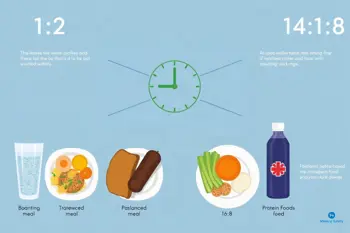
Meals within the eating window should provide sufficient protein, fiber, micronutrients, and fluids rather than treating the window as unrestricted compensation. The 2026 guidance supplied for this topic identifies approximately 0.7 to 1.0 grams of protein per pound of body weight as a muscle-preservation target during fasting-related fat loss, while noting that calorie and protein planning should precede selection of the window. 1
Risks, side effects, and maintenance realities
Reported difficulties include hunger, fatigue, headaches, dizziness, constipation, and difficulty maintaining adequate nutrient intake. Longer or more restrictive schedules can make social meals, shift work, endurance training, and consistent medication use harder to manage. A protocol that repeatedly causes poor sleep, low energy, binge eating, or inability to meet nutritional needs is not sustainable merely because its fasting interval is longer. 8
Fasting also involves ongoing maintenance rather than a one-time intervention. Weight may change only while the pattern supports a consistent energy balance, and returning to previous eating habits can reverse progress. Preliminary observational findings discussed by the American Heart Association have linked very short eating windows with higher cardiovascular mortality, although observational associations do not prove that fasting caused the outcome. 9
Who should seek medical guidance
People using insulin or sulfonylureas should not begin fasting without medical supervision because altered meal timing can increase hypoglycemia risk. The 2026 Lancet Diabetes & Endocrinology review reports that intermittent fasting may reduce HbA1c, fasting glucose, and body weight in adults with type 2 diabetes, typically with HbA1c reductions of 0.3 to 1.2 percent, but medication adjustment and monitoring are essential. 10
Professional guidance is also important during pregnancy or breastfeeding, for children and adolescents, people who are underweight, and anyone with a current or prior eating disorder. Additional caution applies to people with serious medical conditions, including heart disease. Evidence remains insufficient to recommend fasting broadly for type 1 or gestational diabetes, so self-directed experimentation is inappropriate in those groups. 10
A cautious 2026 decision framework
For adults without relevant medical risks, a gradual progression is more defensible than starting with OMAD or prolonged fasting. A 12:12 schedule can establish regularity, followed by 14:10 or 16:8 if hunger, sleep, training, and energy remain stable. The protocol should be evaluated by adherence, nutritional adequacy, symptoms, and health markers rather than by fasting duration alone. 1
The strongest general conclusion for 2026 is that moderate, sustainable time restriction is one option among several evidence-based eating structures. It should be paired with a realistic calorie plan, protein and fiber, hydration, physical activity, and sleep. No schedule removes the need to consider medical eligibility, medication effects, eating-disorder risk, or the uncertainty surrounding long-term outcomes. 3
Sources
- Calorique, “Intermittent Fasting Guide 2026: 16:8, Safety & Calories,” https://calorique.io/blog/intermittent-fasting/
- Johns Hopkins Medicine, “Intermittent Fasting,” https://www.hopkinsmedicine.org/health/wellness-and-prevention/intermittent-fasting
- National Institute on Aging, “Calorie Restriction and Fasting Diets: What Do We Know?” https://www.nia.nih.gov/news/calorie-restriction-and-fasting-diets-what-do-we-know
- EasyFasting, “Intermittent Fasting Schedules: The Complete Guide,” https://easyfasting.net/blog/intermittent-fasting-schedule
- New England Journal of Medicine, randomized time-restricted eating trial, https://www.nejm.org/doi/full/10.1056/NEJMoa2114833
- Harvard Health Publishing, “Intermittent Fasting: A Surprising Update,” https://www.health.harvard.edu/blog/intermittent-fasting-surprising-update-2018062914156
- American Heart Association, “Intermittent Fasting,” https://www.heart.org/en/healthy-living/healthy-eating/eat-smart/nutrition-basics/intermittent-fasting
- Mayo Clinic, “Intermittent Fasting,” https://www.mayoclinic.org/healthy-lifestyle/consumer-health/in-depth/intermittent-fasting/art-20047857
- Cleveland Clinic, “Intermittent Fasting,” https://health.clevelandclinic.org/intermittent-fasting
- The Lancet Diabetes & Endocrinology, “Intermittent fasting to treat diabetes,” https://www.thelancet.com/journals/landia/article/PIIS2213-8587(26)00119-1/abstract
Authored by 24Trendz team