Understand spinal stenosis treatment options: A clinical guide to conservative care and surgery
To understand spinal stenosis treatment options, it helps to view care as a ladder rather than an immediate move to surgery. Most treatment plans begin with measures intended to restore walking and daily function, while procedures are considered when symptoms remain substantially limiting or neurologic problems progress. 1
What spinal stenosis treatment is intended to address
Spinal stenosis is narrowing within the spine that can place pressure on the spinal cord or the nerves traveling to the arms and legs. It most often affects the lumbar spine or the cervical spine and may result from arthritis, bone spurs, disc changes, thickened ligaments, spondylolisthesis, injury, or congenital narrowing. Treatment is guided by symptoms and function rather than by an MRI finding alone. 2 4
Lumbar stenosis commonly produces leg pain, heaviness, numbness, tingling, or weakness during standing and walking. A characteristic pattern, called neurogenic claudication, is improvement after sitting or bending forward. Cervical stenosis may involve neck stiffness, arm or hand symptoms, balance problems, or coordination difficulties. These distinctions matter because the affected spinal region and neurologic findings influence evaluation and treatment selection. 2
- Primary goals include reducing symptoms, improving walking tolerance, and preserving daily activity.
- Visible narrowing can occur in people with few or no symptoms, so imaging is interpreted alongside examination findings.
- Loss of balance, weakness, or reduced ability to stand and walk warrants clinical assessment.
Exercise, physical therapy, and activity changes
Physical therapy is generally a first-line option for people whose symptoms are mild or moderate and who do not have progressive neurologic deficits. Programs may focus on trunk and lower-limb strength, flexibility, balance, and functional movement. The objective is not simply to treat an image or eliminate every structural change, but to improve practical abilities such as walking, standing, shopping, or working. 6
Activity modification can reduce provocation without making a person completely inactive. Lumbar symptoms often ease with sitting or flexion, and low-impact activities such as swimming or cycling may help maintain mobility while limiting stress on the joints. Ongoing exercise, pacing, posture management, and attention to overall health are part of long-term management rather than one-time interventions. 1 4
- Supervised exercise can support strength, stability, flexibility, and balance.
- Shorter activity periods with planned rest may be more manageable than prolonged standing.
- Walking tolerance and recovery time provide useful measures of progress.
Medicines and injections
Medicines may be used to manage pain and inflammation, including commonly prescribed anti-inflammatory drugs and other pain relievers. Neuropathic medicines such as gabapentin and pregabalin are also used for nerve-related leg pain, but the supplied evidence reports that a randomized placebo-controlled trial did not show routine superiority for either drug. Medication decisions therefore require attention to the symptom pattern, health history, and clinical supervision. 3
Epidural steroid injections are an interventional option for selected patients when inflammation around a nerve root contributes to symptoms. Their role is generally symptom relief rather than correction of the underlying narrowing, and relief may be temporary. Injections are consequently one part of a broader plan that may include exercise, activity changes, and reassessment of function. 1 7
- Medication benefits should be weighed against individual medical considerations.
- Injection suitability depends on the suspected pain generator and clinical findings.
- Persistent weakness or declining function should not be managed only by repeated symptom relief.
Minimally invasive and interventional procedures
When nonoperative care does not provide adequate functional improvement, selected patients may be evaluated for minimally invasive lumbar decompression, commonly referred to as MILD. The procedure is considered in treatment frameworks for lumbar stenosis, particularly when the narrowing pattern and contributing anatomy are appropriate. It is not a universal substitute for surgery, because eligibility depends on the structural cause, symptoms, and examination. 3 5
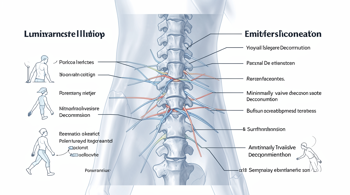
Interspinous spacer procedures are another category discussed for selected lumbar stenosis cases. Pathology-driven assessment is important because lumbar stenosis can involve central canal narrowing, lateral recess narrowing, foraminal narrowing, ligament thickening, disc changes, or combinations of these conditions. Standing or motion-based X-rays may be considered when alignment or instability could change the treatment plan. 4 5
| Option | Typical role in the treatment pathway | Key selection issue |
|---|---|---|
| Injection | Temporary reduction of nerve-related inflammation | Whether inflammation is contributing to symptoms |
| MILD | Minimally invasive decompression for selected lumbar patterns | Anatomy and source of narrowing |
| Interspinous spacer | Interventional option for selected cases | Structural suitability and stability |
When decompression or fusion is considered
Surgical decompression, including laminectomy, may be discussed when walking tolerance and daily function remain substantially limited despite non-surgical care. The decision is influenced by symptom severity, neurologic deficits, response to physical therapy, medication or injections, and the person’s goals. Some patients may reasonably consider surgery earlier when work or essential activities are severely affected, while others may continue conservative care if limitations remain acceptable. 6
Decompression addresses pressure on neural structures, while fusion may be added when significant vertebral instability is present. Surgery is not selected from an MRI alone, and outcomes depend partly on the severity of narrowing and the patient’s overall health. The relevant balance includes expected functional improvement, procedural recovery, and whether the structural problem requires stabilization as well as nerve decompression. 4 8
- Progressive leg or arm weakness, foot drop, or worsening balance changes the clinical discussion.
- Fusion is associated with instability considerations rather than stenosis alone.
- Personal goals and acceptable activity limits are legitimate parts of shared decision-making.
Evaluation, safety signals, and realistic expectations
Assessment usually combines a history of walking distance, standing tolerance, symptom relief with sitting or bending, and recovery after rest with a neurologic examination. Strength, sensation, reflexes, balance, and coordination help determine the significance of nerve compression. MRI or CT can identify narrowing, while standing or flexion-extension X-rays may help evaluate alignment or instability. 2 4
Urgent medical evaluation is appropriate for new loss of bladder or bowel control, sudden severe weakness, rapidly worsening symptoms, or serious balance and coordination changes. For less urgent cases, the natural history may be variable: observational data in the supplied research report that over three years about one-third improved, half remained stable, and 10 to 20 percent worsened. This supports individualized, monitored care rather than automatic escalation. 3 7
- Seek specialist assessment when pain, numbness, weakness, or walking difficulty interferes with daily activities.
- Maintain follow-up when symptoms are changing or treatment is being adjusted.
- Interpret scans in the context of symptoms, examination, function, and personal priorities.
Sources
- The Well by Northwell, “Spinal Stenosis Treatment: What Works (And What To Try First)”
- ColumbiaDoctors, “Spinal Stenosis”
- KevinMD, “6 lumbar spinal stenosis treatments, least invasive first”
- Hanjin Jang, MD, “Lumbar Spinal Stenosis: A Patient Guide”
- Amit Sharma, MD, “Lumbar Spinal Stenosis: Pathology-Driven Treatment Selection Before Surgical Referral”
- New Jersey Brain and Spine, “Spinal Stenosis Treatment Decision: Surgery vs. Non-Surgical”
- Acibadem Hospitals Group, “Spinal Stenosis: Early Symptoms, Diagnosis, and Treatment Options”
- Cyr MD, “Understanding Spinal Stenosis: Causes, Symptoms, and Treatment Options”
Authored by 24Trendz team