Understand herniated disc treatment options: An evidence-based guide to care and recovery
What a herniated disc means
A herniated disc occurs when the soft inner nucleus of a spinal disc moves through a weakened or torn outer layer. The displaced material may irritate or compress a nearby nerve, producing back or neck pain, radiating pain in an arm or leg, tingling, numbness, or weakness. Lumbar herniations occur most often at L4-L5 and L5-S1, while cervical herniations can affect nerve roots or the spinal cord. 1
Treatment depends on the relationship between symptoms and examination findings rather than on an MRI image alone. Disc changes can appear in people without pain, so clinicians generally interpret imaging alongside the symptom pattern, muscle strength, sensation, reflexes, walking ability, and duration of symptoms. Some herniations improve as inflammation settles and the displaced material shrinks or is reabsorbed. 4
First-line nonsurgical treatment
Most people begin with nonsurgical care because many herniated discs improve over several weeks. A brief period of rest may be reasonable when pain is severe, but prolonged bed rest is generally discouraged. Tolerable movement, including short walks, can help maintain function, while twisting, deep bending, heavy lifting, and other movements that intensify symptoms may need temporary modification. 2
Medication may be used to reduce pain and inflammation while normal activity gradually resumes. Nonsteroidal anti-inflammatory drugs such as ibuprofen or naproxen are commonly discussed options when medically appropriate, but suitability depends on a person’s health history, other medicines, and risk factors. A clinician may also consider other pain-management approaches or a short course of oral steroids in selected situations. 2
Physical therapy and activity planning
Physical therapy is intended to restore movement and function rather than simply provide passive symptom relief. Programs may include exercises addressing posture, core strength, flexibility, and spinal mechanics. The specific plan is adjusted according to whether symptoms involve mainly back pain, radiating nerve pain, numbness, or weakness. Progress is usually judged by improved function and neurological stability as well as by pain intensity. 5
Avoiding all activity can contribute to deconditioning and may make daily movement more difficult. The practical objective is gradual participation in activities that remain tolerable, with professional guidance when pain, weakness, or uncertainty limits exercise choices. Physical therapy does not physically remove a disc fragment, but it can support safer movement, conditioning, and return to ordinary activities while the nerve irritation settles. 6
Injections and diagnostic imaging
An epidural corticosteroid injection may be considered when nerve-related leg or arm pain remains difficult to control. Its purpose is to reduce inflammation around an irritated nerve and provide temporary pain relief, not to repair the disc or guarantee long-term resolution. Guidance from NICE describes epidural injections as an option for acute and severe sciatica, while routine spinal injections are not recommended for ordinary low-back pain without sciatica. 10
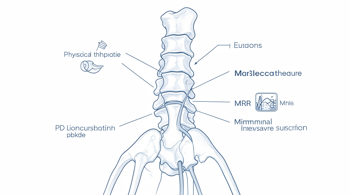
MRI is the preferred imaging method when imaging is clinically indicated, but it is not automatically required for every initial presentation. It may be considered when symptoms persist, serious disease is suspected, or an injection or operation is being planned. A scan that shows a herniation does not by itself establish that the disc is the pain source or that surgery is necessary. 7
When surgery enters the discussion
Surgery is generally considered when disabling radiating pain persists despite appropriate nonsurgical treatment, when significant weakness develops or progresses, or when walking and daily function are substantially affected. The decision also depends on whether symptoms and imaging identify the same compressed nerve. Surgical treatment can relieve pressure more quickly in selected patients, although it still carries procedural risks and does not prevent every future episode of back pain. 8
Microdiscectomy or discectomy removes the portion of disc material pressing on a spinal nerve. These procedures are commonly used for persistent nerve-root symptoms, particularly when pain and neurological findings correspond to a treatable disc herniation. Evidence summarized in StatPearls indicates that discectomy can be more effective than conservative care during the first year of symptoms in selected refractory cases, while its relative benefit is less clear after symptoms have continued for a year. 9
Urgent symptoms and treatment trade-offs
New loss of bladder or bowel control, numbness around the genitals or anus, or rapidly worsening leg weakness requires urgent medical assessment. These findings can indicate compression of nerves responsible for bladder, bowel, or lower-limb function. Severe or progressive neurological changes are treated differently from stable pain without weakness because delaying evaluation may place nerve function at risk. 1
Every treatment option has limitations. Medication may be unsuitable for some people, injections generally offer temporary relief, and surgery addresses a specific nerve-compression problem rather than every cause of back pain. Emerging approaches such as platelet-rich plasma, bone marrow aspirate concentrate, and chemonucleolysis remain subjects of ongoing research, with questions about long-term effectiveness and appropriate patient selection. Care therefore requires reassessment when symptoms change, fail to improve, or conflict with imaging findings. 3
Sources
- NCBI Bookshelf, StatPearls: Disk Herniation
- The Well by Northwell: Herniated Disc Treatment
- Frontiers in Neurology: Recent advances and evolving strategies in the treatment of lumbar disc herniation
- Harvard Health: Herniated Disk
- Mayo Clinic: Herniated disk diagnosis and treatment
- MedlinePlus: Herniated disk
- Johns Hopkins Medicine: Lumbar Disk Disease
- Hospital for Special Surgery: Herniated Disc
- American Association of Neurological Surgeons: Herniated Disc
- National Institute for Health and Care Excellence: Low back pain and sciatica
Authored by 24Trendz team