Boutique Hotels in Italy: A Regional Guide to Character, Heritage, and Practical Trade-Offs
Boutique Hotels in Italy are associated with smaller-scale hospitality, individualized interiors, and a stronger connection to local culture than standardized chain accommodation. Documented examples include family-run properties, converted historic buildings, countryside estates, and seaside retreats across regions such as Tuscany, Campania, Puglia, Marche, and Emilia-Romagna. 1
What Defines the Italian Boutique Hotel
The category generally emphasizes character over uniformity. Research on Italian properties describes independent hotels as places where service, architecture, food, and local identity are integrated into the stay, often through family ownership or long-term stewardship. The Italian model also includes the albergo diffuso, in which rooms are distributed through an existing historic village rather than concentrated in one conventional building. 11
Historical adaptation is a recurring feature. Properties in the research occupy former family homes, palazzos, farmhouses, villas, convents, and monasteries. Atelier Inès Art & Suites in Naples, for example, has nine rooms and is attached to a working artist studio in the owners’ former family home. La Monastica Resort & Spa occupies a carefully restored 16th-century monastery in the medieval village of Buggiano Castello. 1 4
Regional Patterns and Setting
Tuscany has an especially broad range of boutique formats, including vineyard estates, historic villas, adults-only rural retreats, and properties near major cultural cities. Pieve Aldina sits in Chianti beside the Romanesque church of Santa Maria Novella and overlooks vineyards and olive groves. Its 22 rooms and suites are distributed among four restored buildings, including the main abbey, a farmhouse residence, a limonaia, and a convent. 3
Other regions show different relationships between accommodation and landscape. Colleverde Country House near Urbino combines 15 rooms and suites with 10 hectares of woodland and a location described as five minutes from the historic center. In Ischia, Boutique Hotel Ideal is presented as a family-run property near the sea and town center, with Mediterranean interiors, gardens, and a thermal pool. Puglia’s Il Santissimo, by contrast, is arranged in a historic palazzo with 10 rooms and suites. 8 10 7
Architecture, Interiors, and Scale
Design is often used to distinguish boutique accommodation from larger standardized hotels. Pieve Aldina retains exposed beams, traditional Tuscan terracotta floors, and preserved frescoes while adding contemporary minimalism. Villa Casanova, an 18th-century manor house in the hills between Lucca and Viareggio, has 14 suites, each measuring more than 60 square meters, with living areas, relaxation zones, wooden floors, and woodland views. 3 9
Some properties make craftsmanship the central design principle. Atelier Inès Art & Suites is described as containing handmade elements connected to its artists, while Casa Via Costa on Ischia uses hand-painted Vietri tiles, terrazzo floors, oak cabinetry, private kitchens, and sea-facing gardens across four restored guesthouses. These details can produce highly distinctive rooms, but they also mean that layouts, amenities, and accessibility may vary substantially between categories and buildings. 1 2
Services and Local Experiences
Italian boutique hotels frequently connect hospitality with regional food, wine, wellness, and outdoor activities. Pieve Aldina identifies wine tastings, winery visits, and cooking classes among its experience-oriented programming. La Monastica’s restaurant draws on Tuscan tradition, seasonal ingredients, and produce from the resort’s garden. Colleverde combines walks in the surrounding woodland with spa use and views toward the Apennines. 3 4 8
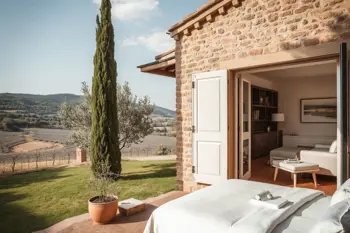
Service expectations are shaped by intimacy rather than scale. Dimora Santa Margherita in the Tuscan Maremma has eight independent suites, with some featuring private gardens, panoramic Jacuzzis, or a private Finnish sauna. Il Santissimo organizes its 10 rooms into four accommodation groupings, including suites with terraces and wellness areas. These features support privacy and place-based experiences, although they may not replicate the extensive facilities or standardized service systems of a large international hotel. 6 7
Matching Properties to Different Travelers
Guest suitability varies by design and operating model. Adults-only Dimora Santa Margherita is oriented toward privacy, quiet, and wellness in the countryside between Castiglioncello Bandini and Cinigiano. Il Santissimo explicitly accommodates couples, destination wedding guests, and intimate celebrations. Villa Casanova presents 14 large suites and event facilities, while Colleverde offers a family-owned country-house setting close to Urbino’s cultural attractions. 6 7 9 8
Location should be assessed as carefully as room design. Rural properties can provide vineyards, forests, gardens, and panoramic views, but their distance from city centers may require planned transport. Conversely, an urban property such as Atelier Inès Art & Suites places guests in Naples’ Rione Sanità neighborhood, where the hotel’s identity is tied to a working atelier and local surroundings. Room count, adults-only rules, private kitchens, and suite layouts are practical eligibility considerations rather than merely decorative distinctions. 1 2
Seasonality, Verification, and Market Friction
Seasonal pricing is a significant consideration in the Italian boutique market. The research indicates that rates can vary sharply between the peak July and August period and quieter months such as November or February, with peak pricing potentially reaching three times off-season levels. This volatility is particularly relevant for coastal, vineyard, and resort properties whose appeal depends strongly on weather and seasonal activities. 19
Independent properties also require more careful verification than uniform chain accommodation. Travelers should confirm whether a room is in the main building or a separate residence, whether an adults-only rule applies, how far rural properties are from transport links, and which wellness or dining services operate during the intended dates. The supplied research does not establish a single national oversight framework for boutique hotels, nor does it verify live availability, current rates, accessibility compliance, or operating schedules. Those limitations are material when comparing historic buildings with modern hotels. 2 3 6
Key Takeaways for Interpreting Listings
Expect substantial variation in room size, building layout, and services because many properties occupy restored structures or several separate buildings. 3 9
Look for evidence of local connection, such as family ownership, artist studios, gardens, regional cuisine, or agricultural settings. 1 2
Distinguish urban boutique hotels from rural estates, since access, transport, and nearby activities can differ considerably. 8 9
Check age policies and accommodation categories, particularly where properties are adults-only or designed primarily for couples. 6 7
Treat seasonal rates and service availability as variable rather than fixed characteristics of the category. 19
Sources
- AFAR
- Italy Segreta
- Pieve Aldina
- La Monastica Resort & Spa
- Svadore
- Dimora Santa Margherita
- Il Santissimo
- Colleverde Country House
- Villa Casanova
- Boutique Hotel Ideal
- Condé Nast Traveler
- Skift
Authored by 24Trendz team