Warning Signs of Osteoporosis: Clinical Findings, Risk Factors, and Screening
Warning signs of osteoporosis can be difficult to recognize because early bone loss is usually silent. The first indication may be a broken wrist, hip, or spinal bone after a minor fall, routine movement, or another force that would not normally fracture healthy bone. Later findings can include unexplained back pain, gradual loss of height, and a forward-curving posture. 1
The Silent Early Stage
Osteoporosis does not usually cause pain or visible changes while bone density is declining. The condition develops when the breakdown of old bone exceeds the creation of new bone, leaving bones thinner, less dense, and more fragile. Because this process often produces no physical sensation, many people learn they have osteoporosis only after a fracture or a bone-density assessment. 1
The absence of symptoms does not mean the risk is absent. Screening may identify low bone density before a major break occurs, particularly in older adults and people with recognized risk factors. Osteopenia, which describes bone density below the usual range but not yet in the osteoporosis range, can also signal increased future fracture risk and warrants clinical interpretation. 3
A Fracture After Minor Trauma
A fracture caused by a minor fall or everyday activity is one of the most important warning signs. Examples include a wrist fracture after falling from standing height, a hip fracture after an awkward low-impact fall, or a break that follows lifting an ordinary object. A cough or sneeze can rarely contribute to a rib or spinal fracture when bones are severely fragile. 4
Osteoporosis-related fractures most often involve the hip, spine, and wrist, although the pelvis, upper arm, ribs, and other bones can also be affected. A previous fracture during adulthood, especially after age 50, increases concern about underlying bone weakness and the possibility of additional fractures. The injury mechanism matters: a break after substantial force has a different clinical meaning from a fragility fracture after minimal force. 2
Back Pain and Spinal Fractures
Spinal compression fractures occur when vertebrae squash down rather than breaking apart. They may cause sudden back pain, persistent or recurring discomfort, muscle spasms, or pain that is mistakenly attributed to arthritis or ordinary aging. Some spinal fractures produce little pain or go unnoticed, allowing several injuries to accumulate before the change becomes apparent. 6
Persistent or unexplained back pain should be considered alongside other findings, such as reduced height or a new change in posture. A spinal fracture is not always dramatic, and the absence of severe pain does not exclude it. Clinical evaluation can help distinguish a vertebral fracture from other causes of back symptoms and determine whether bone-strength assessment is appropriate. 5
Height Loss and a Stooped Posture
Gradual loss of height may reflect compression of the spine from one or more vertebral fractures. Mayo Clinic identifies loss of height over time and a stooped posture as possible symptoms once osteoporosis has weakened the skeleton. A forward curve of the upper back, sometimes called kyphosis, can develop when the spine can no longer adequately support the body. 1
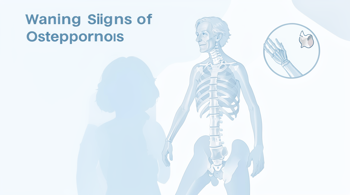
Height change is more meaningful when it is progressive, unexplained, or accompanied by back pain. A curved upper back may have causes other than osteoporosis, so posture alone cannot establish a diagnosis. However, the combination of height loss, hunched posture, and an easily sustained fracture is a pattern that merits discussion with a healthcare professional. 3
Risk Factors That Increase Concern
Some people should consider assessment even before warning signs appear. Higher-risk groups include older adults, women after menopause, people with a parent or sibling who has osteoporosis, and those with a parental history of hip fracture. Early menopause, low body weight, smoking, heavy alcohol use, and inadequate calcium or vitamin D are also recognized risk factors. 8
Medication and medical history can alter fracture risk. Mayo Clinic specifically identifies early menopause and corticosteroid treatment lasting several months as reasons to discuss osteoporosis with a healthcare professional. Osteoporosis can affect men as well as women, although postmenopausal women and older adults have higher average risk. Risk factors do not prove osteoporosis, but they can support earlier screening or closer evaluation. 1
Testing and Clinical Interpretation
A central DXA scan, also called dual-energy X-ray absorptiometry, measures bone mineral density and is commonly used to assess the lumbar spine, hip, and femoral neck. The test helps identify osteoporosis and estimate fracture risk before symptoms appear. Bone-density results are interpreted with age, sex, fracture history, medications, and other clinical factors rather than treated as an isolated number. 5
The U.S. Preventive Services Task Force recommends screening women aged 65 years or older and recommends screening postmenopausal women younger than 65 when their risk is increased. Testing decisions for men and other groups depend on individual circumstances and clinical guidance. A normal-feeling back or lack of prior fracture cannot reliably rule out osteoporosis because the early condition is often asymptomatic. 7
When a Warning Sign Needs Medical Attention
An unexplained fracture, especially after a fall from standing height or less, should prompt medical review rather than being dismissed as an isolated accident. New or persistent back pain, measurable height loss, or a developing stooped posture also deserves assessment, particularly when combined with age, family history, early menopause, corticosteroid exposure, smoking, heavy alcohol use, or low body weight. 4
Evaluation may include a review of fracture circumstances, medical conditions, medicines, family history, and bone-density testing. Osteoporosis is treatable, and management may involve exercise, nutrition guidance, and medication selected according to fracture risk and clinical findings. Because hip and spinal fractures can affect mobility and independence, recognizing warning patterns and obtaining an appropriate assessment is more reliable than waiting for repeated injuries. 2
Sources
- Mayo Clinic, Osteoporosis: Symptoms and causes
- Cleveland Clinic, Osteoporosis: Symptoms, Causes & Treatment
- Penn Medicine, Osteoporosis: Symptoms and Causes
- NHS inform, Osteoporosis
- GoodRx, What Are the Early Signs of Osteoporosis?
- Royal Osteoporosis Society, Symptoms of osteoporosis
- U.S. Preventive Services Task Force, Screening for Osteoporosis to Prevent Fractures
- National Institute on Aging, Osteoporosis
Authored by 24Trendz team