How to build muscle with joint pain safely: An evidence-informed training report
How to build muscle when joints hate heavy lifting requires a change in strategy, not an end to resistance training. Muscle growth responds to tension, effort, consistency, and progression, while heavy loads represent only one way to create that stimulus. Joint-friendly programming aims to challenge muscles without repeatedly aggravating sensitive tissues.1
Distinguish muscular effort from joint warning signs
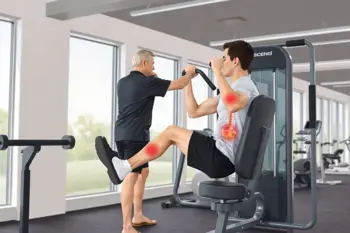
Training discomfort is not automatically harmful, but its location and character matter. Burning muscles, temporary fatigue, and shaking near the end of a set are different from sharp pain, catching, swelling, numbness, instability, or symptoms that become progressively worse. A knee-focused exercise should primarily challenge the thighs, while a press should load the chest, shoulders, and triceps rather than create stabbing discomfort in the joint.1
Chronic pain also requires a measured approach rather than either complete avoidance or forcing every movement. PT Complete describes strength training with persistent pain as an ongoing process of adjusting movement tolerance, load, volume, intensity, and flare patterns. Persistent, severe, injury-related, or function-limiting pain should be evaluated by a qualified medical or rehabilitation professional before training is advanced.2
Choose stable exercises that reduce unnecessary joint demand
Machines can provide external stability and reduce the balance and joint-stabilization demands required by free weights. A hack squat, leg press, or belt squat may allow hard quadriceps training when a barbell squat irritates the knees or back. A converging chest press may be more comfortable than a barbell bench press for some people whose shoulders react poorly to the barbell position.1
Joint-friendly exercise selection is defined by appropriate loading, controlled movement, and respect for individual tolerance rather than by avoiding resistance altogether. Supported rows, cables, bands, dumbbells, box squats, step-ups, sled pushes, and supported single-leg exercises are examples of movements that can improve alignment and control while still challenging the muscles. The appropriate choice remains individual because the same exercise can be comfortable for one person and irritating for another.3
Adjust load, repetitions, range, and grip
High-repetition, lower-weight training can stimulate hypertrophy while reducing the absolute load placed on sensitive joints. This approach is useful when heavier weights provoke symptoms, provided the sets remain sufficiently challenging and recovery is managed. Controlled tempo and longer time under tension can also increase muscular demand without requiring maximum external resistance.510
Range of motion should be adjusted when a specific angle consistently produces joint pain. A practical modification is to stop before the painful point while maintaining muscular tension, then gradually expand the range only as tolerance improves. Neutral grips, including palms-facing-in positions, may reduce stress on the wrists, elbows, and shoulders during pressing or pulling movements compared with more provocative grip positions.49
Use tempo and isometrics strategically
A slow, controlled eccentric phase, meaning the lowering portion of a repetition, can increase time under tension and make a moderate load more demanding. The method may help maintain a muscle-building stimulus when joint symptoms make heavy loading unsuitable. Control is more important than deliberately moving as slowly as possible, since momentum and forced end-range positions can increase irritation.710
Isometric exercises create muscle activation without repeated joint movement. They can be useful for maintaining strength or introducing training during periods when dynamic repetitions are poorly tolerated. Examples include holding a selected joint position against resistance or sustaining a supported bodyweight position, but the position should remain within the person’s comfortable tolerance and should not reproduce sharp pain or instability.8
Progress gradually and manage flare-ups
Progression does not have to mean adding weight every session. It can involve completing more controlled repetitions, adding a set, improving range of motion, increasing pause duration, or using a slightly heavier resistance only after the current workload is tolerated. This approach keeps the training stimulus moving forward while reducing the risk of sudden changes in joint stress.24
Flare management is part of the program rather than evidence that training has failed. When symptoms increase, reducing range, resistance, volume, or exercise frequency can preserve movement while allowing irritation to settle. If pain worsens across several weeks, changes sides, affects daily activities, or is accompanied by swelling, numbness, or instability, a medical or physiotherapy assessment is more appropriate than repeated experimentation in the gym.42
Warm up carefully and consider specialized methods
A warm-up can use low-intensity movement and dynamic preparation before resistance training. NASM identifies structured warm-ups as important for preparing the body and reducing injury risk, while joint-focused guidance emphasizes controlled movement, avoidance of forced end ranges, and gradual exposure to the planned exercise. The warm-up should prepare the relevant movement pattern rather than exhaust the muscles before working sets begin.103
Blood flow restriction training is another specialized method that can produce a substantial muscle-building stimulus with very light loads, which may be relevant when degenerative joint conditions limit conventional resistance. Because cuff placement, pressure, exercise selection, and medical suitability affect safety, BFR should be considered with guidance from an appropriately qualified professional rather than improvised. Resistance training itself is not inherently damaging when loading and technique are appropriately designed, and stronger muscles can improve joint support and stability.63
Sources
- Mindset Fit
- PT Complete
- BOXROX
- Reshape App
- Healthline
- Verywell Fit
- ACE Fitness
- WebMD
- Muscle & Fitness
- National Academy of Sports Medicine
Authored by 24Trendz team