Mediterranean Cruise from Miami to Greece: A Route and Planning Analysis
The phrase Mediterranean Cruise from Miami to Greece generally describes a seasonal transatlantic or repositioning voyage rather than a standard year-round sailing. Published examples in the research data more commonly travel from Athens or Rome toward Miami or Fort Lauderdale, while future cruise listings also identify an Athens-to-Miami itinerary. 1
How the routing typically works
Miami is a major cruise departure center with multiple terminals and transportation links to Miami International Airport and downtown Miami. A west-to-east voyage normally requires several Atlantic sea days before reaching the Mediterranean, and it is usually sold as a one-way itinerary rather than a round trip. Seasonal scheduling is a central constraint because ships are often repositioned between North American and European cruising regions. 2
The published data illustrates the reverse pattern clearly. Oceania’s 34-day Isles & Rivieras itinerary begins in Athens and ends in Miami aboard Marina, while another Oceania itinerary runs 26 days from Rome to Miami. Princess lists a 23-day Athens-to-Fort Lauderdale itinerary, and Holland America lists a 25-day Athens-to-Fort Lauderdale itinerary. 1
Greek ports and destinations
Piraeus is the principal cruise gateway for Athens. The port is approximately 12 kilometers from central Athens, with the city generally reachable in about 20 to 30 minutes by taxi or train, according to the itinerary information. Athens provides access to the Acropolis, the Parthenon, the Temple of Olympian Zeus, and the Acropolis Museum, making a pre-cruise stay materially different from a short port call. 3
Greek island calls vary by ship and season. Documented itineraries include Santorini, Mykonos, Rhodes, Corfu, Chania, Katakolon, and Milos. A seven-night Celebrity Infinity sailing from Piraeus is identified as a round trip with Mykonos among its listed ports, while a 14-night Celestyal Journey itinerary includes Katakolo, Rhodes, Santorini, Mykonos, and Adamantas. 4
Representative itinerary structures
| Operator and ship | Length | Routing | Selected destinations |
|---|---|---|---|
| Oceania Marina | 34 days | Athens to Miami | Mykonos, Barcelona, Amalfi Coast, Ephesus, Gibraltar |
| Oceania Marina | 26 days | Rome to Miami | Mediterranean and Caribbean segments |
| Sun Princess | 23 days | Athens to Fort Lauderdale | Messina, Naples, Barcelona, Cadiz, Gibraltar |
| Rotterdam | 25 days | Athens to Fort Lauderdale | Montenegro, Malta, Sicily, Spain, Morocco |
The documented voyages show that an Atlantic crossing can be combined with western Mediterranean ports before or after Greek calls. The 34-day Oceania itinerary includes Athens, Olbia, Messina, Ephesus, Amalfi Coast, Toulon, Barcelona, Cadiz, Gibraltar, Horta, and Miami. The longer 57-day Oceania itinerary from Rome to Miami extends through Italy, Greece, Turkey, Cyprus, Israel, Egypt, Spain, Morocco, Portugal, and Caribbean destinations. 5
Ships, duration, and onboard scale
Ship size differs substantially across the available examples. Oceania Marina is listed with 1,250 passengers and 800 crew, while Sun Princess is listed with 4,300 passengers and 1,346 crew. Rotterdam is listed with 2,668 passengers and 800 crew. These figures indicate that a transatlantic itinerary can involve either a smaller, longer-format ship or a much larger vessel with a higher passenger capacity. 6
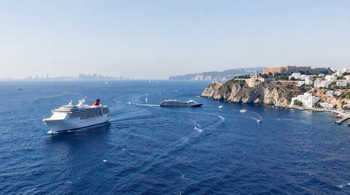
Duration also ranges widely. The shortest documented Greek-island examples are seven to 11 nights, but they are regional cruises rather than Miami-to-Greece crossings. One Princess itinerary runs 11 days from Athens to Rome, and another runs 15 days from Barcelona to Athens. By contrast, the listed transatlantic journeys range from 23 to 57 days, reflecting sea days, additional European ports, and Caribbean or Atlantic segments. 7
Fare interpretation and trip expenses
Published base fares in the research data are not directly comparable because they use different currencies, dates, room assumptions, operators, and itinerary lengths. Examples include A$11,689 per person for the 34-day Oceania itinerary, A$13,668 for the 26-day Oceania itinerary, A$3,444 for the 23-day Princess itinerary, US$2,454 for the 25-day Holland America itinerary, and US$2,546 for an 11-day Princess itinerary. 8
Base cruise pricing commonly excludes airfare, shore excursions, specialty dining, alcoholic beverages, gratuities, and some onboard services. Flights are especially important for a one-way journey because travelers must arrange transportation to the embarkation city and from the disembarkation port. Travel insurance, hotel nights, transfers, and contingency funds can materially change the total trip cost, even when the published cruise fare appears comprehensive. 9
Entry, timing, and operational risks
U.S. citizens visiting Greece for tourism generally fall under Schengen short-stay rules permitting up to 90 days in any 180-day period, subject to passport and entry requirements. ETIAS is planned as a travel authorization system for visa-exempt non-EU travelers, so requirements should be checked through official European Union information before departure. Greek visa guidance is also provided by the Greek Ministry of Foreign Affairs. 10
Operational planning is complicated by weather, port changes, flight delays, and the limited frequency of repositioning voyages. Flights connected to embarkation or disembarkation should include substantial time buffers because missed embarkation or delayed arrival may not be covered by the cruise fare. Travelers should also review passport validity, health guidance, insurance exclusions, and current cruise requirements shortly before departure. 11
What to compare before selecting an itinerary
The most consequential comparison is direction. A Miami-to-Greece voyage requires an eastbound Atlantic crossing and ends near Athens or another European port, while the documented alternatives largely begin in Greece and finish in Florida. Travelers should distinguish a genuine transatlantic itinerary from a Mediterranean cruise that only connects to an independent flight or separate booking. 1
Other comparison points include the number of sea days, Greek island coverage, final port, ship capacity, cabin category, included services, cancellation terms, and the date of operation. A route featuring Piraeus, Santorini, and Mykonos emphasizes Greek history and islands, while a longer Athens-to-Miami itinerary may add Italy, Spain, Portugal, Atlantic islands, and Caribbean ports. Availability and departure dates remain seasonal and subject to change. 12
Sources
- Global Journeys, Isles & Rivieras, Oceania
- PortMiami
- Piraeus Port Authority and Visit Greece
- The Cruise Nexus, Celebrity Infinity and Celestyal Journey itineraries
- Global Journeys, Antiquity To America, Oceania
- Global Journeys, ship specifications for Oceania, Princess, and Holland America
- Global Journeys, Mediterranean and transatlantic itinerary listings
- Global Journeys, published itinerary fare examples
- General cruise fare and planning information from the supplied research
- U.S. Department of State, Greek Ministry of Foreign Affairs, and European Union ETIAS
- U.S. Centers for Disease Control and Prevention
- Royal Caribbean, Norwegian Cruise Line, Celebrity Cruises, Holland America Line, and MSC Cruises
Authored by 24Trendz team