A complete guide to cruise routes featuring Northern lights viewing: A neutral field report on where ships position for aurora conditions
Across Northern lights cruise coverage, the central premise is consistent: aurora viewing improves when ships operate in high-latitude regions with dark skies, then reposition to respond to weather and sky conditions. That framing aligns with common industry guidance that aurora visibility depends on solar and geomagnetic activity and local cloud cover, which is why cruise operators plan flexible overnight viewing opportunities rather than treating sightings as guaranteed. 1
1) What Northern lights cruises are trying to optimize: latitude, darkness, and mobility
From a planning perspective, cruise routes featuring Northern lights viewing focus on two technical constraints: darkness and latitude. High-latitude locations such as Alaska, Northern Canada, Iceland, and Norway are frequently emphasized because auroral emissions are more visible at higher latitudes. 1
Unlike fixed land viewing areas, ships can move to reduce exposure to clouds. Cruise coverage repeatedly notes that captains can reposition to avoid heavy cloud cover and find clearer skies, which is central to why itineraries may include sea time or late-night viewing windows. 2
- Primary driver from space weather: aurora occurs when charged solar particles interact with Earth’s atmosphere. 1
- Primary driver from atmosphere and observing conditions: visibility is affected by solar wind and geomagnetic conditions, plus local weather. 3
- Operational driver: cruise routes often schedule more night hours and include time at sea to increase observing opportunities. 4
2) Seasonal timing: September to March windows and the role of long nights
Multiple cruise planning references converge on a seasonal viewing window in the higher-latitude cruising zone, commonly described as roughly September through March. One Norway-focused summary lists “Best Season Sep - Mar” and describes Northern Norway as the viewing region under clear, dark skies. 5
Another route-focused planning pattern highlights long stretches of darkness as a key advantage, including examples of “more than 30 hours of darkness” while docked in Arctic Norway and nearly 60 hours on November sailings, with time at sea expanding those observing windows further. This emphasizes why late autumn and winter itineraries are used to increase the number of possible aurora observing hours. 6
| Region/coverage theme | Season window mentioned | Why it matters for viewing |
|---|---|---|
| Norway cruise planning summaries | Sep to Mar 5 | Clear, dark skies during the aurora season window 5 |
| Arctic Norway itinerary coverage | October and November 2026 sailings referenced 6 | Extended hours of darkness improve observing opportunities 6 |
| General aurora physics framing | Not season-specific, visibility is conditions-dependent 1 | Aurora depends on charged particles and geomagnetic activity, while sightings also depend on clouds 1 3 |
3) Northern Norway as a cruise route corridor: Hurtigruten coastal patterns and port logic
Norwegian coastal routes are among the most repeatedly discussed cruise corridors for Northern lights viewing. A Hurtigruten coastal-voyage description states that ships have traveled Norway’s coastline since 1893 and that the route covers about 2,500 nautical miles across 12 days, connecting Bergen in the south to Kirkenes near the Russian border. 7
Viewing logic also appears in operational messaging. One Norway aurora cruise guide notes a Northern Lights Promise guarantee for winter voyages: if the Northern Lights do not appear during a journey of 11 days or more, travelers receive a complimentary 6 to 7 day voyage to try again, with the promise described for the October to March aurora season. 8
Route geography and why it is used for aurora watching
Coastal routes that extend into the far north increase the time spent under auroral-activity latitudes. A cruise planning comparison for Northern lights emphasizes “the mobile advantage” and the ability to reposition for clear skies, which is particularly relevant along a long north-south coastline where conditions vary across the route. 2
Port-day planning is also part of the route story. For example, Tromsø is described as a cruise hub positioned at about 69°N, with cruise visitors able to use city infrastructure while still operating in a high-latitude observation region above the Arctic Circle. 9
- Hurtigruten route framing: Bergen to Kirkenes, about 12 days, calling at 34 ports northbound and 33 southbound. 7
- Northern Lights Promise described for voyages of 11 days or more during an aurora season window of October to March. 8
- Tromsø viewing context described as positioned above the Arctic Circle at about 69°N. 9
4) Iceland and Greenland route characteristics: Ring Road cruise logic and northern seas
Iceland-focused aurora cruise guidance commonly pairs cruise itineraries with the travel season from September through March. One Iceland aurora cruise planning guide states that the 2026 aurora season runs September through March and frames a Ring Road cruise approach as a way to “chase the northern lights” while visiting well-known sites. 10
That same coverage provides a route comparison table format, indicating multiple itinerary types with differing durations and ports, along with an “Aurora Probability” column that is described as high for a Classic Ring (Reykjavik round-trip) itinerary. While exact percentages are not provided in the table, the structure is intended to help compare expected observing conditions against budget and schedule constraints. 10
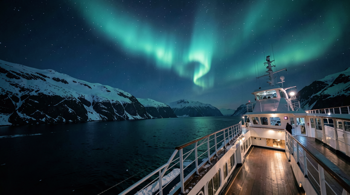
How Greenland and Iceland route planning differs from purely coastal Norway
Remote-at-sea expedition routes introduce different operational constraints. Small-ship northern lights cruise coverage emphasizes access to dark skies with little or no light pollution and the ability for flexible routing to exploit clear-sky weather opportunities and microclimates. This also notes that an expedition can still include wildlife viewing and off-vessel activities if skies are not cooperative. 11
Example itinerary framing from expedition coverage includes a Northern Lights Explorer voyage that starts in Tromsø, sails across Norwegian coastal regions, includes a planned day around Jan Mayen, then allocates extended time for East Greenland and finishes in Iceland, with explicit positioning near Arctic Circle and high-latitude regions described as prime aurora locations. 12
5) Alaska constraints and itinerary timing: long-season reality versus aurora season
Alaska Northern lights cruise planning presents a specific scheduling tension. Royal Caribbean’s Alaska-focused guide describes that Alaska cruises with that operator typically run from May to September, when weather tends to be better, while also noting that Northern Lights sightings are less common during those months. It then suggests selecting September itineraries to add a northern-aurora element while staying within the operating season. 13
Operationally, this means Alaska itineraries may prioritize cruising comfort and general weather suitability over peak darkness. The result is a different risk profile than Norway and Iceland, where northern lights cruise windows commonly emphasize months with longer nights. This does not change the underlying physics of aurora generation, but it changes the observation window created by the itinerary. 1 13
- Alaska itinerary window described as “May to September” for weather, with aurora sightings less common in those months. 13
- September described as a compromise that can still provide aurora viewing potential. 13
- Aurora visibility remains dependent on geomagnetic activity and local conditions. 3
6) What to look for when comparing cruise routes: onboard tracking, wake-up calls, and viewing deck design
Route selection is not only about latitude and season. Coverage on northern lights cruises points to onboard monitoring and observation workflows, including real-time tracking and the use of onboard experts who track solar activity. One guide explicitly describes onboard expertise that tracks solar activity in real time and wake-up calls when the sky turns green. 2
Another cruise-reporting example emphasizes onboard “northern lights wake-up calls when the aurora is visible,” pairing that with extended darkness from docking in Arctic Norway plus time at sea. Even where sightings are not guaranteed, the presence of alerts and structured observing periods can shift practical observation time from scattered self-searching toward concentrated observing windows. 6
| Decision factor | How it appears in current coverage | Why it matters |
|---|---|---|
| Operational flexibility | Captains reposition to avoid heavy cloud cover and find clear skies 2 | Cloud cover is a major limiter for visibility 3 |
| Solar monitoring | Onboard experts track solar activity in real time 2 | Visibility depends on geomagnetic and solar wind conditions 3 |
| Observing workflow | Wake-up calls when aurora is visible 6 | Maximizes useful observing time during a limited dark window 6 |
7) Risks, limitations, and practical friction points: cloud cover, non-guarantees, and remote-weather realities
A balanced view requires addressing why Northern lights cruises cannot treat sightings as certain. NOAA and related space-weather explanations emphasize that aurora visibility depends on solar wind and geomagnetic activity and also on local observing conditions. 3 In practice, cruise routes attempt to reduce operational risks with repositioning and planned dark hours, but cloud cover can still block the view during the moments auroral activity is present. 3 2
Cold-weather cruising introduces health and safety considerations. Winter-weight layers, water-resistant outerwear, and footwear suited to icy conditions are commonly recommended in cold-weather cruise preparation guidance. The same planning logic emphasizes hypothermia risk and the need to follow crew instructions for deck viewing or excursions to remote locations. These factors matter because extended night viewing and outdoor time can increase exposure to cold air and wind chill. 4
- Observing limitation: visibility depends on geomagnetic activity and local cloud cover. 3
- Operational mitigation: cruises may reposition to avoid heavy cloud cover. 2
- Safety and equipment friction: winter layers, water-resistant outerwear, and ice-suitable footwear are part of cold-climate planning guidance. 4
Sources
- NOAA on aurora mechanisms and visibility at higher latitudes: https://www.noaa.gov/education/resource-collections/space-weather/aurora
- AAA Trip Canvas on Northern lights cruise advantages, repositioning for clear skies, and onboard tracking: https://www.aaa.com/tripcanvas/article/northern-lights-cruises-our-guide-for-where-and-when-to-go-CM1714
- NOAA SWPC on aurora forecasting and geomagnetic drivers: https://www.swpc.noaa.gov/products/aurora-forecast-experimental
- General cruise planning guidance collected from LLM: winter-layer and safety considerations (as summarized in provided research inputs)
- Arctic Norway Tours on best season Sep to Mar and Northern Norway viewing: https://arcticnorwaytours.com/en-us/northern-lights-cruise-norway/
- TravelPulse on extended darkness, Tromsø and Alta calls, and onboard wake-up calls (Holland America coverage): https://www.travelpulse.com/news/cruise/holland-america-line-invites-travelers-to-experience-the-northern-lights-on-a-cruise
- Arctic Norway Tours on Hurtigruten coastal voyage route scale and ports: https://arcticnorwaytours.com/en-us/hurtigruten-coastal-voyage/
- Arctic Norway Tours on Hurtigruten Northern Lights Promise for voyages of 11 days or more: https://arcticnorwaytours.com/en-us/hurtigruten-coastal-voyage/
- Pierstop on Tromsø port context at 69°N and cruise docking area: https://pierstop.com/blog/tromso-cruise-guide
- Travel Arbitrage on Iceland aurora cruise season Sep to Mar and route comparisons: https://www.travelarbitrage.net/en/blog/iceland-northern-lights-cruise-guide-2026/
- Adventuresmith Explorations on small-ship flexibility, dark skies, and expedition structure: https://adventuresmithexplorations.com/cruises/arctic/northern-lights/
- Polar Cruises on Northern Lights Explorer route overview (Tromsø to Reykjavik) and planned Arctic-Circle positioning: https://polarcruises.com/expeditions/northern-lights-explorer-douglas-mawson/
- Royal Caribbean on Alaska itinerary months and that aurora sightings are less common during May to September: https://www.royalcaribbean.com/guides/northern-lights-alaska
Authored by 24Trendz team