Recognizing the Warning Signs of Polycystic Ovary Syndrome: A Clinical Overview
The warning signs of polycystic ovary syndrome, commonly called PCOS, may involve menstrual cycles, skin, hair, fertility, weight, and metabolic health. Symptoms vary substantially, and no single sign confirms the condition. PCOS is a hormonal and metabolic syndrome that may occur without polycystic ovaries visible on an ultrasound, so evaluation depends on the overall clinical pattern rather than one symptom alone. 1
Menstrual changes are a major early clue
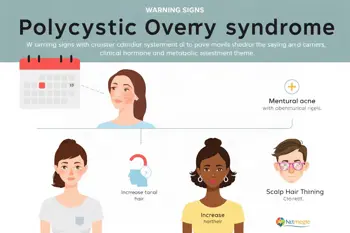
Irregular, infrequent, or absent periods are among the most recognizable warning signs. A cycle may become difficult to predict, occur several weeks apart, or disappear for months. These patterns can reflect irregular ovulation, which is a central feature clinicians assess when considering PCOS. Some people may also experience unusually heavy or prolonged bleeding after a long interval without menstruation. Menstrual changes can have several causes, so they require clinical assessment rather than self-diagnosis. 2
Difficulty predicting ovulation can also affect attempts to become pregnant. PCOS may interfere with regular egg release, making conception more difficult for some people. Fertility concerns can therefore provide an important reason to discuss menstrual history with a healthcare professional, particularly when irregular cycles occur alongside acne, increased hair growth, or other androgen-related symptoms. The absence of fertility concerns does not exclude PCOS, because symptoms and reproductive effects differ between individuals. 3
Androgen-related skin and hair symptoms
Higher androgen activity may appear through new or increased facial and body hair. Coarser, darker hair may develop on the chin, upper lip, neck, chest, abdomen, or other areas. Persistent acne, especially acne that continues beyond adolescence or does not respond to usual skin care, may also occur. Oily skin is another reported feature. These findings do not establish PCOS by themselves, but their combination with irregular ovulation can be clinically meaningful. 4
Scalp hair changes can provide another visible clue. Some people notice thinning at the temples, a widening part, or a pattern resembling male-pattern hair loss. The same androgen-related changes that contribute to facial hair and acne may affect scalp hair differently. Hair loss has many possible explanations, including conditions unrelated to PCOS, which is why a clinician may review medical history, examine the pattern of hair change, and order laboratory tests when appropriate. 5
Metabolic signs and body changes
PCOS is frequently associated with insulin resistance, a state in which the body responds less effectively to insulin. Weight gain or difficulty losing weight may occur, although neither is required for diagnosis and PCOS can affect people across body sizes. Darkened, thickened, or velvety skin in body folds, known as acanthosis nigricans, may appear on the neck, underarms, or groin and can be associated with insulin-related changes. 6
Metabolic symptoms can be subtle and may not feel connected to reproductive symptoms. A person might first notice cycle irregularity, acne, or hair changes, while blood testing later identifies concerns involving glucose or cholesterol. PCOS is linked with increased long-term risks including type 2 diabetes, high blood pressure, abnormal cholesterol, sleep apnea, and endometrial problems. These associations explain why assessment may address broader health rather than focusing only on the ovaries. 8
Why symptoms can be missed
PCOS does not present in one standard pattern. Some people have irregular periods and excess hair growth, while others mainly experience acne, scalp hair thinning, infertility, or metabolic findings. Symptoms may begin during the teenage years or early adulthood, but their importance can be overlooked when irregular cycles are considered a normal part of adolescence or when individual signs appear unrelated. The condition is also commonly misunderstood as a disorder defined by ovarian cysts. 1
The term “polycystic” can create confusion because ovarian cysts are not required for diagnosis. Ultrasound may show numerous small follicles in some patients, but a person can have PCOS without that finding. Conversely, an ultrasound appearance alone does not establish the syndrome. Clinicians generally consider combinations of irregular ovulation, excess androgen effects or laboratory evidence, and ovarian findings when relevant, while excluding alternative explanations. 7
How clinicians investigate possible PCOS
Evaluation generally begins with a detailed history covering cycle timing, bleeding patterns, acne, hair growth, scalp hair changes, weight changes, medications, and fertility. A physical examination may assess skin, hair distribution, blood pressure, and other findings. Blood tests can help evaluate androgen levels and metabolic health. Depending on the situation, pelvic ultrasound may be used to assess the ovaries, but testing is interpreted alongside symptoms and examination findings rather than treated as a standalone answer. 3
Other causes of similar symptoms must be considered before a PCOS diagnosis is made. Irregular menstruation, excess hair, acne, or hair loss can arise from more than one hormonal or medical condition. A healthcare professional may therefore use medical history, examination, laboratory testing, and sometimes ultrasound to distinguish PCOS from other explanations. Persistent or newly developing symptoms deserve assessment, especially when several warning signs occur together or fertility becomes a concern. 4
What to record before a medical discussion
A symptom record can make the clinical history more precise. Useful details include the first day of each period, gaps between cycles, unusually heavy bleeding, new facial or body hair, acne location and persistence, scalp hair thinning, skin darkening, weight changes, and the length of time spent trying to conceive. Listing medications and relevant medical history can also help clinicians interpret symptoms and determine which tests may be appropriate. 2
The main warning is not one isolated feature but a persistent pattern involving reproductive, androgen-related, or metabolic changes. PCOS is manageable through individualized medical care, but treatment choices depend on goals such as cycle regulation, skin and hair concerns, fertility, and reduction of metabolic risks. Because symptoms overlap with other conditions, online checklists cannot replace diagnosis. Professional evaluation is the appropriate way to clarify whether PCOS or another explanation accounts for the pattern. 7
Sources
- World Health Organization, “Polycystic ovary syndrome,” https://www.who.int/news-room/fact-sheets/detail/polycystic-ovary-syndrome
- Office on Women’s Health, “Polycystic Ovary Syndrome,” https://womenshealth.gov/a-z-topics/polycystic-ovary-syndrome
- National Institute of Diabetes and Digestive and Kidney Diseases, “Polycystic Ovary Syndrome,” https://www.niddk.nih.gov/health-information/endocrine-diseases/polycystic-ovary-syndrome/all-content
- American College of Obstetricians and Gynecologists, “Polycystic Ovary Syndrome,” https://www.acog.org/womens-health/faqs/polycystic-ovary-syndrome-pcos
- Mayo Clinic, “Polycystic ovary syndrome,” https://www.mayoclinic.org/diseases-conditions/pcos/symptoms-causes/syc-20353439
- MedlinePlus, “Polycystic ovary syndrome,” https://medlineplus.gov/polycysticovarysyndrome.html
- National Health Service, “Polycystic ovary syndrome,” https://www.nhs.uk/conditions/polycystic-ovary-syndrome/
- Endocrine Society, “Polycystic Ovary Syndrome,” https://www.endocrine.org/patient-engagement/patient-resources/polycystic-ovary-syndrome
Authored by 24Trendz team