Best float tank therapy for stress relief: An evidence-based consumer guide
Best float tank therapy for stress relief: An evidence-based consumer guide
For people seeking stress relief through silence, weightlessness, and reduced sensory input, float tank therapy offers a structured form of rest rather than a conventional massage or meditation class. This article explains what the treatment involves, what research suggests about stress and anxiety, and how to assess safety, cleanliness, comfort, and suitability without treating commercial claims as medical guarantees.
How float tank therapy works
Float therapy, also called flotation-REST or sensory deprivation therapy, places a person in approximately 10 inches of water saturated with roughly 1,000 pounds of magnesium sulfate, commonly known as Epsom salt. The concentration creates buoyancy, while water temperatures generally remain near skin temperature, around 93.5 to 95 degrees Fahrenheit. These conditions reduce pressure from gravity, thermal sensation, and some ordinary tactile input. 1
A typical session occurs in a private tank, pod, or pool where the participant can control lighting and, in some facilities, sound. Darkness and quiet are optional in certain settings, but they are central to the sensory-reduction model. The intended result is a low-stimulation environment that may make it easier to notice muscle relaxation, breathing, and mental activity without external interruptions. 2
What the evidence says about stress
Clinical research cited in the supplied evidence base indicates that flotation-REST can reduce perceived stress and anxiety symptoms, with one NIH-indexed study specifically examining stress and anxiety outcomes. The proposed mechanism is not that the tank changes every aspect of brain chemistry, but that reduced sensory and gravitational demands may support a shift away from sustained arousal and toward relaxation. 3
Research summaries describe cortisol reductions after sessions, although the size and consistency of the effect vary across studies. A 2024 review described 63 studies involving 1,838 participants and reported consistent findings for anxiety, stress, pain, and sleep, while also noting that the field contains studies of different designs and quality. These findings support cautious optimism, not a conclusion that floating treats an anxiety disorder or replaces clinical care. 4
Which format may suit stress relief
The most relevant choice is usually the environment, not a particular brand or named facility. Enclosed pods can provide darkness and quiet in a compact space, while larger private pools may feel less confined and allow more room to change position. Both formats use buoyant saltwater, and many centers provide a private shower, towels, earplugs, and controls for lighting or sound. 5
People who feel uneasy in confined spaces may prefer a roomier pool or a tank with an accessible lid and interior light. Those seeking stronger sensory reduction may favor a private pod or suite that can become fully dark and quiet. A first session is often described as lasting 60 minutes, while some facilities offer 75- or 90-minute formats. Longer sessions are not automatically more effective for stress. 6
What to assess before choosing a center
Water sanitation is a central quality indicator because the same water is used by multiple customers. The Floatation Tank Association identifies sanitation standards as an important part of safe operation, and commercial centers commonly describe filtration and disinfection processes such as multiple-stage filtration, ultraviolet light, hydrogen peroxide, or ozone. A responsible facility should explain its cleaning cycle, water testing, shower requirements, and procedures for handling contamination. 7
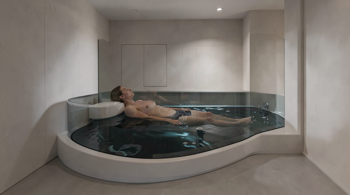
Privacy and staff guidance also affect whether the setting is suitable for stress relief. Useful questions include whether the tank is in a private room, whether an internal light or assistance system is available, how the facility responds to panic or discomfort, and whether first-time instructions are provided. Facility descriptions commonly list private changing and shower areas, earplugs, towels, and user-controlled lighting as practical features rather than therapeutic guarantees. 8
Preparing for a first session
Preparation can reduce avoidable discomfort. Guidance for first-time users generally includes showering before entering the tank, protecting irritated skin, and avoiding shaving or waxing immediately beforehand because concentrated magnesium sulfate may sting sensitive areas. Earplugs can help reduce sound, while a small amount of petroleum jelly may be suggested by some facilities for minor cuts, subject to center policy. 9
The first minutes may feel unfamiliar because the body is supported without normal pressure from a mattress or floor. A participant can keep the light on, leave the lid open where applicable, or exit the tank if anxiety increases. Floating should be treated as an optional complementary wellness practice, especially when stress is persistent, severe, or associated with panic, depression, trauma symptoms, or impaired daily functioning. 10
Risks, limits, and realistic expectations
Float therapy is generally presented as suitable for many healthy adults, but it is not appropriate for every situation. Concerns requiring advance discussion include open wounds, contagious skin conditions, uncontrolled epilepsy, severe claustrophobia, intoxication, and medical or psychiatric conditions that could make isolation unsafe. Pregnancy, medication use, and significant health conditions should be reviewed with a qualified clinician and the facility before participation. 6
The strongest expectation supported by the supplied research is short-term relaxation and possible reductions in acute stress or anxiety. Evidence remains more limited for treating chronic disease, insomnia, PTSD, or long-term burnout, and commercial claims about immune enhancement, magnesium absorption, inflammation, or guaranteed neurological effects should be interpreted cautiously. Floating can complement medical or psychological treatment, but it should not delay assessment when symptoms are ongoing or worsening. 4
How to interpret results over time
Some participants report feeling calmer after one session, but individual responses differ. A quiet environment may be particularly useful for people whose stress is linked to constant sensory input, muscle tension, or difficulty creating uninterrupted time for relaxation. Others may find darkness, silence, or unusual bodily sensations uncomfortable. A useful evaluation focuses on observable outcomes such as perceived tension, sleep quality, and anxiety after sessions rather than relying on broad promises. 2
Repeated use is sometimes recommended in wellness literature, with summaries describing cumulative benefits after four to eight weekly floats. That pattern should be regarded as a practice suggestion rather than a universally validated treatment schedule. Costs, travel, sanitation quality, accessibility, and the possibility of no meaningful benefit are practical constraints. The most defensible choice is a clean, transparent, private setting that explains limitations and allows the participant to stop safely. 5
Sources
- BestDosage, “Float Therapy: A Chemist's Guide to Sensory Deprivation Tanks”
- National Institutes of Health, “Floatation-REST research on stress and anxiety”
- Cleveland Clinic, “Flotation Therapy”
- Float Finder, “Float Tank Science: How Restricted Environmental Stimulation Works”
- Float St. Louis, “What Is Float Therapy?”
- WebMD, “What to Expect During a First-Time Float Therapy Session”
- Floatation Tank Association, “Safety Standards”
- Psychology Today, “Can Sensory Deprivation Tanks Help Anxiety?”
- Men's Health, “What to Know Before Using a Float Tank”
- Wellness Finder Pro, “Float Tank Therapy Benefits: The Honest Truth”
Authored by 24Trendz team