Best shockwave therapy for Achilles tendonitis: An evidence-based clinical analysis
People searching for the best shockwave therapy for Achilles tendonitis are usually comparing radial pressure wave therapy with focused extracorporeal shockwave therapy. The evidence supports a more cautious interpretation: treatment type, tendon location, exercise rehabilitation, symptom duration, and device settings all matter, and current comparative research has not established one universally superior modality.
What the two shockwave approaches mean
Extracorporeal shockwave therapy is an umbrella term covering acoustic-wave treatments delivered through the skin. Focused shockwave therapy concentrates energy at a target and is generally capable of reaching deeper tissue, while radial pressure wave therapy disperses energy outward from the applicator and is typically used for shallower regions. These mechanical differences explain why clinicians may choose different approaches for different tendon locations, but they do not by themselves prove superior pain or function outcomes.
- Focused therapy is often considered when the painful tissue lies deeper or close to the heel insertion.
- Radial therapy is commonly used for midportion symptoms and is widely available in physiotherapy settings.
What current comparative research shows
A 2026 systematic review and meta-analysis in Scientific Reports assessed randomized trials comparing radial and focused shockwave therapy across upper- and lower-limb tendinopathies. Nine articles involving 530 patients were included, but the review found no clear superiority for either modality in pain or functional outcomes; certainty was rated low or very low for those conclusions. The evidence therefore supports matching treatment to the clinical presentation rather than labeling radial or focused therapy as categorically superior.
The review did identify a moderate-quality finding for tennis elbow, where radial therapy improved wrist-extensor strength more than focused therapy, with a mean difference of 1.81 and a 95% confidence interval from 0.97 to 2.64. That result concerns the wrist, not Achilles tendinopathy, so it should not be transferred directly to heel or calf symptoms. Achilles-specific comparisons remain less decisive, particularly when protocols, energy levels, and exercise programs differ between studies.
Evidence specific to Achilles tendinopathy
A systematic review published in the Journal of Orthopaedic & Sports Physical Therapy in 2026 evaluated shockwave therapy for both midportion and insertional Achilles tendinopathy. Its objective was to compare shockwave used alone, as a co-intervention, or against no treatment with sham shockwave in randomized controlled trials. The title, “A Nail in the Coffin?”, signals a critical reassessment of assumptions about effectiveness, rather than confirmation that every patient benefits from adding shockwave.
A separate 2026 randomized clinical trial studied 41 people with chronic midportion Achilles tendinopathy. Both groups completed a 12-week progressive resistance program, while one group also received four focused shockwave sessions. Both groups reported significant pain reduction and functional improvement, but tendon macromorphology changed minimally. Some ultrasound-based remodeling measures appeared more pronounced in the combined group, although the study does not establish that focused therapy produces superior patient outcomes to loading exercise alone.
Midportion versus insertional symptoms
Location is a central consideration when assessing the best shockwave therapy for Achilles tendonitis. Midportion tendinopathy generally refers to pain several centimeters above the heel, whereas insertional tendinopathy affects the attachment at the calcaneus. The two presentations expose the tendon to different mechanical stresses and may require different loading modifications. Research summaries commonly describe radial therapy as more frequently used for midportion cases and focused therapy as a possible choice for deeper insertional tissue, but these are clinical patterns rather than definitive rules.
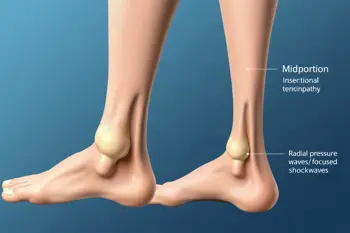
- Midportion cases are commonly evaluated for progressive calf and tendon loading tolerance.
- Insertional cases require attention to the heel attachment and the amount of compression during exercise.
- Neither location makes shockwave a substitute for diagnosis, rehabilitation planning, or load management.
Typical treatment protocols and practical limitations
Published clinical information commonly describes a course of three to five shockwave sessions spaced approximately seven to ten days apart. Protocols can still vary substantially in energy, pulse count, treatment frequency, applicator type, and pain tolerance. A clinic’s device brand is therefore less informative than whether the practitioner can explain the diagnosis, treatment parameters, expected response, and exercise plan. Reported ESWT success rates of roughly 60% to 80% are usually associated with combined physical therapy, not shockwave used as an isolated intervention.
Shockwave can be uncomfortable during application, and adverse effects are among the outcomes monitored in comparative trials. The broader evidence base also has important limitations, including small studies, differing treatment protocols, and low or very low certainty for several comparisons. Symptoms may improve gradually rather than immediately, while tendon capacity still depends on ongoing progressive loading. These factors create practical friction for patients who expect a single procedure to resolve a chronic tendon problem.
Safety, regulation, and treatment selection
Most guidelines and evidence summaries place conservative care, particularly structured eccentric or progressive strengthening, before shockwave therapy. The treatment decision should account for symptom location, duration, severity, activity demands, previous rehabilitation, and the possibility of a partial tear or another source of heel pain. An assessment by a qualified clinician is important because a painful Achilles tendon is not automatically suitable for acoustic-wave treatment, and inappropriate loading can remain a problem even when pain temporarily changes.
In the United States, many shockwave devices are regulated as Class II medical devices and require 510(k) clearance for specific indications. Regulatory clearance describes device authorization for a defined use; it does not guarantee that one machine, energy setting, or protocol is more effective than another. Common systems used in clinical practice include Storz Medical, EMS DolorClast, and Richard Wolf PiezoWave devices, but published outcomes should be judged by study design and protocol rather than brand recognition.
How to interpret the evidence before treatment
The most defensible conclusion is that no clearly proven overall winner exists between radial and focused shockwave therapy for Achilles tendinopathy. Focused treatment may be considered for deeper or insertional targets, while radial treatment may be selected for more superficial midportion symptoms, yet the 2026 comparative review found no clear pain or function advantage across tendinopathies. The strongest practical signal is the importance of progressive rehabilitation, with shockwave considered an adjunct when conservative management has been appropriately attempted.
- Confirm whether symptoms are midportion or insertional.
- Ask which evidence supports the proposed modality and protocol.
- Clarify how shockwave will be combined with progressive loading.
- Discuss discomfort, adverse effects, expected time course, and follow-up.
- Be cautious about claims of guaranteed healing or universal success.
Sources
- Journal of Orthopaedic & Sports Physical Therapy, systematic review and meta-analysis: https://www.jospt.org/doi/10.2519/jospt.2026.13985
- Journal of Science and Medicine in Sport, randomized clinical trial: https://doi.org/10.1016/j.jsams.2026.04.008
- Scientific Reports, radial versus focused shockwave systematic review: https://www.nature.com/articles/s41598-026-37160-3
- Treat My Achilles, clinical explanation of extracorporeal shockwave therapy: https://www.treatmyachilles.com/post/extracorporeal-shockwave-therapy-for-achilles-tendonitis-does-it-work
- Cleveland Clinic, general shockwave therapy information: https://my.clevelandclinic.org/health/treatments/21516-shockwave-therapy
- National Institutes of Health, clinical evidence on chronic Achilles tendinopathy: https://www.ncbi.nlm.nih.gov/pmc/articles/PMC6029906/
- American Academy of Orthopaedic Surgeons, Achilles tendinopathy guidance: https://www.aaos.org/
- U.S. Food and Drug Administration, medical-device regulatory information: https://www.fda.gov/
Authored by 24Trendz team