Daily 10 Minute Fitness Routines: A Practical Evidence Review
The phrase “10-minute HIIT workouts, no equipment needed” describes a practical approach for busy days: short sessions using bodyweight movements, intervals, or mobility drills. Research and professional guidance indicate that a focused 10-minute workout can contribute to cardiovascular fitness, strength, mood, and daily activity, although it does not eliminate the need for broader weekly movement or appropriate recovery. 1
Why Ten Minutes Can Still Matter
High-intensity interval training alternates brief, demanding efforts with recovery periods. Kaiser Permanente describes intense exercise such as sprinting followed by rest, with the work interval raising heart rate and the recovery interval allowing it to come down. The same source reports that HIIT may improve blood pressure and reduce heart-disease risk, while a 10-minute session containing about one minute of intense exercise can provide benefits comparable to a longer moderate workout. 1
The main practical advantage is adherence. A short routine creates fewer scheduling barriers than an hour-long workout, making repeated participation more realistic for people managing work, family, or other obligations. Gold’s Gym reports that focused short sessions can challenge major muscle groups, support endurance, improve energy, and help mental sharpness, while fitness experts cited by Stridekick emphasize that consistency is more influential than occasional marathon sessions. 28
Common Formats for a Daily Routine
Most 10-minute plans use an interval, circuit, or targeted format. One example uses 40 seconds of work followed by 20 seconds of rest for 10 exercises, which fills the full 10 minutes and keeps transitions simple. Another follow-along routine uses 30 seconds of work and 15 seconds of rest across a broader exercise menu, allowing users to select lower-impact alternatives such as marching, step-outs, slow climbers, or squat-to-calf raises. 35
- HIIT: brief high-effort intervals separated by recovery.
- Circuit training: several strength and cardio exercises performed in sequence.
- Mobility: controlled movements emphasizing joint range and reduced stiffness.
- Targeted strength: a short session focused on legs, upper body, or core.
Exercise selection should match current ability rather than forcing every movement into a high-impact version. Demonstrated alternatives include no-jump burpees, high-knee marching, slow mountain climbers, lateral side steps, and step-out plank jacks. These substitutions preserve the movement pattern while reducing jumping and impact, which can make a routine more suitable for beginners or people returning after inactivity. 36
Building a No-Equipment Full-Body Session
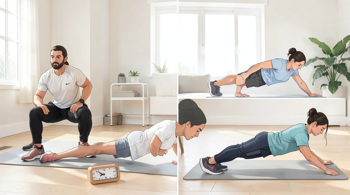
A balanced bodyweight routine can cover the lower body with squats and reverse lunges, the upper body with push-ups, and the trunk with planks, shoulder taps, or bicycle crunches. A published 10-minute video sequence combines high knees, burpees, reverse lunges, mountain climbers, lateral movements, push-ups, plank variations, commandos, and abdominal exercises. The structure demonstrates how cardio, strength, and core work can be combined without gym equipment. 3
Movement quality remains important when the workout is short. Squats require controlled lowering and a stable torso; lunges require balance and knee control; push-ups can be performed from an elevated surface or knees when necessary. A routine should stop or change an exercise when sharp pain, unusual dizziness, or loss of control appears. Gold’s Gym specifically advises consultation with a qualified healthcare provider before beginning a new program when a person has an injury history or medical condition. 2
Strength, Mobility, and Age-Appropriate Options
Ten minutes does not have to mean maximum intensity. SilverSneakers presents a 10-minute sequence built around simple exercises intended to improve strength, mobility, and general fitness. This type of session may be more appropriate on recovery days, for older adults, or for people whose primary limitation is stiffness rather than cardiovascular capacity. It also shows that a daily routine can prioritize controlled movement instead of perspiration or speed. 4
Resistance can be added when the goal is muscular development. Women’s Health describes a 10-exercise dumbbell workout using 40 seconds of work and 20 seconds of rest, with a recommended starting load of 2 kilograms for beginners and progression toward 5 kilograms as capacity develops. The program includes dumbbell thrusters and kneeling shoulder presses, illustrating how external resistance can make a short session more strength-focused. 5
Progression and Weekly Context
Progression can occur through better technique, a greater range of motion, slightly more repetitions, shorter recovery, or added resistance. It does not require turning every session into an all-out effort. A muscle-preservation analysis argues that conventional HIIT movements such as jumping jacks, high knees, and mountain climbers create cardiovascular and metabolic stress but may provide limited mechanical tension for larger muscles, making resistance patterns relevant when body composition and strength are priorities. 7
A daily 10-minute session also needs to be viewed within the broader activity week. The American Heart Association guidance supplied for this topic identifies 150 minutes of moderate activity per week as an adult target, so one 10-minute workout per day contributes 70 minutes but does not independently reach that figure. Additional walking, household movement, longer sessions, or several short activity breaks can provide the remaining volume, depending on ability and medical guidance. 11
Risks, Recovery, and Realistic Expectations
High intensity increases training demand, so repeating maximal HIIT every day may not be suitable for every person. Alternating hard sessions with mobility, moderate cardio, or strength-focused work can make the schedule more sustainable. The research describes “microdose fitness” as bursts lasting 10 minutes or less, sometimes as short as 60 seconds, including stairs, squats, or brisk walking. These short bouts can increase activity and interrupt long periods of sitting, but they are not presented as a complete replacement for all exercise. 10
Reported outcomes should also be interpreted carefully. BODi cites observational findings associating three to four minutes of vigorous daily activity with a 17% to 32% lower cancer risk and three short daily bursts with a 48% to 49% lower risk of cardiovascular death, but associations do not prove that brief exercise alone caused those outcomes. A sound routine therefore emphasizes gradual progression, technique, recovery, and long-term participation rather than dramatic promises about weight loss or health transformation. 108
Sources
- Kaiser Permanente, “10-minute HIIT workouts, no equipment needed,” https://healthy.kaiserpermanente.org/health-wellness/healtharticle.10-minute-hiit-workouts
- Gold’s Gym, “The 10 Minute Workout a Day Plan: Small Routine, Big Results,” https://www.goldsgym.com/blog/10-minute-workout/
- TIFF x DAN, “Quick 10 Minute Full Body Workout (No Equipment),” https://www.youtube.com/watch?v=4kfCR-lWIwc
- SilverSneakers, “10 Exercises 10 Minutes,” https://www.youtube.com/watch?v=123Ai40VBpo
- Women’s Health, “10-minute full-body dumbbell workout,” https://www.womenshealthmag.com/uk/fitness/workouts/a68052987/caroline-idiens-full-body-workout/
- TIFF x DAN, “10 MIN FULL BODY HIIT,” https://www.youtube.com/watch?v=mVlRIWksyDg
- Bassam Mallick, “Ultimate HIIT: 10-Minute Routine for Fat Loss + Muscle Gain,” https://www.bassammallick.com/blog/ultimate-hiit-fat-loss-muscle-gain
- Stridekick, “The Best 10-Minute Workout, According to Pros,” https://stridekick.com/blog/the-best-10-minute-workout-according-to-pros
- American Heart Association, “Recommendations for Physical Activity in Adults,” https://www.heart.org/en/healthy-living/fitness/fitness-basics/aha-recs-for-physical-activity-in-adults
- BODi, “Can a 10-Minute Workout Actually Change Your Health?” https://www.bodi.com/blog/can-a-10-minute-workout-actually-change-your-health
- HowToBeFit, “10 Minute Focus With Kelsey Heenan,” https://howtobefit.com/coach-blog/2026/04/22/10-minute-focus-with-kelsey-heenan/
Authored by 24Trendz team