Effective strategies for managing minor skin wounds at home: A clinical guide to safe first aid
Effective strategies for managing minor skin wounds at home begin with a simple assessment, careful cleaning, bleeding control, and protection from further contamination. Small, clean cuts and scrapes often heal without complications, but punctures, bites, embedded objects, deep tissue damage, and persistent bleeding require a different level of care. 1
Assess whether home care is appropriate
Home treatment is generally suitable for small, shallow cuts and scrapes that are not heavily contaminated and do not involve deeper structures. A wound may need professional assessment when it is deep, gaping, jagged, caused by a bite or puncture, located on the face, hand, joint, or genitals, or associated with impaired movement or sensation. Foreign material such as glass, splinters, or clothing fragments can remain hidden and contribute to infection, pain, or delayed healing. 2
- Do not attempt to remove a deeply embedded object at home.
- Seek advice sooner when diabetes, poor circulation, or immune suppression may impair healing.
- Consider the wound mechanism, depth, location, contamination, and bleeding before beginning home care.
Control bleeding with steady pressure
After washing the hands, place clean gauze or cloth directly over the wound and apply firm, continuous pressure. Repeatedly lifting the covering to inspect the injury can disturb clot formation. Most minor bleeding settles after several minutes, while bleeding that continues after about 10 minutes of firm pressure warrants medical evaluation. Elevating an injured arm or leg above heart level may also help reduce bleeding when practical. 3
- Use a clean dressing or cloth rather than bare hands.
- Add another layer if blood soaks through instead of removing the first layer.
- Persistent, forceful, or rapidly flowing bleeding requires urgent assessment.
Rinse away dirt and debris
Once bleeding is controlled, rinse the wound under clean running water for several minutes. Water helps flush dirt and particles from the injured surface, while mild soap can be used on the surrounding skin. Soap should not be scrubbed into the open wound because irritation may result. Hydrogen peroxide and rubbing alcohol are not recommended for routine cleaning because they can damage healthy tissue and slow healing. 4
- Use gentle rinsing rather than aggressive scrubbing.
- Pay particular attention to abrasions, where gravel or dirt may be ground into the skin.
- Seek professional care if debris cannot be removed with gentle rinsing.
Maintain a protected, slightly moist surface
After cleaning, a thin layer of petroleum jelly can help maintain moisture and reduce scab formation. A sterile adhesive bandage or nonstick dressing then protects the area from dirt, friction, and additional injury. Dressings should be changed at least daily and whenever they become wet or dirty. The appropriate covering depends on the wound’s size, location, drainage, and exposure to movement or friction. 5
- Wash hands before each dressing change.
- Choose a covering that does not adhere strongly to the wound surface.
- Keep observing the surrounding skin as the injury heals.
Use ointments and antiseptics cautiously
Routine wound care does not require harsh antiseptics applied directly to damaged tissue. Petroleum jelly is commonly recommended for minor cuts because it supports a moist healing environment. Some clinical guidance also discusses over-the-counter antibiotic ointment, but topical antibiotics can irritate skin or cause allergic reactions in some people. Product labels and individual medical circumstances matter, particularly when a wound is recurrent, extensive, or slow to heal. 6
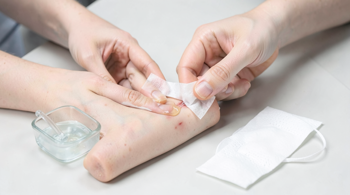
- Avoid hydrogen peroxide, rubbing alcohol, and iodine directly in a minor open wound.
- Stop using a topical product if a new rash, itching, or worsening irritation develops.
- Do not substitute topical products for evaluation of a deep or contaminated injury.
Monitor healing and recognize infection
Minor wound discomfort usually lessens after the first day, but worsening symptoms are not part of an uncomplicated recovery. Increasing redness, warmth, swelling, pain, pus, red streaks, or fever can indicate infection. A wound that contains retained foreign material may remain painful or heal slowly. Infection risk is higher in deep abrasions, puncture wounds, bites, and injuries that remain contaminated for longer periods. 7
- Watch whether redness expands rather than gradually settling.
- Pay attention to drainage that increases or develops an unpleasant odor.
- Contact a healthcare professional when infection signs appear or symptoms worsen.
Review tetanus protection and special risks
Tetanus prevention depends on the wound classification and the person’s vaccination history. A healthcare professional or public health service can determine whether a booster or other preventive treatment is appropriate. This review is particularly relevant after puncture wounds, heavily contaminated injuries, and wounds involving soil or other contamination. People with diabetes, circulation problems, immune suppression, or conditions that delay tissue repair should obtain individualized advice earlier rather than relying solely on routine home care. 8
- Keep a record of prior tetanus vaccinations when possible.
- Describe the object, bite, puncture, or contamination that caused the injury.
- Ask for professional guidance when vaccination history is uncertain.
Know when professional evaluation is necessary
Professional care is appropriate for deep or gaping wounds, uncontrolled bleeding, embedded objects, serious contamination, animal or human bites, and suspected injury to nerves, tendons, or blood vessels. Loss of sensation, weakness, paralysis, or inability to move a body part fully can indicate deeper structural damage. Wounds on sensitive locations may also require evaluation because function, scarring, and infection risks can be more consequential in those areas. 9
- Seek care for increasing redness, warmth, swelling, discharge, red streaks, or fever.
- Obtain evaluation when pain persists or intensifies rather than improving.
- Do not delay care for wounds that look more serious than a superficial cut or scrape.
Sources
- Merck Manual Consumer Version, First Aid for Cuts, Scrapes, and Wounds: https://www.merckmanuals.com/home/injuries-and-poisoning/first-aid/first-aid-for-cuts-scrapes-and-wounds
- Covenant Clinic, Cuts, Scrapes, and Wound Care: A Quick Guide: https://www.covenant.clinic/blog-post/cuts-scrapes-and-wound-care-guide
- American Academy of Dermatology, Treat Minor Cuts: https://www.aad.org/public/everyday-care/injured-skin/burns/treat-minor-cuts
- Mayo Clinic, First Aid for Cuts: https://www.mayoclinic.org/first-aid/first-aid-cuts/basics/art-20056711
- MedlinePlus, Cuts and Scrapes: https://medlineplus.gov/ency/patientinstructions/000040.htm
- Centers for Disease Control and Prevention, Tetanus: https://www.cdc.gov/tetanus/about/index.html
- National Health Service, Cuts and Grazes: https://www.nhs.uk/conditions/cuts-and-grazes/
- Cleveland Clinic, First Aid for Cuts and Scrapes: https://my.clevelandclinic.org/health/articles/15665-first-aid-for-cuts-and-scrapes
- Johns Hopkins Medicine, Cuts and Scrapes: https://www.hopkinsmedicine.org/health/treatment-tests-and-therapies/cuts-and-scrapes
Authored by 24Trendz team