Easy home ways to reduce daily stress: Evidence-informed routines for calmer days
Why small stress-management habits matter
Daily stress activates the body’s fight-or-flight response, releasing hormones such as adrenaline and cortisol. That response can be useful during immediate danger, but prolonged activation has been associated with effects involving mood, memory, sleep, cardiovascular health, and weight regulation. Sutter Health notes that chronic stress can increase risks including heart disease, depression, memory problems, and weight gain. The practical implication is that ordinary home routines can support recovery when practiced consistently, although they are not a substitute for clinical care when symptoms are severe. 3
Research highlighted by AARP and the American Institute of Stress indicates that short “micro-moments” may influence mood and perceived stress. A 2025 study reported that people who spent five minutes daily meditating or watching professionally produced inspirational videos felt more hopeful and experienced less stress than comparison groups for up to 10 days after the activity. A 2020 study also found benefits from five-minute meditation, with both five-minute and 20-minute groups improving, although the shorter group showed stronger reported outcomes in that study. 1 2
Use slow breathing to interrupt acute tension
Slow, deliberate breathing is one of the simplest techniques available at home because it requires no equipment and can be practiced while seated. Harvard Health describes the relaxation response as a physiological state that counteracts the stress response, while the U.S. Department of Veterans Affairs presents diaphragmatic breathing as a method that may reduce tension and promote calm. Breathing should remain comfortable rather than forced. Anyone who feels dizzy, uncomfortable, or short of breath should return to normal breathing. 12 15
A practical routine is to inhale gently for four counts and exhale for six, repeating several cycles. The home-routine research supplied for this article recommends pairing this pattern with brief journaling and light movement in a five-to-10-minute morning sequence. Longer exhalation is commonly used as a calming cue, but the available research does not establish one universally superior counting pattern. Breath holds should be avoided when they cause discomfort, particularly for people with relevant medical conditions. 4
Add brief physical activity during the day
Physical activity can help process stress-related arousal and support mood. The Centers for Disease Control and Prevention states that activity can improve mental health, reduce short-term anxiety, and support sleep quality. The World Health Organization likewise identifies mental-health benefits from regular physical activity and recommends reducing sedentary time through movement across the day. At home, movement can include walking indoors or outdoors, gentle stretching, household activity, or a short body-weight routine selected according to current ability. 7 14
Sutter Health identifies a 20-minute walk as an example of activity that may calm the mind and lift energy without requiring an intense exercise program. The goal is regularity rather than exhausting effort. A short movement break can be placed between work tasks, after a caregiving responsibility, or during a transition from one part of the day to another. People with medical limitations should adjust intensity appropriately and seek professional guidance when exercise causes unusual symptoms. 3
Practice mindfulness and control digital stimulation
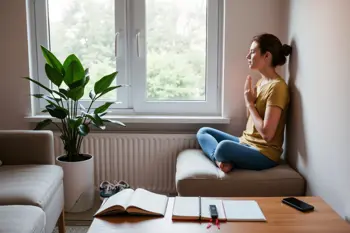
Mindfulness means directing attention to the present activity without immediate judgment. The National Center for Complementary and Integrative Health reports that mindfulness meditation may reduce stress, anxiety, and depressive symptoms for some people. At home, a practice can involve observing breathing, noticing physical sensations, or focusing carefully on an ordinary task such as washing dishes. Benefits depend on continued practice, and mindfulness should not be presented as a guaranteed treatment for every form of anxiety or distress. 9
Technology boundaries can reinforce that practice by reducing interruptions and separating restorative areas from constant notifications. The supplied home-routine research recommends a device-free zone, short restorative breaks every 60 to 90 minutes, and a low-stimulation evening period. Healthline also describes transition rituals for separating work from home, including changing clothes, taking a walk, closing an office door, showering, or tidying for 10 minutes. These actions create cues that the work period has ended, especially for people working at home. 4 5
Protect sleep and build an evening transition
Sleep affects emotional regulation and the ability to cope with pressure. The National Heart, Lung, and Blood Institute states that insufficient sleep can influence mood, decision-making, and stress management. A regular sleep schedule and a calming bedtime routine may therefore be more useful than relying on occasional recovery after several difficult nights. Evening steps can include lowering stimulation, keeping work materials separate from the sleeping area, and repeating a predictable sequence that allows mental and physical activity to wind down. 10
Stress-management routines should account for substances that can interfere with rest or emotional stability. The supplied research recommends reducing excessive caffeine, alcohol, and nicotine use, particularly when these habits worsen sleep or increase irritability. A transition ritual can begin before bedtime rather than at the moment of getting into bed. Quiet reading, gentle breathing, light stretching, or a warm shower may serve as signals for reduced activity, while persistent insomnia or major sleep disruption warrants medical assessment. 5 8
Reduce household overload through planning and order
Large, undefined responsibilities can make daily demands feel unmanageable. The National Institute of Mental Health lists time management among useful coping strategies, and Mayo Clinic includes planning and organization within practical approaches to stress relief. Breaking a task into a first action, a short work period, and a defined stopping point can reduce the mental burden of deciding what to do next. Flexible planning is preferable to a rigid schedule when caregiving, health needs, or unexpected responsibilities regularly change the day. 8 11
The home-routine material recommends modular blocks, brief check-ins, and a two-minute decluttering ritual. Its underlying principle is to reduce visual and cognitive load rather than pursue perfect order. A calm area can be created by assigning everyday items a consistent place and limiting devices or unfinished work in that space. These environmental changes do not eliminate external stressors, but they can make transitions, concentration, and recovery more predictable. Household maintenance remains ongoing, so the routine should be small enough to repeat without becoming another source of pressure. 4
Use nature, hobbies, and supportive relationships
Restorative activities can add positive experiences to days dominated by work or caregiving. Sutter Health identifies walking in nature, reading, gardening, cooking, music, and time with friends as examples of activities that can help people unwind and reconnect with themselves. Even a short period looking at art has been discussed as a quick way to shift attention away from ongoing demands. The relevant standard is personal engagement, not whether an activity is traditionally labeled as wellness. 1 3
Social support is another established coping resource. The American Psychological Association explains that stress affects the body and identifies relaxation, physical activity, and social support as useful management approaches. The American Heart Association also includes deep breathing, movement, adequate sleep, and social connection among lifestyle strategies that can help manage stress. A brief conversation with a trusted relative, friend, or community member may provide perspective and emotional support, but severe distress, panic, trauma symptoms, or interference with daily functioning calls for qualified mental-health assistance. 6 13
Sources
- AARP, “How to Relieve Stress in 5 Minutes or Less”
- The American Institute of Stress, “5 Things to Do for 5 Minutes a Day to Relieve Stress”
- Sutter Health, “10 Simple Ways to Cope With Stress Every Day”
- Brighter Daily Choices, “How to Build a Home Routine That Reduces Stress”
- Healthline, “How to Decompress After Work”
- American Psychological Association, “Stress Effects on the Body”
- Centers for Disease Control and Prevention, “Adding Physical Activity”
- National Institute of Mental Health, “So Stressed Out”
- National Center for Complementary and Integrative Health, “Meditation and Mindfulness”
- National Heart, Lung, and Blood Institute, “Sleep Deprivation”
- Mayo Clinic, “Stress Relief”
- Harvard Health Publishing, “Relaxation Techniques”
- American Heart Association, “Stress Management”
- World Health Organization, “Physical Activity”
- U.S. Department of Veterans Affairs, “Deep Breathing”
Authored by 24Trendz team