Tropical Island Getaways: A Practical Analysis of Beaches, Access, and Secluded Resorts
Private-island escapes, secluded beaches, turquoise lagoons, and resort stays are central themes in tropical island getaways. The category includes highly private retreats such as Guana Island and Ray Caye, larger island destinations such as Fiji and the Bahamas, and culturally or geographically varied locations including Puerto Rico, Hawaiʻi, and the Dominican Republic. The meaningful differences are access, scale, accommodation style, marine conditions, weather exposure, and how much of the surrounding community is integrated into the trip.
How tropical island destinations differ
Tropical island travel is not a single experience. The Maldives is associated with low-lying coral islands, lagoons, snorkeling, scuba diving, and resort islands, while Fiji combines reef activities, cultural experiences, inter-island travel, and accommodation options across a South Pacific island nation. Seychelles adds beaches, granite landscapes, protected natural areas, and marine activities, creating a setting that differs materially from a flat atoll destination. These geographic distinctions affect available excursions, transportation, and the balance between resort time and exploration. 1
Caribbean destinations also vary considerably. Puerto Rico combines beaches with El Yunque National Forest, historic San Juan, and Spanish-Caribbean culture. The U.S. Virgin Islands center on St. Thomas, St. John, and St. Croix, with sailing, snorkeling, beaches, and national-park scenery. Aruba is characterized by white-sand beaches, dry sunny weather, and an arid interior, while the Bahamas offers island-hopping across a large archipelago with beaches, reefs, boating, and diving. 2
Private-island stays and capacity
Private-island resorts emphasize seclusion, controlled capacity, and a concentrated property experience. Guana Island in the British Virgin Islands covers 850 acres and accommodates a maximum of about 35 guests in 18 rooms and villas, with seven beaches, hiking trails, tropical forest, quiet ponds, and flamingos described in the supplied reporting. The resort and destination are effectively the same place, which reduces the need to travel between a hotel and separate attractions but also limits spontaneous access to the wider region. 3
Other private-island models use different scales and service structures. Turtle Island Fiji has 14 thatched bures across a 500-acre island, with each bure assigned a personal concierge or butler known as a Bure Mama. Ray Caye, located off Placencia in Belize, places guests near the Belize Barrier Reef and combines oceanfront accommodation with snorkeling, diving, fishing, boat transfers, and guided marine activities. These examples show that “private island” may mean either intimate low-capacity service or a more activity-oriented reef base. 4
Accommodation and traveler suitability
Accommodation design often signals the intended traveler profile. Amanpulo in Palawan places casitas in the forest canopy, on hillsides, or along the beach, while its villas can contain up to four bedrooms, a private pool, private chef, and butler. Its location on Pamalican Island is reached by a 90-minute flight from Manila International Airport. The arrangement is suited to travelers prioritizing privacy, multibedroom space, and planned excursions over easy independent movement through a town. 5
Family and adults-only categories require particular attention before travel. Fantasy Island Resort in Roatán is an all-inclusive resort on a private island with three private beaches, 160 rooms, ocean, pool, or lush scenery views, and family-oriented positioning. By contrast, Lomani Island Resort in Fiji is explicitly adults-only and focuses on couples, intimacy, wellness, snorkeling, kayaking, and nature-based sustainable adventures. In practical terms, eligibility is determined by the accommodation’s stated age policy, room configuration, and capacity rather than by the destination label alone. 6
Marine activities and nature-based experiences
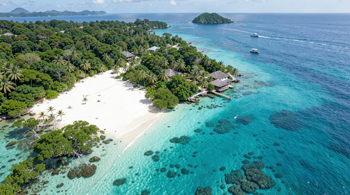
Marine access is a defining feature across the category, but the documented experiences differ by location. Conrad Maldives Rangali Island spans two naturally formed islands in the South Ari Atoll, with villas above the water and along white-sand beaches. The surrounding waters are associated with year-round encounters with whale sharks and manta rays, while Ithaa is described as the world’s first undersea restaurant, positioned five meters below the Indian Ocean’s surface. 7
Belize and the British Virgin Islands provide alternative activity patterns. Ray Caye places guests near the Belize Barrier Reef for snorkeling and diving, with complimentary paddleboards, kayaks, Hobie Cats, and snorkel gear among its listed amenities. Scrub Island in the British Virgin Islands combines a marina, waterfront dining, ocean-view accommodation, and access to open Caribbean water; its supplied itinerary describes a 10-minute private ferry from EIS airport. Such activities remain dependent on sea conditions, operator schedules, and the physical limits of island infrastructure. 8
Access, seasonal risk, and practical friction
Seclusion creates transportation friction. Amanpulo requires a 90-minute flight from Manila, Scrub Island uses a private ferry from Trellis Bay Dock, and the Pine Cay resort in Turks and Caicos is described as occupying an 800-acre private island reached through a sleepy marina gateway. These arrangements can reduce casual access to nearby communities and make arrival timing, luggage handling, boat schedules, and weather disruption more consequential than at a conventional mainland hotel. 9
Weather is a material planning risk for tropical destinations in or near the Atlantic and Caribbean. The National Hurricane Center identifies the official Atlantic hurricane season as June 1 through November 30. That designation does not mean every island experiences severe conditions during those dates, but it establishes a period requiring attention to official forecasts, transportation interruptions, marine closures, and accommodation policies. The comparable issue in the South Pacific and Indian Ocean is destination-specific seasonal planning rather than assuming uniform tropical weather. 10
Choosing by trip purpose, not resort imagery
A useful comparison begins with the experience sought. Travelers seeking landscape variety may find Hawaiʻi relevant because its beach destinations coexist with volcanic scenery, including Hawaiʻi Volcanoes National Park. Puerto Rico offers a stronger combination of nature, historic San Juan, and Spanish-Caribbean culture. The Dominican Republic connects resort beaches with mountains, rainforest, colonial settings, and cultural attractions. These destinations generally provide a broader regional context than a private island where the resort grounds supply most daily activities. 11
Travelers prioritizing quiet, marine recreation, or wellness should compare capacity and operating structure rather than rely on tropical branding. Guana Island limits occupancy sharply relative to its land area, Lomani restricts stays to adults, and Turtle Island assigns dedicated hosts to its small inventory of bures. Ongoing maintenance realities include remote supply chains, scheduled boat or aircraft transfers, limited dining choices, and dependence on staff availability for excursions. Market friction is therefore part of the experience: greater privacy can mean fewer independent alternatives and more advance coordination. 3
Sources
- Visit Maldives, https://visitmaldives.com/en
- Hawaiʻi Tourism Authority, Discover Puerto Rico, U.S. Virgin Islands Department of Tourism, Aruba Tourism Authority, and The Islands of The Bahamas
- Caribbean Journal, https://www.caribjournal.com/2026/07/07/caribbean-island-guana-seven-beaches/
- Ray Caye Island Resort and Turtle Island Fiji, https://raycaye.com/ and https://www.turtlefiji.com/week-on-a-private-island-fiji/
- Amanpulo, https://www.aman.com/resorts/amanpulo
- Fantasy Island Resort and Lomani Island Resort, https://www.fantasyislandresort.com/ and https://www.lomaniisland.com/
- Conrad Maldives Rangali Island, https://www.conradmaldives.com/
- Ray Caye Island Resort and Scrub Island, https://raycaye.com/ and https://www.scrubisland.com/seven-days-on-scrub-island/
- The New York Times, https://www.nytimes.com/2026/03/11/travel/turks-and-caicos-private-island-all-inclusive.html
- National Hurricane Center, https://www.nhc.noaa.gov/climo/
- Hawaiʻi Tourism Authority, Discover Puerto Rico, and Ministry of Tourism of the Dominican Republic
Authored by 24Trendz team