Best physical therapy for rotator cuff tears: Evidence, Exercises, and Treatment Decisions
The best physical therapy for rotator cuff tears generally centers on symptom-guided movement, progressive resistance training, and restoration of shoulder and scapular control. Conservative rehabilitation is commonly considered first for many non-traumatic or degenerative tears, although tear size, injury mechanism, tissue status, functional goals, and response to treatment affect the decision. A 2026 literature review describes conservative care as a stepwise process that combines education, mobility work, strengthening, and functional progression. 1
How physical therapy approaches a torn rotator cuff
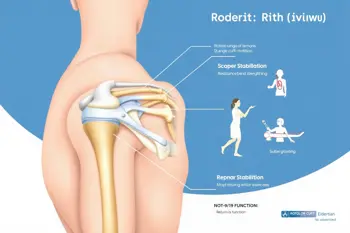
A rotator cuff tear can involve the supraspinatus, infraspinatus, teres minor, or subscapularis tendons. The cuff helps rotate the arm and stabilize the humeral head in the shoulder socket, so rehabilitation is not limited to the painful tendon. Treatment also addresses shoulder range of motion, muscular coordination, scapular mechanics, and the ability to tolerate occupational, recreational, or sporting demands. 3
Physical therapy does not necessarily recreate an intact tendon, particularly when a tear is full thickness. Instead, training may improve the capacity and coordination of the remaining cuff and surrounding muscles. The clinical objective is usually better pain control, usable movement, improved strength, and restored function. Programs should be individualized rather than selected from a fixed calendar because pain response, movement quality, strength, and tissue restrictions differ among patients. 2
Phase one: symptom control and gentle mobility
Early rehabilitation typically reduces provocative loading while preserving comfortable movement. Pendulum exercises, passive or assisted elevation, gentle shoulder rotation, and scapular activation are commonly used when active lifting is painful. A finger-walk or “climb the wall” movement can help maintain elevation gradually, provided it remains within a tolerable range. Activity modification is also important, especially when repeated overhead motion or heavy loading increases symptoms. 6
The initial phase should not be interpreted as complete immobilization in non-surgical care. The appropriate amount of movement depends on the examination and the type of tear. After surgery, protection is more restrictive because the repaired tendon requires biological healing, and surgeon-specific limits may govern passive motion, active movement, and resistance. Non-operative care generally permits pain-guided movement earlier than post-surgical rehabilitation. 2
Phase two: restoring active movement and mechanics
Once symptoms are manageable, therapy progresses toward unassisted range of motion and better control of the shoulder blade. Scapular exercises may target the serratus anterior and other stabilizing muscles to support coordinated upward rotation and positioning of the arm. The purpose is not to force the shoulder into a prescribed posture, but to improve movement efficiency and reduce excessive demand on painful structures during reaching and elevation. 1
Exercise selection should be based on the patient’s movement limitations and response rather than on a single supposedly superior routine. A 2025 Bayesian network meta-analysis examined seven exercise categories for rotator cuff-related shoulder pain and included 15 studies involving 913 participants. The review found substantial evidence supporting exercise therapy, but it did not establish one universal program for every presentation or tear. 5
Phase three: progressive strengthening
Strengthening generally advances from low-load isometric work to resisted internal rotation, external rotation, elevation, and scapular exercises. Elastic bands, cables, light weights, or body-supported positions may be used according to tolerance. The essential principle is gradual loading with consistent monitoring of pain, movement quality, and next-day response. Eccentric contractions may be included in later rehabilitation, although the exact dosage and exercise choice require clinical adjustment. 3
Progressive resistance is especially relevant because a shoulder may feel better before it has regained adequate capacity for work or sport. A structured program therefore measures more than pain alone. Functional reach, active range, strength, endurance, and the ability to perform required tasks help determine whether loading should advance. Home exercise adherence is repeatedly emphasized in rehabilitation guidance because outcomes depend on regular participation between supervised sessions. 6
| Rehabilitation stage | Typical emphasis | Progression consideration |
|---|---|---|
| Early | Comfortable mobility and symptom management | Pain and irritability remain controlled |
| Active motion | Unassisted movement and scapular control | Movement quality improves without significant flare-ups |
| Strengthening | Rotator cuff and shoulder-blade resistance work | Load tolerance and strength increase |
| Return to function | Work, recreation, or sport-specific tasks | Functional testing supports the demands of the activity |
Physical therapy compared with surgery
For many atraumatic degenerative tears, conservative physical therapy can produce meaningful functional improvement and may allow patients to avoid surgery. Earlier evidence cited in the research payload describes physical therapy and surgery as having comparable long-term outcomes for some atraumatic full-thickness tears. This comparison does not mean that surgery is unnecessary in every case, because symptoms, weakness, injury history, tear characteristics, and personal goals can change the balance. 8
Evidence for partial-thickness tears is more mixed. A 2026 systematic review and meta-analysis pooled 33 trials involving 1,818 patients and found higher weighted Constant and ASES scores in surgical cohorts than in non-surgical cohorts, although the indirect comparison had important limitations and no specific surgical technique was shown to be superior. The findings support shared clinical decision-making rather than an automatic preference for either treatment. 4
When rehabilitation needs reassessment
Reassessment is appropriate when pain or function fails to improve despite a well-adhered, progressively adjusted program, or when the shoulder cannot meet essential work, daily-life, or sporting requirements. Traumatic injuries, substantial weakness, massive tears, and symptoms that remain disabling may justify earlier orthopedic evaluation. The research information specifically distinguishes massive or traumatic tears from chronic degenerative presentations, for which a trial of structured rehabilitation is more commonly considered. 1
Post-surgical therapy follows different rules from non-operative care. A phase-based guide places protected rehabilitation at approximately weeks zero to six after surgery, active range of motion around weeks six to twelve, and strengthening later, with timing affected by repair size, tissue quality, and surgical instructions. These time frames are planning references, not guarantees. Advancing too quickly can conflict with tendon-healing restrictions, while advancing too slowly can prolong stiffness and functional limitations. 2
What patients should evaluate in a therapy plan
A credible plan should identify the tear type, establish baseline pain and movement findings, explain which activities are being modified, and define measurable progression criteria. It should include both supervised instruction and a home program, with exercise intensity adjusted when symptoms persist after loading. The goal is not simply to collect exercises, but to build a progression that connects early mobility with the strength and endurance needed for actual daily activities. 7
Patients should also understand the limits of imaging and generalized protocols. A tear visible on imaging may coexist with variable symptoms, while a painful shoulder may require clinical assessment to determine whether the cuff is the principal source of disability. The 2025 AAOS update describes a broad guideline covering conditions from impingement and bursitis to the full spectrum of rotator cuff tears, with recommendations graded by evidence strength. 7
Sources
- Rotator Cuff Disorders: Practical Recommendations for Conservative Management Based on the Literature, MDPI. https://www.mdpi.com/1648-9144/62/2/272
- Rotator Cuff Treatment: A Phase-Based Guide for Physical Therapists, Physitrack. https://www.physitrack.com/insights/rotator-cuff-treatment-phase-based-guide-physical-therapists
- Rotator Cuff Injury: The Complete Physical Therapy Guide, Curated PT. https://curatedpt.com/rotator-cuff-injury-the-complete-physical-therapy-guide-2025/
- Surgical vs. non-surgical therapy for partial tears of the rotator cuff, BMC Musculoskeletal Disorders. https://link.springer.com/article/10.1186/s12891-026-09938-z
- Effects of seven types of exercise in the treatment of rotator cuff-related shoulder pain, Journal of Orthopaedic Surgery and Research. https://link.springer.com/article/10.1186/s13018-025-06514-4
- Physical Therapy for a Torn Rotator Cuff, Sword Health. https://swordhealth.com/care-explorer/torn-rotator-cuff/physical-therapy
- AAOS Updates Clinical Practice Guideline for the Management of Rotator Cuff Injuries. https://www.prnewswire.com/news-releases/aaos-updates-clinical-practice-guideline-for-the-management-of-rotator-cuff-injuries-302539537.html
- American Academy of Orthopaedic Surgeons, clinical discussion of surgery and physical therapy for rotator cuff tears. https://www.aaos.org/aaosnow/2019/oct/clinical/clinical01/
Authored by 24Trendz team