Dance Classes for Seniors: An Overview of Movement-Based Wellness and Accessibility Options
Dance classes for seniors represent a multifaceted approach to wellness, integrating aerobic exercise, balance training, and social interaction into a single activity 1. As older adults seek effective ways to meet the recommended 150 minutes of weekly moderate-intensity aerobic activity, dance has emerged as a popular, evidence-based alternative to traditional gym workouts 1, 11. By engaging multiple facets of brain function, including memory, coordination, and rhythmic response, dance serves as a dual-action intervention for physical health and cognitive maintenance 1, 15.
Physical and Cognitive Benefits of Senior Dance Programs
The physiological advantages of structured dance programs for older adults are extensive. Research consistently indicates that dance improves balance and coordination, which are critical factors in reducing the risk of falls-a primary health concern for those over 65 2, 3, 16. Beyond stability, these programs support joint mobility and muscle strength without the high-impact stress often associated with other forms of cardiovascular exercise 3, 8. The low-impact nature of many senior-specific styles allows participants to maintain activity levels appropriate for their individual physical conditions 1, 13.
Cognitively, dance requires sustained attention and the ability to process sequences of movement, which provides a unique mental challenge 1, 15. Unlike repetitive physical movements, dance keeps the mind active by requiring learners to respond to rhythm and spatial cues 8, 15. These cognitive demands contribute to mental sharpness and emotional well-being, often cited as a key component in reducing feelings of isolation and promoting social connection within community settings 1, 6, 16.
Specialized Adaptations for Diverse Ability Levels
Modern dance programming for seniors often includes specialized adaptations to ensure accessibility for individuals with varying mobility levels. Seated dance classes, for example, allow participants with limited mobility to engage in a total-body workout that emphasizes range of motion and cardiovascular health without requiring weight-bearing stability 7. Such programs often utilize diverse musical genres, such as salsa, merengue, or ballroom, to maintain interest and motivation 7, 8. Inclusive design strategies, such as supported standing or wheelchair-accessible choreography, are becoming standard in many community-based and professional studio settings 1, 4, 9.
For those living with neurodegenerative conditions such as Parkinson's disease, specialized dance programs provide tailored instruction that utilizes rhythm and movement to improve gait, balance, and quality of life 1, 8. These classes often incorporate expressive movement and partner-assisted exercises in environments designed to be calm and supportive 2, 17. The following table summarizes common program formats and their respective focus areas for seniors:
| Program Format | Primary Focus | Accessibility Features |
|---|---|---|
| Ballroom/Partner | Posture and Social Interaction | Adaptable to varied skill levels |
| Seated Dance | Mobility and Flexibility | Ideal for limited mobility |
| Dance for Parkinson's | Rhythm, Gait, and Balance | Specialized clinical guidance |
| Line Dancing | Coordination and Memory | Low-impact, group-based |
Community and Non-Profit Initiatives
Many organizations deliver dance programming through non-profit initiatives aimed at lowering barriers to entry. Some entities operate on donation-based models to ensure that cost remains a non-factor for seniors living on fixed retirement or social security income 2. These initiatives are often locally focused, providing essential services in community centers, libraries, and dedicated studios to reach older adults in diverse urban and suburban environments 1, 2, 4. By removing the financial and physical barriers, such programs enable a broader demographic of older adults to remain physically and socially active 2, 6.
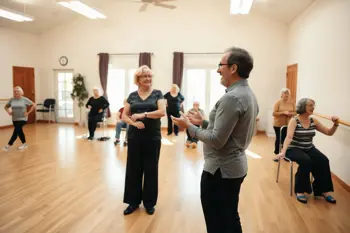
When researching available classes, it is common to encounter programs ranging from contemporary dance projects that challenge age-related stereotypes to traditional ballet-based programs like the RAD Silver Swans curriculum 5, 6. These structured programs are typically guided by professional instructors who understand geriatric health requirements and prioritize safe, gradual progression 3, 5, 8. Program participants are encouraged to consult with their healthcare providers regarding individual physical limits, particularly if they have a history of dizziness or chronic injury 1, 9.
Evaluating Class Structure and Safety Protocols
Quality control in senior dance education involves verifying that instructors are trained in geriatric-specific pedagogy. Effective programs typically feature a structured session format: a gentle warm-up to ensure joint mobility, a main movement phase, balance and stability training, and a controlled cool-down period 3, 5, 8. These segments work in concert to prepare the body for exertion, provide the intended health benefits, and ensure a gradual return to a resting state 3.
Safety is a paramount concern for all participants, and many accredited programs adhere to specific health-related criteria to mitigate fall risks 9. Elements such as adequate floor surfacing, the presence of stable handholds, and the option for frequent rest periods are indicators of a well-managed program 1, 4, 9. Potential participants are encouraged to review class schedules to ensure the intensity matches their personal experience level and physical capability 2, 3, 9.
Navigating Administrative and Enrollment Procedures
Enrollment for senior dance classes can vary significantly by region and facility type. Some programs require advance registration via municipal websites or event portals, while others offer walk-in accessibility for community-led sessions 2, 4, 9. Prospective students should check for necessary documentation, such as medical release forms or initial health screenings, which are common in programs that emphasize professional clinical standards 1, 9.
Communication with instructors is advised, especially regarding any underlying physical conditions or restrictions 9. Many studios provide detailed schedules and descriptions of their programs online, allowing potential attendees to verify requirements such as footwear or clothing prior to attending their first session 2, 9. By proactively gathering this information, seniors can choose programs that best align with their personal health goals and lifestyle preferences 1, 8.
Sources
- All Seniors Foundation: https://allseniors.org/services/senior-dance-programs/
- By Your Side Dance Studio: https://byyoursidedancestudio.com/free-dance-classes-for-seniors-los-angeles/
- Palm Beach Dancing: https://palmbeachdancing.com/senior-dance-program/
- ALL ARTS: https://www.allarts.org/events/active-aging-workshops/
- The Ballet Academy: https://www.theballetacademy.com.sg/post/ballet-for-seniors-rad-silver-swans-ballet-classes
- Susanna Leinonen Company: https://susannaleinonen.com/en/dance-art-for-seniors/
- New York Public Library: https://www.nypl.org/events/programs/2026/06/02/latin-rhythms-chair-dance-class-tremont-library
- Flair Entertainment LLC: https://entertainmentflairfl.com/senior-classes/
- COTA NT: https://www.cotant.org.au/event/seniors-dance-session-with-australian-ballet/
- MOVE: https://move.org.nz/class/zumba-gold/
- Centers for Disease Control and Prevention: https://www.cdc.gov/physical-activity-basics/guidelines/older-adults.html
- World Health Organization: https://www.who.int/news-room/fact-sheets/detail/physical-activity
- U.S. Department of Health and Human Services: https://health.gov/sites/default/files/2019-09/Physical_Activity_Guidelines_2nd_edition.pdf
- National Institute on Aging: https://www.nia.nih.gov/health/exercise-and-physical-activity/exercise-and-physical-activity-older-adults
- Harvard Health Publishing: https://www.health.harvard.edu/blog/dancing-and-the-brain-2018062514123
- Mayo Clinic: https://www.mayoclinic.org/healthy-lifestyle/fitness/in-depth/dance/art-20048187
- Parkinson’s Foundation: https://www.parkinson.org/living-with-parkinsons/management/exercise/dance
Authored by 24Trendz team