A 10-day cruise itinerary through the Mediterranean: A port-by-port planning analysis
A 10-day cruise itinerary through the Mediterranean typically balances major European cities, archaeological sites, island landscapes, and scheduled time at sea. Published examples show routes departing from Barcelona, Rome, or Athens and visiting combinations that include Marseille, Naples, Piraeus, Santorini, Mykonos, Croatia, Malta, and Istanbul, although ports and sailing dates vary by operator. 1
How a 10-day route is structured
A representative western-to-eastern itinerary can begin in Barcelona, continue to Marseille and Genoa, use Civitavecchia as the gateway to Rome, and call at Naples before moving toward Greece. Barcelona has dedicated cruise facilities and is used as a major embarkation point, while Civitavecchia is the principal cruise gateway for Rome. 2 3
Published cruise schedules demonstrate several variations. Royal Caribbean lists a 10-night journey from Barcelona to Ravenna with Sicily, Athens, and Rhodes, while Disney lists a 10-night voyage from Civitavecchia to Barcelona with two sea days and a Piraeus call. These examples show that a nominal 10-day trip may be described as 10 nights or 11 calendar days, depending on the departure and arrival convention. 4 5
Days 1 and 2: Barcelona and Marseille
Barcelona is a practical starting point for travelers interested in architecture, food markets, and historic neighborhoods before embarkation. Published itinerary material identifies Las Ramblas, the Gothic Quarter, and La Boqueria market as central visitor areas. The Port of Barcelona also maintains dedicated cruise operations and passenger services, making the city a clearly established embarkation location. 2 6
Marseille provides a contrasting French stop centered on the Vieux-Port, the city’s historic harbor and a major visitor district. A compact port-day plan can focus on the harbor, the Le Panier neighborhood, and Notre-Dame de la Garde, while longer excursions may extend beyond the central city. The principal planning issue is time management, because a port call cannot replicate an overnight stay. 7
Days 3 to 5: Genoa, Rome, and Naples
Genoa adds a northern Italian perspective through its historic center and Renaissance and Baroque palaces. The Port of Genoa is the relevant official authority for passenger and cruise-port information. Civitavecchia, rather than central Rome, is the ship’s port for a Rome visit, so the Colosseum, Roman Forum, Pantheon, or Vatican area require a shore transfer and careful return planning. 8 3
Naples is particularly useful for travelers prioritizing archaeology because it provides access to Pompeii and the preserved remains managed by Pompeii Archaeological Park. The city itself also offers historic streets, regional food traditions, and views toward Mount Vesuvius. A choice between Pompeii and central Naples is usually necessary during a standard call, since both destinations require different time allocations and transport arrangements. 9
Days 6 to 8: Athens and the Cycladic islands
Piraeus is Greece’s principal passenger and cruise port and serves as the maritime gateway to Athens. A shore visit can prioritize the Acropolis and its surrounding historic areas, although travel between the port and central Athens must be incorporated into the schedule. Athens-focused itineraries published by cruise companies commonly position Piraeus as a major cultural highlight rather than simply a transit point. 10 5
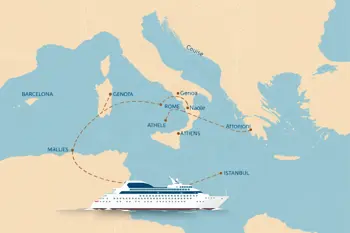
Santorini and Mykonos offer different island experiences. Santorini is associated with volcanic scenery and its caldera landscape, while Mykonos provides access to an island town, beaches, and optional cultural excursions such as Delos. Tendering, walking on uneven surfaces, and limited port time can affect how much of either island is realistically accessible in one day. 11 12
Days 9 and 10: Istanbul or the return west
An eastern extension to Istanbul changes the character of the itinerary by adding a transcontinental city with major historic and cultural attractions. Official destination information identifies Istanbul as a location with substantial heritage and cultural interest. Depending on the voyage direction, Istanbul may function as a final port, an intermediate stop, or part of a longer route that continues toward Greece or the Adriatic. 13
Not every 10-day itinerary reaches Istanbul. Other published examples end in Barcelona, Athens, Ravenna, or Valletta, and some include Malta, Croatia, Sicily, or additional sea days. Oceania’s listed Rome-to-Valletta itinerary, for example, is described as a 10-night voyage visiting 10 ports with one sea day. These differences make the stated endpoint and number of port calls important comparison points. 14 4
Practical constraints and documentation
The main operational constraint is that port schedules can change because of weather, safety, or other operating considerations. Cruise-line itinerary pages explicitly note that ports of call are subject to change. Shore excursions also carry timing risk: distant destinations such as Rome from Civitavecchia or Pompeii from Naples require transport buffers, and independent travelers remain responsible for returning before the ship’s departure.
Travel documents require country-specific review, particularly on routes crossing Schengen-area destinations and Turkey. U.S. travelers should verify passport validity, Schengen requirements, Turkey entry rules, and cruise-line documentation requirements before departure. The U.S. Department of State’s Greece information is one official reference for passport, entry, safety, and travel-document guidance, but requirements can change and should be checked against current government and carrier instructions. 15
Comparing itinerary priorities
| Priority | Ports that support it | Planning consideration |
|---|---|---|
| Ancient history | Rome, Naples, Athens, Delos | Allow for transfers and timed site access |
| Island scenery | Santorini, Mykonos, Rhodes | Check tender arrangements and walking demands |
| Urban culture | Barcelona, Marseille, Genoa, Istanbul | Concentrate on central districts during a short call |
The strongest itinerary depends on the balance between cities, archaeological sites, islands, and sea time rather than the number of destinations alone. A route with many consecutive port days can maximize geographic coverage but leave little recovery time. A route with one or two sea days creates more onboard time and reduces daily transfers, while an itinerary including Istanbul or Athens may require closer attention to border and documentation requirements.
Sources
- Royal Caribbean, 10 Night Greece, Italy and Croatia Cruise from Barcelona
- Port de Barcelona, Cruise Operations
- Turismo Roma, Colosseum
- Disney Cruise Line, 10-Night Mediterranean with Greek Isles
- Holland America Line, 10-Day Mediterranean Splendor
- World of Cruising, 10-Day Mediterranean
- Marseille Tourism, The Old Port
- Ports of Genoa
- Pompeii Archaeological Park
- Piraeus Port Authority
- Visit Greece, Santorini
- UNESCO World Heritage Centre, Delos
- GoTürkiye, Istanbul
- CruiseCaptain, 10-Night Mediterranean Cruise on Sirena
- U.S. Department of State, Greece Travel Information
Authored by 24Trendz team