Understand pancreatic cancer treatment options: A Clinical Guide to Staging, Therapies, and Supportive Care
Understand pancreatic cancer treatment options by looking first at how clinicians classify the disease and determine whether surgery is possible. Treatment may involve surgery, chemotherapy, radiation therapy, symptom control, or combinations of these approaches. The following overview focuses primarily on exocrine pancreatic cancer, including pancreatic ductal adenocarcinoma, which accounts for most pancreatic cancers. 1
How treatment decisions are made
Pancreatic cancer treatment is guided by the tumor’s position in the pancreas, its type, whether it has spread, whether surgeons can remove it, and the patient’s general health. The pancreas contains a head, body, and tail, and tumors in these locations can require different operations. Diagnostic imaging and staging help classify disease as resectable, borderline resectable, locally advanced, or metastatic. Personal preferences and the anticipated effects on daily life also form part of the treatment discussion. 12
Because pancreatic cancer can involve nearby blood vessels or distant organs, treatment planning commonly requires several specialties. Surgical oncology, medical oncology, radiation oncology, gastroenterology, nutrition professionals, and supportive-care clinicians may contribute to a coordinated plan. Multidisciplinary review is particularly important when imaging does not clearly establish whether a tumor can be removed safely or when treatment needs to balance cancer control with digestive and metabolic complications. 34
Surgery for localized disease
Surgery aims to remove all visible cancer and offers the clearest potential for long-term disease control when the tumor is confined sufficiently for complete removal. A Whipple procedure, also called pancreaticoduodenectomy, is generally associated with tumors in the pancreatic head. A distal pancreatectomy is used for selected tumors in the body or tail, while total pancreatectomy removes the entire pancreas in particular circumstances. The procedure depends on anatomy, tumor involvement, and surgical assessment. 47
Surgery is major treatment with substantial recovery demands and possible effects on digestion and blood-sugar regulation. Chemotherapy is often administered after surgery to address cancer cells that may remain elsewhere in the body. For resectable disease, an expert review identifies surgery followed by adjuvant chemotherapy as a standard strategy, with modified FOLFIRINOX described as a preferred option for appropriate patients. Borderline resectable tumors may instead receive treatment before surgery to improve the chance of successful removal. 5
Chemotherapy and systemic treatment
Chemotherapy uses medicines that circulate through the body, making it relevant before surgery, after surgery, or when cancer has spread. Common combinations include FOLFIRINOX, consisting of folinic acid, fluorouracil, irinotecan, and oxaliplatin, and gemcitabine with nab-paclitaxel. Selection depends on fitness, organ function, previous treatment, side-effect risks, and treatment goals. More intensive regimens may not be suitable for every patient, so clinical judgment and monitoring are central to safe use. 15
For metastatic disease, systemic therapy is the primary treatment because surgery cannot usually remove cancer that has spread to distant organs. The research supplied identifies FOLFIRINOX, NALIRIFOX, and gemcitabine with nab-paclitaxel as first-line options in appropriate patients. One review reported median survival of 11 months with FOLFIRINOX compared with 8.5 months with gemcitabine and nab-paclitaxel in metastatic patients, although individual outcomes vary and historical treatment comparisons do not predict a particular person’s result. 65
Radiation therapy and chemoradiation
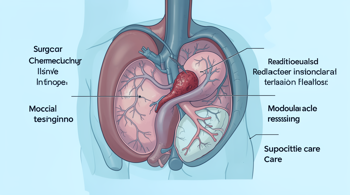
Radiation therapy uses high-energy X-rays to damage cancer cells in a targeted area. It may be combined with chemotherapy, a method called chemoradiation, and can be considered before surgery for selected tumors or when disease remains confined locally but cannot be removed. Radiation is also used in some situations to help control symptoms caused by a pancreatic tumor. The treatment plan depends on tumor location, nearby organs, prior therapies, and the intended clinical goal. 2
Locally advanced pancreatic cancer may grow around major blood vessels or other structures, making immediate surgery inappropriate. In such cases, chemotherapy is often central, while radiation or chemoradiation may be evaluated for local control. The potential benefits must be weighed against treatment burden and effects on surrounding tissues. Radiation oncology assessment is therefore integrated with imaging review and medical oncology planning rather than selected in isolation. 47
Biomarker-directed and investigational options
Molecular testing can identify a smaller group of patients who may qualify for targeted treatment. The supplied research identifies olaparib maintenance treatment for patients with advanced pancreatic cancer and inherited BRCA1 or BRCA2 mutations, and pembrolizumab for tumors demonstrating high microsatellite instability or mismatch repair deficiency. These treatments are not universal pancreatic cancer therapies. Eligibility depends on validated testing, disease setting, previous treatment, regulatory criteria, and the treating team’s interpretation of results. 610
Clinical trials remain an important route for evaluating new approaches, including vaccines, experimental targeted medicines, antibody-drug conjugates, and combinations involving immunotherapy. Research reports that targeted agents and immunotherapies currently apply to narrow molecular groups or remain under investigation. Trial participation can involve strict eligibility requirements, additional monitoring, uncertain benefit, and possible inconvenience. A trial should therefore be considered alongside established care, not described as a guaranteed improvement or replacement for individualized medical advice. 57
Supportive and palliative care
Supportive care addresses the effects of pancreatic cancer and its treatment at every stage. Pain management, nutrition, digestive enzyme replacement, and attention to pancreatic insufficiency may be necessary because the pancreas helps digest food and regulate blood sugar. Supportive services can be provided alongside anticancer treatment and may also become the main focus when disease cannot be controlled. The goal is to manage symptoms, preserve function, and reflect the patient’s priorities. 14
Practical treatment discussions should cover expected benefits, side effects, recovery, nutritional needs, blood-sugar management, and what happens if the cancer responds, remains stable, or progresses. A second opinion can help clarify staging, surgical feasibility, pathology, biomarker findings, and clinical-trial eligibility. Pancreatic cancer is complex, and care plans may change as new imaging, laboratory results, treatment responses, or health concerns emerge. Decisions require direct consultation with qualified clinicians who know the individual case. 13
Sources
- 1. National Cancer Institute, Pancreatic Cancer Treatment, https://www.cancer.gov/types/pancreatic/patient/pancreatic-treatment-pdq
- 2. Cancer Research UK, Treatment for pancreatic cancer, https://www.cancerresearchuk.org/about-cancer/pancreatic-cancer/treatment
- 3. Penn Medicine, Pancreatic cancer treatment, https://www.pennmedicine.org/conditions/pancreatic-cancer/treatment
- 4. Fred Hutch Cancer Center, Treatments and Therapies for Pancreatic Cancer, https://www.fredhutch.org/en/diseases/pancreatic-cancer/treatment.html
- 5. CECOG Pancreas Cancer Academy expert opinion, Springer Nature, https://link.springer.com/article/10.1007/s12254-026-01107-1
- 6. Current Systemic Treatment Options for Advanced Pancreatic Cancer, Biomedicines, https://doi.org/10.3390/biomedicines14010188
- 7. American Cancer Society, Treating pancreatic cancer, https://www.cancer.org/cancer/types/pancreatic-cancer/treating.html
- 10. Mount Sinai, Pancreatic cancer treatment, https://www.mountsinai.org/care/cancer/services/pancreatic/treatment
Authored by 24Trendz team