Registered nurse salary comparison by state: A data-driven review of wages, costs, and workplace factors
National benchmark and measurement
A registered nurse salary comparison by state is most useful when the comparison distinguishes median pay from mean pay. The national registered nurse median was $97,550 annually, or approximately $48.76 per hour, in the May 2025 BLS Occupational Employment and Wage Statistics data. Median pay represents the midpoint of the wage distribution, while the mean can be influenced by highly paid specialists, managers, and nurses in premium labor markets. 1
| Measure | National figure | Interpretation |
|---|---|---|
| Median annual wage | $97,550 | Typical midpoint |
| Approximate median hourly wage | $48.76 | Annual median converted to hourly pay |
| Mean annual wage | $101,420 | Average that can be lifted by higher earners |
BLS estimates describe occupational wages rather than guaranteed starting salaries, individual offers, or total compensation. Salary websites may report different figures because they can use job postings, employee-reported compensation, recruiter information, or modeled estimates instead of employer-reported occupational survey data. 3 10
Highest reported median salaries
The 2025 median figures show a pronounced Pacific and coastal concentration among the highest-paid locations. California recorded a $140,270 median annual wage, followed by Hawaii at $136,320, Oregon at $129,010, Washington at $124,200, and Alaska at $109,480. Other high-median markets included New York at $109,440, New Jersey at $106,500, Massachusetts at $104,550, and Connecticut at $102,740. 2
| State or district | Median annual wage | Mean annual wage |
|---|---|---|
| California | $140,270 | $150,280 |
| Hawaii | $136,320 | $124,340 |
| Oregon | $129,010 | $123,140 |
| Washington | $124,200 | $121,540 |
| Alaska | $109,480 | $114,870 |
The figures do not mean every employer in these states pays at the state median. Hospital system, specialty, shift, tenure, credentials, union representation, and regional labor demand can materially affect compensation within the same state. Government facilities, outpatient specialty care, hospitals, and high-acuity units may pay differently from lower-acuity settings. 11
Lower reported median salaries
The lower end of the comparison includes several states in the South, Midwest, and Great Plains. Alabama had the lowest median among the state figures reported by RenewRN at $77,080, followed by Arkansas at $78,940, Iowa at $78,630, Kansas at $79,320, Louisiana at $80,230, and Kentucky at $81,040. Florida’s median was $84,190, while Indiana recorded $83,500. 1
| State | Median annual wage | Approximate hourly equivalent |
|---|---|---|
| Alabama | $77,080 | Not reported in source table |
| Iowa | $78,630 | Not reported in source table |
| Arkansas | $78,940 | Not reported in source table |
| Kansas | $79,320 | Not reported in source table |
| Louisiana | $80,230 | Not reported in source table |
| Florida | $84,190 | Not reported in source table |
Another salary comparison using later BLS-based reporting placed South Dakota at a $72,210 average annual salary, Alabama at $74,970, Arkansas at $77,720, Iowa at $77,780, and Kansas at $79,430. These differences illustrate why the data year and measure must be checked before rankings are compared. A mean from one release cannot be treated as identical to a median from another release. 5
Mean versus median rankings
Mean and median wages can produce different impressions of a state’s nursing market. California’s mean annual wage was $150,280 compared with its $140,270 median, while Hawaii’s mean was $124,340 compared with a $136,320 median. Massachusetts showed a particularly wide contrast, with a $117,960 mean and a $104,550 median. These gaps may reflect the distribution of pay, occupational composition, and the mix of experienced and entry-level workers. 2
| State | Mean | Median | Difference in reported measures |
|---|---|---|---|
| California | $150,280 | $140,270 | Mean higher |
| Massachusetts | $117,960 | $104,550 | Mean higher |
| New York | $113,440 | $109,440 | Mean higher |
| Hawaii | $124,340 | $136,320 | Median higher |
For a typical nurse evaluating a general market, the median often provides a clearer anchor than the mean because it is less affected by the highest earners. For workforce planning, both measures are relevant, particularly when employers need to understand the range between ordinary wages and compensation levels associated with specialized or senior roles. 6
Cost of living changes the comparison
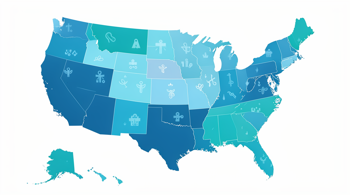
Nominal salary rankings do not measure purchasing power. A cost-adjusted analysis reported California’s $140,270 median as approximately $99,840 after applying a cost-of-living index of 140.5, while Oregon’s $129,010 became about $117,710 with a 109.6 index. Hawaii’s $136,320 became approximately $73,770 under a 184.8 index, and Minnesota’s $101,510 became approximately $108,680 with a 93.4 index. 7
| State | Nominal median | Cost-adjusted figure |
|---|---|---|
| California | $140,270 | $99,840 |
| Oregon | $129,010 | $117,710 |
| Hawaii | $136,320 | $73,770 |
| Minnesota | $101,510 | $108,680 |
| Texas | $95,970 | $105,810 |
Cost-adjusted values are analytical estimates, not take-home pay. They do not automatically incorporate a particular city’s rent, commuting costs, taxes, health insurance, retirement contributions, childcare, or overtime access. Regional price measures help frame purchasing power, but an individual household’s expenses can differ significantly from the statewide index. 8
Factors beyond the state average
State salary averages are affected by local labor demand, cost of living, unionization, practice setting, hospital concentration, and the availability of specialty-care employers. Nurses in high-acuity units, government facilities, hospitals, and outpatient specialty care may earn more than nurses in lower-acuity or lower-cost settings within the same state. Experience, education, role, and employer also influence compensation, so a state median should be treated as a reference point rather than an eligibility threshold or expected offer. 11
- Compare median and mean wages using the same data year.
- Check whether the figure is annual, hourly, reported, or modeled.
- Account for benefits, overtime, shift differentials, and staffing conditions.
- Compare the state figure with the specific metropolitan or rural labor market.
- Review licensing requirements and the regulatory environment before relocation.
Professional eligibility remains separate from compensation. Registered nurses generally need the required education, licensure, and authorization to practice under the applicable state nursing regulatory system. Salary comparisons also carry practical risks: a higher nominal wage may coincide with higher living costs, while a lower wage may occur in a market with different housing and household expenses. BLS and CareerOneStop provide structured wage information, but neither replaces employer-specific compensation review. 3 4
How to interpret a state comparison
A sound comparison begins by identifying the occupation code, publication year, wage measure, and geographic scope. Registered nursing is standardized as occupation 29-1141, and BLS provides state and metropolitan-area estimates through its Occupational Employment and Wage Statistics program. Comparing a 2025 median with a 2023 mean, or mixing statewide wages with metropolitan data, can create an apparent ranking change that reflects methodology rather than an actual shift in nurse compensation. 3 9
| Review question | Why it matters |
|---|---|
| What year is reported? | Wage estimates change between releases. |
| Mean or median? | The measures describe different points in the distribution. |
| State or metro area? | Local labor markets can vary within a state. |
| Nominal or adjusted? | Cost-of-living adjustments alter purchasing-power comparisons. |
The most defensible conclusion is that location materially affects registered nurse pay, but salary alone does not determine financial or professional value. A complete assessment pairs the wage estimate with living costs, benefits, workplace conditions, licensing obligations, specialty opportunities, and the reliability of the underlying source. 1 7
Sources
- RenewRN, Registered Nurse Salary by State, https://www.renewrn.net/nurse-salary
- Mappr, Registered Nurse Salary by State, https://www.mappr.co/registered-nurse-salary-by-state/
- U.S. Bureau of Labor Statistics, Occupational Employment and Wage Statistics, https://www.bls.gov/oes/current/oes291141.htm
- CareerOneStop, Salary Tool, https://www.careeronestop.org/Toolkit/Salary/welcome.aspx
- Nurse.org, Nurse Salaries by State, https://nurse.org/articles/highest-paying-states-for-registered-nurses/
- Rippling, Registered Nurse Salary in the US, https://www.rippling.com/blog/registered-nurse-salary-in-the-us-2026
- NursingSchoolsNearMe, Nurse Salary by State, https://nursingschoolsnearme.com/nursing-salary-by-state/
- Innovative Nurse, What a Nurse’s Paycheck Is Really Worth, https://innovativenurse.com/what-a-nurses-paycheck-is-really-worth/
- O*NET OnLine, Registered Nurses, https://www.onetonline.org/link/summary/29-1141.00
- Indeed, Registered Nurse Salaries, https://www.indeed.com/career/registered-nurse/salaries
- General research synthesis on registered nurse compensation factors
Authored by 24Trendz team