Exploring cultural adventure tours in Japan 2026
Travelers seeking to understand the full scope of cultural adventure tours in Japan for 2026 will find a remarkably diverse market, ranging from nine-day immersions into coastal Kyushu to 21-day journeys threading Tokyo with Hokkaido and the Kumano Kodo pilgrimage trail. Japan shattered tourism records with over 37 million visitors in 2025, and projections suggest an expected 40 million visitor surge in 2026, placing strategic planning at the center of any serious itinerary. 1 The country's simultaneous command of ancient tradition and hyper-modern infrastructure continues to make it one of the world's most architecturally complex destinations for cultural adventure.
Regional Diversity: Where Cultural Adventure Tours Operate in 2026
The geographic spread of 2026 cultural adventure tours extends well beyond Kyoto and Tokyo. The Hokuriku region, covering Toyama, Ishikawa, and Fukui prefectures, has attracted dedicated tour programs centered on the concept of dotoku, or the virtue of the land, with itineraries visiting woodcarvers in Inami, lacquer masters in Yamanaka, and sacred groves around Mount Hakusan. 2 Separately, the island of Kyushu has emerged as a destination organized around volcanic landscape, ancient gastronomy, and the layered spiritual history of Nagasaki, where hidden Christian communities and stone Buddha statues coexist with active geothermal vents in Beppu. 3
The Seto Inland Sea circuit represents another regional corridor gaining traction, with tours visiting art islands including Naoshima and Shodoshima, alongside Edo-period architecture in Okayama and indigo dyeing traditions in Tokushima. 4 The Nakasendo Trail through Kiso Valley, connecting preserved post-towns like Narai-juku and Tsumago with an 8-kilometer guided walk between Tsumago and Magome, continues to attract itineraries focused on Edo-period trade culture and forested terrain. 5 The Shikoku 88 Temple Pilgrimage, a 1,300-kilometer circuit traditionally completed on foot over 45 to 50 days, is increasingly offered in guided and self-driven formats covering 10 to 14 days as demand for meaningful pilgrimage experiences grows. 6
Tour Formats and Structural Characteristics
The 2026 market shows clear diversification across tour formats. Small-group programs dominate the cultural adventure segment, with group size caps ranging from 10 to 18 participants depending on operator. Itinerary length varies significantly: a 9-day Hokuriku journey starts from $12,900 USD per person, a 9-day Kyushu circuit is priced from $13,900 USD, and a 14-day Far Horizons expert-led archaeology and temple tour is priced at $14,995 USD plus air. 7 At the accessible end, a 9-day Alpine Route and Nagoya package starts from $3,988 per person in double occupancy for economy class. 8 At the premium tier, Pelorus Travel's bespoke ancient rituals experience is priced from $28,500 per person excluding international flights, covering Kyoto, the Kumano Kodo, and Naoshima Island. 9
Accommodation integration is a defining structural feature. Most cultural adventure itineraries in 2026 blend hotel nights with traditional ryokan stays, shukubo temple lodgings, and minshuku-style guesthouses. The Much Better Adventures Ultimate Japan tour, for example, includes 5 hotel nights, 3 ryokan nights, 2 minshuku nights, and 1 temple overnight with Buddhist monks at Koyasan, within an 11-night structure. 10 Study-travel hybrid programs from operators like Go! Go! Nihon combine Japanese language instruction with cultural immersion, with an Autumn Study Trip running November 1 to 14, 2026, priced at 390,000 yen. 11
Hands-On Cultural Experiences: What Tours Typically Include
The experiential core of 2026 cultural adventure tours is organized around direct participation rather than passive observation. Documented activities across multiple operators include Edo woodblock print workshops, traditional soba-making classes, Japanese archery inside ancient fortress grounds, kimono dyeing, shibori and roketzu textile workshops, sumo training session attendance, sushi masterclasses, and tea ceremony participation with maiko. 12 The Seto Inland Sea Art and Culture Tour includes aizome indigo dyeing, uchiwa fan making, a ningyo-joruri puppet show, and an Awaodori dance performance, with 26 meals featuring kaiseki dinners as part of the itinerary. 4
Adventure-oriented activities integrated into cultural itineraries include kayaking near Mount Fuji, hiking the Kumano Kodo with yamabushi mountain priests, cycling through rural Nagano countryside past cliffside temples, and hiking Jigokudani Valley to observe snow monkeys in natural hot springs. 13 Regional food culture receives structured attention on many tours, particularly in Kyushu where the concept of Saga mariage, the idea that a meal is incomplete until local ingredients meet local clay, forms a gastronomic organizing principle. 3 Craft-focused tours such as the Kumihimo Resource Japan Adventure Tour limit groups to 10 travelers for 14 to 15-day programs centered on Kyoto traditional crafts, Naoshima Art Islands, and Hiroshima. 14
Seasonal Windows and Timing Considerations
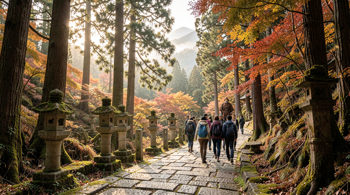
Spring (March to May) and autumn (September to November) represent the dominant booking windows for cultural adventure tours due to climate, foliage conditions, and festival calendars. Cherry blossom season now attracts over 4 million monthly visitors, and regional destinations like Takayama have reported 32% year-over-year visitor increases. 1 Autumn foliage on the Tateyama Kurobe Alpine Route, accessible from mid-April to November, peaks at the summit and creates significant seasonal demand for the Nagoya and Northern Alps corridor. 8
November specifically concentrates a high volume of cultural tour departures. The Far Horizons Japan in Autumn Colors tour runs November 6 to 18, 2026. The La Fugue guided journey covers October 31 to November 9, 2026. The Yoga Journeys Sacred Pilgrimage from Kyoto to Tokyo operates November 6 to 15, 2026. 15 The Country Heritage Tours Blue Japan textile tour runs November 4 to 14, 2026, priced at $7,495 per person double occupancy, focusing on kimono dyeing and fabric districts from Tokyo to Kyoto. 16 Travelers selecting autumn departures should account for high demand for ryokan accommodations near foliage viewing areas, which can require reservations months in advance.
Sustainability Trends and the Shift Toward Off-the-Beaten-Path Regions
Japan's national tourism strategy for 2026 explicitly promotes off-the-beaten-path prefectures to redistribute visitor load from overwhelmed urban centers. Analysts note that travelers are increasingly abandoning crowded iconic sites in favor of Shikoku's sacred pilgrimage paths, the Satoyama village ecosystems of rural Nagano, and artisan corridors in Wajima and Tokushima. 17 Rural areas are also deploying high-value cultural tourism anchors: Nikkei Asia reported that some rural communities are attracting wealthy international visitors through bespoke offerings such as $40,000 custom sword commissions from master swordsmiths. 18
Tour operators are increasingly structuring itineraries around slow-travel principles, including overnight stays in renovated kominka farmhouses and community-led agricultural experiences. The GLA Cultural Kaleidoscope program, for example, incorporates working alongside local farmers in Yamanashi's rice paddies as a core program element alongside kayaking near Mount Fuji and temple visits. 19 Local guides specializing in sustainable cultural engagement are a consistent feature across operator profiles, with English-speaking specialists trained in heritage interpretation accompanying all scheduled activities on most 2026 programs.
Practical Considerations, Costs, and Risk Factors
US citizens visiting Japan in 2026 retain a 90-day visa-free entry period under standard tourist agreements, which accommodates the full length of virtually all cultural adventure tour programs. Transportation across regions is typically handled by tour-included transfers and the Shinkansen bullet train network, which connects Tokyo to Kyushu, Hokuriku, and the Kansai region efficiently. The JR Pass remains a cost-effective option for independent travelers on multi-region itineraries, though most organized tours include all intra-Japan transport within the package fee.
Physical readiness requirements vary across programs and deserve careful review. Many tours require the ability to walk several hours at a steady pace, manage personal luggage independently, and navigate stairs and uneven surfaces in temple and castle environments. 16 Higher-intensity options such as the Kumano Kodo hiking segments or the Nakasendo Trail walk between Tsumago and Magome involve forested terrain over multiple kilometers. Cultural etiquette at onsen, temple lodgings, and private artisan workshops requires advance briefing, and most operators include orientation sessions to prepare participants. Solo travelers are accommodated across many programs, with single supplement fees ranging from $495 to $1,595 depending on tour length and operator, and some formats are explicitly designed for solo participation with group dynamics built in from the start. 20
Sources
- blog.destinations.ai - 10 Jaw-Dropping Japan Experiences for 2026
- unpluggedjapan.com - Hokuriku 2026: Spirits of the Earth
- unpluggedjapan.com - Kyushu 2026: Faith, Fire, and Flavor
- hishawaii.net - Seto Inland Sea: Japan Art and Culture Tour 2026
- heartlandjapan.com - The Luxury Golden Route: Nakasendo Trail to Historic Capitals
- shikokutours.com - Shikoku Pilgrimage Cost: A Planning Guide for a Meaningful Journey
- farhorizons.com - Japan in Autumn Colors: Temples and Traditions
- pandaonline.com - Leaf Peepers: Alpine Route Adventure, Nagoya and Beyond 2026
- pelorustravel.com - Weave Together Japan's Ancient Rituals and Modern Life
- muchbetteradventures.com - The Ultimate Adventure Through Japan
- gogonihon.com - Japanese Study Trips: Autumn in Japan Study Trip
- lafugue.com - Japan: Along the Paths of Japan, October-November 2026
- heartlandjapan.com - The Master's Footsteps: A Journey Along the Hokusai Road
- kumihimoresource.com - Japan Adventure Tour 2026: The Craft and Culture Tour
- yoga-journeys.com - Japan Sacred Pilgrimage from Kyoto to Tokyo, November 2026
- countryheritagetours.com - Blue Japan 2026 Quilt Tour
- travelandtourworld.com - Japan Leads the 2026 Escape Revolution Toward Shikoku's Sacred Paths
- asia.nikkei.com - Rural Japan Tries to Draw Wealthy Tourists with $40,000 Custom Swords
- experiencegla.com - Japan: Cultural Kaleidoscope Program
- farhorizons.com - Japan in Autumn Colors: Pricing and Single Supplement Details
Authored by 24Trendz team