Recognizing the signs of chronic fatigue: A clinical guide to persistent exhaustion
Recognizing the signs of chronic fatigue begins with distinguishing constant, disabling exhaustion from ordinary tiredness after a hectic day or a poor night’s sleep. Chronic fatigue syndrome, also called myalgic encephalomyelitis or ME/CFS, involves a broader pattern of symptoms that can persist despite rest and interfere with daily activities. 1
When fatigue becomes persistent and disabling
ME/CFS is characterized by profound fatigue that is not adequately relieved by rest and is not simply the expected result of exertion. Contemporary clinical descriptions emphasize a substantial reduction in previous activity, persistent symptoms, and impairment in work, education, social participation, or routine tasks. Diagnosis remains clinical because no validated biomarker or single laboratory test currently confirms the condition in routine practice. 1
Duration alone does not establish ME/CFS. The Centers for Disease Control and Prevention describes the syndrome in relation to fatigue lasting at least six months, while clinicians also assess whether other explanations, including sleep disorders, hormonal problems, nutritional deficiencies, mood conditions, or other medical illnesses, better account for the symptoms. 3
Post-exertional malaise is a defining warning sign
Post-exertional malaise, commonly abbreviated as PEM, is a disproportionate worsening of symptoms after physical, mental, emotional, or sensory effort. The decline may not appear immediately. Reports describe symptoms emerging approximately 12 to 72 hours after an activity that was previously tolerated, with recovery sometimes lasting days or weeks. 2
PEM can follow activities that appear minor, such as household tasks, prolonged concentration, social interaction, or exposure to light and noise. This delayed pattern helps distinguish ME/CFS from routine tiredness, in which rest generally allows recovery. Clinical management commonly emphasizes pacing and activity modification because repeatedly exceeding an individual’s available energy can intensify crashes. 1
Unrefreshing sleep and disrupted recovery
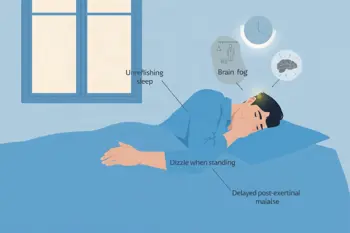
Unrefreshing sleep is another central sign. A person may sleep for an apparently adequate number of hours yet wake feeling as tired, weak, or mentally slowed as before going to bed. The issue is not necessarily difficulty falling asleep alone. Some people report fragmented sleep, delayed sleep onset, or sleep that does not restore normal function. 1
Sleep symptoms should be assessed alongside fatigue rather than treated as proof of ME/CFS by themselves. Persistent tiredness can occur with several sleep-related and medical conditions, so a clinical history and appropriate evaluation are important. The international diagnostic framework places sleep disturbance together with activity reduction and PEM, rather than using any single symptom in isolation. 2
Brain fog and other cognitive changes
Cognitive impairment, often called brain fog, may involve difficulty concentrating, slower information processing, memory problems, or trouble finding words. These changes can affect reading, conversations, planning, studying, and workplace tasks. The National Institutes of Health identifies cognitive dysfunction as a major symptom that can substantially affect quality of life. 5
Cognitive symptoms can fluctuate and may worsen after mental effort, just as physical symptoms can worsen after exercise. Patients may describe good days and bad days, with functional capacity changing considerably over time. Symptom tracking can help document these patterns for a clinician, particularly when the person’s ability to complete ordinary tasks varies from one day to another. 11
Orthostatic intolerance and physical symptoms
Orthostatic intolerance refers to symptoms that occur or worsen while standing, such as lightheadedness, dizziness, weakness, rapid heartbeat, or fainting. Autonomic nervous system dysfunction is discussed as one possible contributor to this pattern, although the mechanisms of ME/CFS remain under investigation and no routine diagnostic biomarker has been validated. 6
Other reported symptoms include muscle and joint pain without clear injury or swelling, headaches, recurring sore throat, and tender lymph nodes in the neck or armpits. These features are not unique to ME/CFS, so their presence does not establish a diagnosis. Their relevance depends on the overall symptom pattern, duration, severity, and effect on functioning. 9
How clinicians approach diagnosis and evaluation
There is no single test that definitively confirms ME/CFS. Clinicians generally review symptom history, changes in activity, the timing of PEM, sleep quality, cognitive function, dizziness, pain, and related symptoms. Testing is used to investigate alternative explanations rather than to produce one definitive ME/CFS result. 7
A medical assessment is especially important when fatigue is disabling, lasts for months, or follows an infection such as glandular fever or COVID-19. The illness can follow a relapsing course, and overlapping post-acute infection syndromes can complicate classification. Care commonly focuses on pacing, sleep support, and treatment of associated pain, mood symptoms, sleep disorders, or dysautonomia. 1
What to record before a medical appointment
A symptom record can make fluctuating illness easier to describe. Useful observations include sleep duration and whether sleep felt restorative, the type and amount of physical or mental activity, delayed symptom increases, concentration problems, pain, dizziness while standing, and the time required to recover. Such records do not replace clinical assessment, but they can clarify patterns that are difficult to recall.
Note whether activity triggers delayed worsening rather than immediate tiredness.
Record changes in work, study, household responsibilities, and social participation.
Identify symptoms that occur together, including unrefreshing sleep, brain fog, pain, and dizziness.
Describe changes over time, including relapses and periods of partial improvement.
Symptoms that resemble ME/CFS can also occur in other conditions, which is why self-diagnosis is unreliable. A clinician can determine what evaluations are appropriate and consider overlapping problems rather than assuming that every case of persistent fatigue represents one specific syndrome. 12
Sources
- National Center for Biotechnology Information, StatPearls: Chronic Fatigue Syndrome
- BMC Medicine, International expert consensus framework for diagnostic standardization
- Centers for Disease Control and Prevention, ME/CFS symptoms
- Mayo Clinic, Chronic fatigue syndrome symptoms and causes
- National Institute of Neurological Disorders and Stroke, ME/CFS
- Cleveland Clinic, Chronic fatigue syndrome
- Johns Hopkins Medicine, Chronic fatigue syndrome
- Solve ME/CFS Initiative, ME/CFS symptoms
- WebMD, Understanding chronic fatigue syndrome symptoms
- Stanford Medicine, ME/CFS Initiative
- Open Medicine Foundation, What is ME/CFS?
- Healthline, Chronic fatigue syndrome diagnosis and symptom overlap
Authored by 24Trendz team