Best physical therapy tools for post-surgery: A clinical evidence guide
For people researching the best physical therapy tools for post-surgery, the central issue is not the most advanced device but the tool that matches the operation, healing stage, weight-bearing restrictions, pain level, and therapist-directed goals. Safe supported walking, prescribed exercises, swelling control, and measurable progress are recurring elements of postoperative rehabilitation. 1
Walking aids for early mobility
Walkers, crutches, and canes can reduce weight-bearing demands and improve safety during early recovery, but the appropriate device and duration should be prescribed by the surgeon or physical therapist. NHS guidance describes walking aids and prescribed exercises as part of hip-replacement recovery, with progression based on recovery status and clinical advice. The correct height, hand position, and gait sequence matter because an incorrectly adjusted aid can increase instability or encourage compensatory movement. 2
Supported gait systems occupy a more specialized category. WalkPort describes a body-support walking device intended for home use, while the Journey Frame is presented as a modular system for sit-to-stand practice, walking, balance work, and adjustable body-weight support. These systems may be relevant when weakness, balance loss, or fear of falling limits ordinary walking, but they require clinical screening and appropriate supervision, particularly after orthopedic or trauma surgery. 34
Exercise tools for strength and range of motion
Early exercise tools are usually simple because the initial objectives are circulation, joint mobility, and muscle activation rather than maximal resistance. MedlinePlus postoperative knee-replacement instructions include ankle pumps, quadriceps exercises, and straight-leg raises. Resistance bands and light ankle weights may be introduced later to progressively strengthen muscles around the surgical area once the incision and tissues can tolerate loading. The timing and resistance should follow the rehabilitation protocol. 5
Stationary bicycles can provide low-impact range-of-motion and cardiovascular exercise after some knee or hip procedures, but clearance from the rehabilitation team is necessary before use. Balance boards and proprioception tools are generally later-stage options, after wound healing, basic strength, and weight-bearing control have developed. Continuous passive motion machines should not be assumed to replace active exercise, since a Cochrane review found little or no clinically important improvement in many outcomes after total knee replacement compared with standard rehabilitation. 6
Cold therapy and compression equipment
Cold therapy may help manage postoperative pain and swelling, while compression can support edema management. The Breg Polar Care Wave is described as combining motorized cold therapy with active compression, adjustable temperature and compression levels, and a stated runtime of six to eight hours. Such specifications describe the device category, not a universal treatment schedule. Use must remain consistent with surgical instructions, skin condition, sensation, and the prescribed rehabilitation plan. 7
Cold devices also carry avoidable risks. The FDA warns that improper use can cause cold-related injuries, so excessive exposure, direct skin contact, unsuitable temperature settings, and failure to inspect the skin are safety concerns. Reduced sensation, vascular problems, or difficulty communicating discomfort may require additional precautions or make unsupervised use inappropriate. A cold-compression system is therefore an adjunct for symptom management, not a substitute for mobility training, wound monitoring, or medical review. 8
Digital tools for monitored rehabilitation
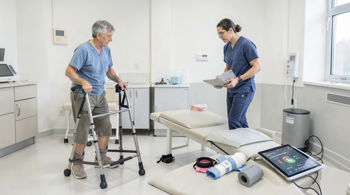
Digital rehabilitation platforms can help clinicians design and monitor individualized programs between face-to-face visits. Rehametrics reports that its postoperative platform records virtual-reality exercise sessions and tracks progress from the acute phase through return to activity. The company reports 30% more sessions completed than with its conventional comparison, more than 100 clinical parameters recorded per session, and 89% of patients reporting higher motivation. These figures are provider-reported platform metrics rather than universal outcomes. 9
Motion-tracking and virtual-reality systems are designed to quantify movement while making exercises more interactive. Rehametrics Physical describes more than 120 analytical and functional exercises covering range of motion, motor control, coordination, balance, gait, strength, and functional mobility. Its physiotherapy VR module describes more than 70 upper-limb and hand exercises using hand tracking without controllers, sensors, or gloves. Digital tools may improve documentation, but therapist interpretation remains necessary. 1011
Gait and lower-limb rehabilitation devices
Clinic-based gait trainers are intended for patients who need intensive, supported practice. Tyromotion describes Lexo as an end-effector gait trainer with trunk support, rapid setup, and active patient participation. The company positions it for early gait training and gradual progression toward upright function. Because these systems involve specialized setup and clinical handling, they are generally not equivalent to household mobility aids and should be selected according to strength, balance, surgical precautions, and walking goals. 12
Omego Plus is described as a lower-limb rehabilitation device for balance, strength, endurance, coordination, symmetry, cadence, and sensory or foot-ankle training. It can support training in sitting, standing, or lying positions, which may be relevant across different rehabilitation phases. A different category is biofeedback for weight-bearing: ComeBack Mobility describes patient-specific protocols, a biofeedback device, and therapist monitoring of adherence. Such systems may be particularly relevant when precise loading limits are part of bone or fixation recovery. 1314
How to choose and what to avoid
The most appropriate tool is determined by the operation and its restrictions, not by a generic equipment list. A therapist may prioritize a walker or crutches for protected mobility, prescribed activation exercises for a knee replacement, cold therapy for swelling, or objective testing for progression. Forward PT describes tracking strength symmetry, range of motion, functional performance, and patient-reported outcomes across phases of care. These measures can help determine whether progression is justified rather than relying only on time since surgery. 15
Foam rollers, massage tools, and deep-tissue techniques should not be used directly over a fresh incision, healing fracture, implanted hardware, or areas with reduced sensation unless specifically approved. Home programs are most effective when individualized to the procedure, restrictions, pain, and functional goals. Warning signs requiring professional review can include worsening symptoms, skin injury from cold therapy, or difficulty following weight-bearing instructions. Maintenance also includes device cleaning, correct adjustment, battery or tubing checks where applicable, and regular reassessment of whether the tool remains necessary.
Sources
- Rehametrics, Post-operative Rehabilitation Software
- NHS, Hip Replacement Recovery
- WalkPort, For Home Users
- Neuro Rehab Recovery, The Journey Frame
- MedlinePlus, Knee Replacement Exercises
- Cochrane, Continuous Passive Motion After Total Knee Replacement
- Vital Mobility, Breg Polar Care Wave
- U.S. Food and Drug Administration, Cold Therapy Devices
- Rehametrics, Post-operative Rehabilitation Using Digital Tools
- Rehametrics Physical
- Rehametrics, VR Module for Physiotherapy
- Tyromotion, Lexo Gait Trainer
- Tyromotion, Omego Plus
- ComeBack Mobility, Biofeedback Weight-Bearing Devices
- Forward PT, Return+ Testing
Authored by 24Trendz team