Early symptoms of Psoriasis you should know: A clinical guide to first signs
Early symptoms of Psoriasis you should know include changes in the skin, scalp, nails, and sometimes joints. The first signs can be limited to a few small areas, may vary substantially across skin tones, and can resemble eczema, dandruff, seborrheic dermatitis, or fungal infection, making clinical assessment important.
How psoriasis commonly begins
Psoriasis is a chronic inflammatory skin disease in which immune-system dysfunction accelerates skin-cell growth, causing cells to build up at the surface. The most common form, plaque psoriasis, generally starts as a raised, clearly outlined patch that may become covered with dry, whitish or silvery scale. On lighter skin, it often appears pink or red, while on brown or Black skin it may look purple, violet, gray, or darker than nearby skin. 1 3
Early lesions can be small or extensive and may occur in more than one location. Common sites include the elbows, knees, scalp, chest, lower back, and trunk, although psoriasis can appear anywhere on the body. A distinct border between affected and normal skin is a useful visual clue, particularly when the patch is raised and has a flaky surface. 2 5
Early sensations and surface changes
Visible scaling is not the only early warning sign. Affected areas may itch, burn, sting, feel sore, or remain unusually dry. Cracks can develop in dry skin and may bleed, especially when a plaque is thick, irritated, or located over a joint that bends frequently. Symptoms often follow a recurring pattern, with flares lasting weeks or months before partially subsiding. 1 4
- Raised or thickened patches with a defined edge.
- Flaking that may resemble dandruff or dry skin.
- Itching, irritation, burning, or tenderness.
- Dryness severe enough to produce fissures or bleeding.
- Periods in which symptoms become more noticeable and later recede.
The intensity of discomfort does not always match the visible area. A small plaque on a sensitive or highly visible site may affect daily activities, sleep, concentration, or emotional well-being even when the overall skin involvement is limited. 1
Scalp, folds, and less typical locations
Scalp psoriasis may initially look like persistent dandruff, but scaling can be thicker and may extend beyond the hairline. Psoriasis can also affect the chest, lower back, genital area, or skin folds. Inverse psoriasis, which occurs in areas such as the armpits, groin, or beneath the breasts, commonly produces smooth, shiny, inflamed patches rather than heavy scale because moisture and friction alter the surface appearance. 3 4
Location can therefore be as informative as color or scaling. A shiny patch in a fold, a sharply bordered scalp eruption, or plaques over both elbows and knees may point toward different psoriasis patterns. However, appearance alone cannot reliably distinguish psoriasis from eczema, infection, or other inflammatory conditions, particularly during an initial episode. 7
Small spots, pustules, and other early patterns
Not every early presentation consists of one large plaque. Guttate psoriasis often appears as numerous small, drop-shaped, scaling spots on the trunk, arms, or legs. It is more common in children and young adults and may follow a streptococcal infection such as strep throat. The eruption can appear relatively suddenly, unlike plaques that gradually enlarge or recur in familiar areas. 2 3
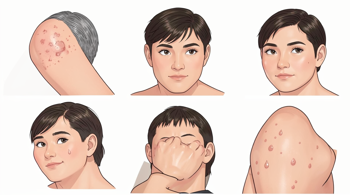
Pustular psoriasis has a different appearance, with visible white pustules surrounded by inflamed skin. The pustules contain non-infectious pus, but their presence should not be assumed to represent psoriasis without medical evaluation because pustular or blister-like eruptions have several possible causes. The research data also identifies psoriasis types that can affect broad areas of skin, so changing distribution and severity are clinically relevant details. 1 4
Nail changes and possible joint clues
Early psoriasis may appear in the nails even when skin findings are subtle. Reported nail abnormalities include tiny pits, discoloration, thickening, flaking, and separation of the nail from its bed, known as onycholysis. Nail changes can affect fingernails, toenails, or both, and they may be mistaken for trauma or a fungal problem. Their presence is useful information to record for a clinician assessing a broader pattern. 3 4
Joint symptoms are another important part of the psoriasis spectrum. Psoriatic arthritis can cause pain, swelling, or stiffness, and joint symptoms may occur alongside skin disease or, in some cases, before obvious skin lesions. The Canadian Dermatology Association reports joint involvement in about one-third of people with psoriasis, while professional dermatology guidance describes psoriatic arthritis as a potential associated condition. 3 6
Triggers, family history, and timing
Psoriasis can develop at any age and often has a genetic component. About one-third of people with psoriasis have at least one affected family member according to the Canadian Dermatology Association. Recognized triggers include minor skin injuries, sunburn, infections such as strep throat, emotional stress, alcohol consumption, tobacco smoking, obesity, and certain medications, including beta-blockers, lithium, chloroquine, some anti-inflammatory drugs, terbinafine, interferon-alfa, and immune checkpoint inhibitors. 2 3
Timing can help explain a flare but does not establish a diagnosis. A new eruption after an infection, injury, medication change, or intense stress should be documented with dates and associated symptoms. Psoriasis commonly follows cycles of flare and remission, but recurring symptoms do not prove that every episode has the same cause. Medication changes should be discussed with the prescribing clinician rather than made independently. 1 2
When assessment is needed
Because early psoriasis can resemble eczema, ringworm, seborrheic dermatitis, or irritation, a diagnosis generally depends on the appearance and distribution of lesions together with medical history. There is no single blood test that confirms psoriasis; clinicians commonly assess the skin, scalp, nails, and joints and may consider other explanations for scaling or inflammation. 6 7
Useful details for an appointment include when the changes began, whether they recur, how quickly they spread, the locations involved, recent infections or injuries, current medications, family history, nail changes, and any joint pain or morning stiffness. Assessment is particularly relevant when symptoms persist, recur, bleed, interfere with sleep, or involve nails or joints, because psoriasis is chronic and associated inflammatory problems may extend beyond the visible skin. 1 5
Sources
- Mayo Clinic, “Psoriasis: Symptoms and causes”
- Merck Manual Consumer Version, “Psoriasis”
- Canadian Dermatology Association, “Psoriasis”
- National Psoriasis Foundation, “About Psoriasis”
- NCBI Bookshelf, StatPearls, “Plaque Psoriasis”
- MSD Manual Professional Edition, “Psoriasis”
- Acibadem Hospitals Group, “Early Psoriasis: Signs, Diagnosis and Treatment”
Authored by 24Trendz team