Early red flags of rheumatoid arthritis: Clinical patterns and evaluation
Early red flags of rheumatoid arthritis include joint pain, swelling, tenderness, warmth, prolonged morning stiffness, fatigue, and symptoms affecting both sides of the body. These features can resemble overuse, aging, or other forms of arthritis, so the pattern, duration, and progression of symptoms are important in deciding when clinical assessment is appropriate. 1
Persistent joint inflammation
A common early pattern is persistent pain, tenderness, swelling, or warmth in the small joints of the hands, wrists, or feet. Rheumatoid arthritis is an autoimmune inflammatory disease that primarily affects the joint lining, and inflammation may gradually reduce movement or hand function. Symptoms can begin gradually or with a more noticeable onset, and early disease may initially be mistaken for an injury, repetitive strain, or ordinary wear-and-tear arthritis. 2
Swelling that remains present, returns repeatedly, or involves several joints is more concerning than brief soreness after a specific activity. The Centers for Disease Control and Prevention identifies joint pain, stiffness, swelling, and involvement of multiple joints as characteristic features of rheumatoid arthritis. Persistent symptoms do not prove that RA is present, but they justify a medical history and physical examination rather than prolonged self-attribution to overuse. 3
Morning stiffness and inactivity
Morning stiffness lasting longer than 30 minutes is a key inflammatory warning sign, particularly when it affects the hands, wrists, or feet. Rheumatoid arthritis stiffness may also become prominent after sitting or resting and can feel different from mechanical pain that eases quickly with movement. Consumer and clinical references commonly describe stiffness lasting more than 60 minutes as another important pattern, although duration varies among individuals and should not be used as a standalone diagnostic threshold. 4
The timing of stiffness matters because rheumatoid arthritis reflects active inflammation in and around joints. A person may wake with difficulty bending the fingers, making a fist, walking comfortably, or starting ordinary tasks, then experience partial improvement as the joints move. Stiffness that continues for weeks, repeatedly follows periods of rest, or occurs alongside visible swelling is more informative than a single isolated episode. 5
Symmetrical and small-joint involvement
Early RA often affects corresponding joints on both sides of the body, such as both wrists, the same finger joints on each hand, or both feet. This symmetrical distribution is a recognized clinical clue, although rheumatoid arthritis does not always begin in a perfectly symmetrical way. The disease commonly involves proximal interphalangeal and metacarpophalangeal joints, wrists, knees, ankles, and other peripheral joints. 1
Hand symptoms can be especially noticeable during routine activities. Reduced grip strength, difficulty opening containers, trouble fastening buttons, or an inability to make a comfortable fist may reflect inflammation in the fingers and wrists. These functional changes are relevant even when swelling is subtle, because they show that symptoms are affecting movement and daily activity rather than producing pain alone. 6
Whole-body warning signs
Rheumatoid arthritis can produce systemic symptoms in addition to joint problems. Unusual fatigue, weakness, low-grade fever, reduced appetite, and unintentional weight loss have been described among possible features. Fatigue may be disproportionate to physical exertion and can accompany early inflammatory symptoms before extensive joint damage is apparent. These findings are nonspecific, so they must be considered with the joint pattern and other medical explanations. 7
Symptoms outside the joints may also occur because RA is a systemic condition. Dry eyes or mouth, rheumatoid nodules, and, in some cases, respiratory or chest symptoms have been reported. Such manifestations are not required for diagnosis and may have many other causes, but unexplained systemic symptoms combined with persistent inflammatory joint complaints should be documented for a clinician. Severe or new breathing or chest symptoms require appropriate medical attention rather than assumption that they are caused by arthritis. 2
When the pattern warrants evaluation
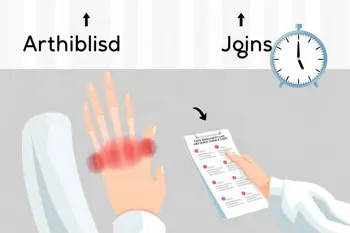
A consultation is particularly reasonable when joint swelling or stiffness persists for several weeks, involves multiple joints, progressively worsens, or interferes with work, sleep, walking, or hand use. The Arthritis Foundation identifies persistent swelling, pain, and morning stiffness in the hands, wrists, and feet as reasons to seek assessment. A symptom diary can record affected joints, morning stiffness duration, visible swelling, fever, fatigue, and changes in function. 8
Early assessment matters because rheumatoid arthritis can cause progressive joint destruction if active inflammation remains untreated. Clinical guidance emphasizes that earlier diagnosis and treatment are associated with better clinical and radiographic outcomes, while delayed or ineffective treatment can have unfavorable consequences. This does not mean every painful joint requires urgent specialist care, but persistent inflammatory patterns should not be dismissed solely because symptoms began mildly. 1
How clinicians investigate suspected RA
Diagnosis is largely clinical and involves the symptom history, physical examination, pattern of joint involvement, persistence of inflammation, and observation over time. Blood tests may include rheumatoid factor and anti-cyclic citrullinated peptide antibodies, while inflammatory markers and imaging can provide additional information. No single blood test definitively confirms or excludes rheumatoid arthritis, so a negative result does not automatically eliminate the possibility when the clinical pattern is persuasive. 2
Clinicians may observe symptoms during the first three months because persistence and an additive pattern of newly inflamed joints can clarify the diagnosis. Alternative explanations include osteoarthritis, gout, psoriatic arthritis, reactive arthritis, injury, and other inflammatory or infectious conditions. The evaluation therefore depends on combining examination findings, laboratory evidence, imaging where appropriate, and the response or nonresponse to therapies rather than relying on one symptom or test. 1
What the early pattern does not establish
Morning stiffness, fatigue, hand pain, and swelling are warning signs, not a diagnosis. Osteoarthritis, viral illness, gout, psoriatic arthritis, connective-tissue disease, and injuries can produce overlapping complaints. RA also varies substantially: some people have a gradual onset, while others develop more noticeable symptoms over a short period. Age, sex, family history, smoking or environmental exposures, and other medical details may influence clinical reasoning, but symptoms still require individualized assessment. 3
The most useful distinction is a sustained pattern of inflammatory symptoms rather than a single uncomfortable day. Persistent swelling, prolonged stiffness after waking or inactivity, symmetrical small-joint involvement, reduced grip, and systemic symptoms together create a stronger reason for evaluation than isolated soreness. Recording the timing and distribution of symptoms can help clinicians identify whether the presentation resembles inflammatory arthritis and determine whether laboratory testing, imaging, or rheumatology referral is appropriate. 5
Sources
- Healio, Diagnosis of Early Rheumatoid Arthritis
- Merck Manual Professional Edition, Rheumatoid Arthritis
- Centers for Disease Control and Prevention, Rheumatoid Arthritis
- National Institute of Arthritis and Musculoskeletal and Skin Diseases, Rheumatoid Arthritis
- Mayo Clinic, Rheumatoid Arthritis Symptoms and Causes
- Johns Hopkins Medicine, Rheumatoid Arthritis
- MedlinePlus, Rheumatoid Arthritis
- Arthritis Foundation, Rheumatoid Arthritis
Authored by 24Trendz team